Written By | Evan Sande Ndahura
Evan Sande Ndahura is a Ugandan legal scholar, political essayist, and social critic whose work interrogates power, constitutionalism, and African political memory.
In Uganda, opposition politics often feels like the one-tenth of the law, while the remaining nine-tenths belong to the ruling National Resistance Movement (NRM). That nine-tenths does not only dominate ordinary citizens; it stretches its long shadow over the institutions of the State itself.
The famous NRM slogan, “Protecting the Gains,” invites a necessary and uncomfortable question:
Whose gains are these?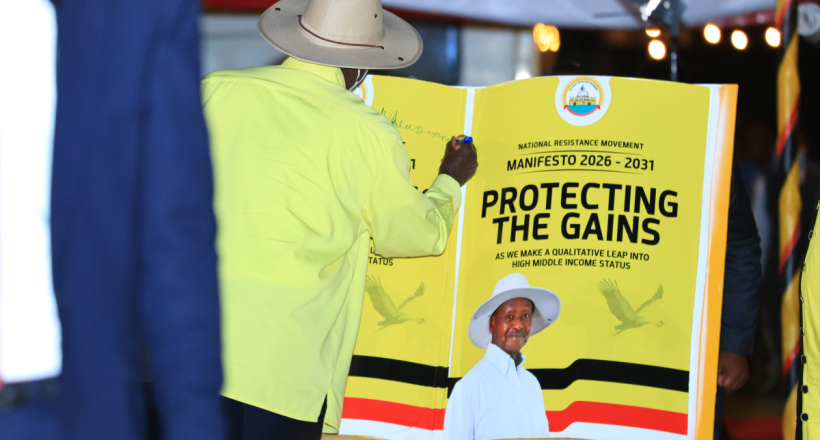 Museveni launchi his 2026 - 2031 'protecting the gains' Manifesto
What exactly does the ordinary Ugandan peasant, teacher, boda-boda rider, nurse, or unemployed graduate have to protect? If we are honest, the loudest beneficiaries of these “gains” are the first families of power, the highly paid heads of institutions, the beneficiaries of state fuel cards, government vehicles, free medical insurance abroad, guarded residences, and lifetime security.
These are the natural singers of “protect the gains.” The ordinary citizen sings it only out of habit, fear, or hunger. This contradiction is among the darkest spots the Ugandan opposition rarely explains to citizens.
The Constitution and the Architecture of Power
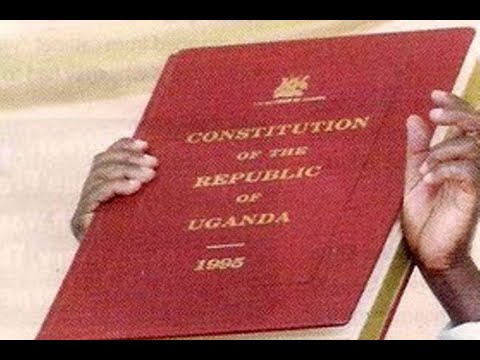
The opposition leadership understands a fundamental truth that is rarely said plainly to the people: the 1995 Constitution of Uganda, as amended, concentrates enormous appointing power in the Presidency.
Article by article, clause by clause, the Constitution legally constructs a political environment where neutrality becomes difficult and independence becomes costly.
Under the Constitution:
Permanent Secretaries, ambassadors, heads of commissions, and boards equally trace their appointments to presidential authority.
These appointments collectively amount to a complete government within one office.
This is not speculation. It is a constitutional fact.
The Myth of Institutional Neutrality
Any average reasoning Ugandan who understands this constitutional structure should not realistically expect an opposition candidate to defeat President Museveni through elections alone.
Why? Because elections do not occur in a vacuum. They are administered, interpreted, secured, and enforced by institutions whose heads owe their positions to the very office being contested.
To expect absolute neutrality in such a system is to ignore a basic political truth: Power rarely hires its own executioners. The Electoral Commission, the police, the military, and the judiciary are expected to arbitrate disputes arising from a process in which their appointing authority is a direct beneficiary. This does not require rocket science to comprehend; it requires only honesty.
Traditionally, in kingdoms and empires alike, servants were loyal to the crown. Modern constitutions may change the language, but human incentives remain stubbornly the same.
Who reasonably expects an individual to betray the source of their livelihood, security, and status in favour of an opposition candidate who cannot guarantee continuity of office the following morning?
Elections as Ritual, Not Transition
Uganda conducts elections every five years. The ballot papers are printed, campaigns held, rallies dispersed, petitions filed, and judgments delivered. But increasingly, elections resemble a ritual of legitimacy rather than a genuine mechanism of transition. They function more like a turn-up test—a constitutional checkbox—than a competitive democratic contest capable of transferring power.
This reality explains why even where irregularities are alleged, citizens should not expect:
All these institutions, by constitutional design and political reality, orbit the Presidency.

Elections in Uganda
The Kenyan Contrast
The 2007 Kenyan election crisis and subsequent judicial reforms offer a useful contrast. Kenya deliberately restructured its electoral and judicial architecture to reduce direct presidential control over appointments. Independent commissions were constitutionally fortified to answer more to the Constitution than to the occupant of State House. Uganda chose a different path.
When legislators amended the Constitution to remove term limits (2005) and age limits (2017), they did more than extend an individual’s stay in power—they constitutionalized permanence. From that moment, elections became predictable outcomes managed within a stable power structure.
The Three Pillars of Power: The 3Ms
Political theorists have long argued that durable power rests on three pillars:
In Uganda, all three overwhelmingly favour the incumbent state.
The opposition possesses none of them at a national scale. This explains why opposition influence largely remains urban—loud on social media, visible in towns, but thin in rural Uganda where state patronage, security presence, and local administrative control dominate everyday life.
The Unspoken Truth About Opposition Survival
Here lies another dark spot rarely admitted: some opposition actors continue contesting not because they expect to win state power, but because opposition itself has become a livelihood.
Campaigns attract donor funding, political visibility, survival capital, and relevance. To continuously promise victory keeps hope alive among citizens, even when the structural odds are constitutionally stacked against change.
As one political philosopher warned: “Hope can be weaponised just as effectively as fear.”
The opposition knows the appointing authority problem. It knows the institutional imbalance. It knows the impossibility of neutrality under the current constitutional order. Yet it rarely tells citizens plainly that no electoral miracle can overcome a system designed to reproduce itself.
Conclusion: Between Democracy and Dynasty
Uganda today stands at a crossroads between democratic form and authoritarian substance.
Elections exist, but power does not genuinely compete. Institutions function, but independence is constrained. Opposition speaks, but structural truth is softened for political survival.
Until the Constitution is fundamentally rebalanced—until appointing authority is diffused, institutions insulated, and power genuinely decentralised—Ugandans should not expect electoral change of government, regardless of slogans, rallies, or candidates.
As history teaches us:
“When the rules of the game are written by one player, victory is not competition—it is procedure.”
About the Writer
Evan Sande Ndahura is a Ugandan legal scholar, political essayist, and social critic whose work interrogates power, constitutionalism, and African political memory. His writings blend law, philosophy, and lived political experience, challenging official narratives while centering the ordinary African citizen. Through essays, poems, and long-form commentary, Ndahura consistently examines the tension between constitutional text and political reality in post-colonial African states, with a particular focus on Uganda and the Great Lakes region.



