Written By | International News Desk
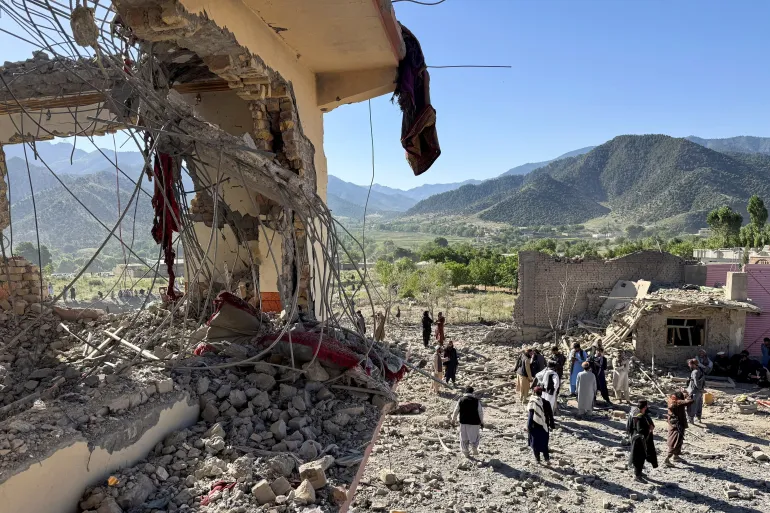
On June 19, Afghanistan struck targets inside Pakistan, in what Al Jazeera reported as a sharp rise in cross-border tension weeks before the current round.
World Politics
The war between Afghanistan and Pakistan has crossed a threshold. On July 1, Afghanistan’s Taliban government announced that its air force had struck what it called Islamic State centers inside Pakistan — in Saranan, a town in Balochistan’s Pishin district, and at sites in Khyber Pakhtunkhwa province — in the first known instance of the Taliban directing drone strikes into Pakistani territory. Pakistan’s military said it shot down four of the drones; two people were reported hurt near a government school in Saranan. Coming hours after Pakistani air and ground operations inside Afghanistan, the exchange marks a dangerous new phase in a conflict that has already killed hundreds of civilians this year and resisted mediation by Qatar, Turkey, and China.
Background
The roots of the war lie in a long-running dispute over militancy along the Durand Line, the colonial-era border that Kabul has never formally recognized. Pakistan has for years accused Afghanistan’s Taliban rulers of sheltering the Tehreek-e-Taliban Pakistan (TTP), the insurgent movement seeking to impose an Islamic emirate in Pakistan’s frontier regions; the Taliban authorities have generally denied it. After the TTP ended a ceasefire with Islamabad in late 2022, its attacks escalated steadily. In October 2025, some of the deadliest cross-border clashes in years produced a Qatar-mediated ceasefire, but implementation proved fragile and follow-up talks in Doha and Istanbul failed to yield a lasting agreement.
Open war began in late February 2026, when Pakistan launched airstrikes on what it described as TTP and Islamic State Khorasan Province camps in eastern Afghanistan, retaliating for a wave of attacks in Balochistan and Khyber Pakhtunkhwa and a major suicide bombing in Islamabad. A temporary pause during Eid al-Fitr in March collapsed with each side accusing the other of violations, and subsequent Chinese mediation has produced no results. The human cost has been severe: the United Nations reported in May that cross-border fighting killed at least 372 Afghan civilians and injured 397 in the first three months of 2026 alone.
Key Developments
June was a month of steady escalation on both sides of the line. On June 10, Pakistan claimed its forces had killed 26 Afghan fighters, while the Taliban government said Pakistani air raids had killed 13 people, including children — another instance of the irreconcilable casualty accounts that have characterized the war. On June 19, Afghanistan struck targets inside Pakistan, in what Al Jazeera reported as a sharp rise in cross-border tension weeks before the current round. Each exchange has followed the same grammar: an attack inside Pakistan attributed to militants operating from Afghan soil, Pakistani strikes across the border in response, Afghan retaliation, and dueling statements in which each government casts itself as acting purely in self-defense.
The current escalation traces to the evening of June 27, when attackers rammed a vehicle-borne improvised explosive device into the gate of a Pakistan Rangers facility in Karachi’s Gulistan-i-Jauhar area, then stormed the compound with gunfire. Three Rangers personnel were killed and four attackers died, according to Pakistan’s military. Islamabad attributed the assault to Jamaatul Ahrar, a faction it called an “Indian proxy” — a charge that reflects Pakistan’s growing anxiety about warming ties between New Delhi and the Taliban government, and one for which it offered no public evidence.
Pakistan’s response came on June 29, with joint army and air force strikes on three targets in Afghanistan’s Paktia, Paktika, and Kunar provinces. Islamabad said the precision strikes destroyed militant facilities and that its forces killed 29 fighters along the border. The Taliban government told a very different story: its deputy spokesman said the strikes killed at least 36 civilians and wounded 163. The UN Assistance Mission in Afghanistan said it could verify 28 fatalities, including 22 in the Paktia airstrike and six in Paktika — a discrepancy between the parties’ claims that remains unresolved.
Kabul’s July 1 retaliation was notable less for its scale than for its method and reach. Afghan aircraft and drones targeted what the defense ministry called a Daesh operational center in Saranan, alongside operations in the Shah Salim Valley of Chitral and Kambar Khel in Khyber Pakhtunkhwa — locations the ministry said were being used to plan sabotage missions and attacks on civilians inside Afghanistan. An Afghan air force statement warned that Kabul would “target every threat.” For a government that inherited a modest air arm from the former republic and has been building drone capability since, striking inside Pakistan signals both intent and a maturing capacity that Islamabad’s planners can no longer discount.
Reactions
International reaction has centered on the civilian toll. UN Secretary-General António Guterres called for the protection of civilians after the Pakistani strikes and urged both governments to resolve their differences through dialogue, stressing adherence to international humanitarian law. UN human rights experts had already appealed in March for a lasting peace along the border. India publicly condemned Pakistan’s weekend airstrikes, citing the civilian deaths — an intervention that will deepen Islamabad’s suspicion that New Delhi is cultivating Kabul as strategic leverage, and that adds an India-Pakistan dimension to what began as a counterterrorism dispute.
Within Pakistan, the strikes and the Karachi attack have hardened official rhetoric, with the military framing its operations as unavoidable responses to externally sponsored terrorism. In Afghanistan, the Taliban leadership has cast its strikes as defensive and lawful, and has used the confrontation to rally nationalist sentiment behind a government whose domestic legitimacy remains contested. Both governments face incentives to escalate publicly even where they may prefer quiet de-escalation: each has framed the other as the aggressor, and each has a domestic audience primed by months of casualties.
What’s Next
The immediate risk is an action-reaction cycle with no working brake. The Qatar-brokered ceasefire framework is defunct in practice, Doha and Istanbul talks have stalled, and China’s mediation — motivated by its investments in Pakistan and its interest in regional stability — has so far achieved nothing. With the Taliban now demonstrating a willingness to strike across the border by air, the threshold question is whether Pakistan treats the drone incursions as a manageable irritant or as grounds for a broader campaign. Pakistani strikes deeper into Afghanistan, or an Afghan attempt to impose costs through TTP-aligned networks, could each trigger the next round.
The India factor deserves particular attention. Islamabad’s decision to label the Karachi attackers an “Indian proxy” fits a broader pattern: as Al Jazeera reported earlier this year, Pakistan’s strategy toward Afghanistan has been shaped by alarm at growing ties between New Delhi and the Taliban government. For Pakistan’s military, the nightmare scenario is strategic encirclement — a hostile Afghanistan aligned, however loosely, with its principal rival. For the Taliban, Indian engagement offers diplomatic options and economic lifelines that reduce dependence on Pakistan. India’s public condemnation of the Pakistani strikes, framed around civilian deaths, will be read in Islamabad as confirmation of that alignment, whatever New Delhi’s stated humanitarian rationale.
The longer-term stakes extend well beyond the border provinces. Sustained conflict threatens to further destabilize a region already coping with mass displacement, as strikes and reprisals push civilians from frontier districts and complicate the return of Afghan refugees expelled from Pakistan in recent years. It also creates space for the Islamic State Khorasan Province — nominally the shared enemy both governments claim to be striking — to exploit the chaos. Whether the next mediation effort comes from Doha, Beijing, or Riyadh, the fundamental bargain has not changed: Pakistan wants verifiable action against the TTP, and the Taliban want an end to strikes on their territory and recognition of their government’s authority. Until someone can enforce that trade, the border war that began in February looks set to grind on.



