Written By | Staff Writer

KAI, rising on Paper Island, turns the harbour swim into civic architecture — and opens its doors on December 5.
Design
On Copenhagen's Paper Island, five irregular brick towers now stand beside the harbour, and they contain one of the most ambitious public bathing projects in Europe. The building, called KAI — a blend of the Japanese word for sea and the Danish word for quay, kaj — is set to open on December 5, 2026. Dezeen reported this week that Kengo Kuma's brick bathhouse is nearing completion.
Form follows the water
The 5,800-square-metre building is composed of five brick towers, each shaped to the outline of the pool beneath it. Designboom reports that the towers rise above a continuous band of glass at ground level, are clad in about 300,000 handmade bricks laid in a stepped pattern, and are punctuated by 403 windows of varying sizes that open the building to the city and the harbour. The tallest, the Culture Tower, houses cultural activities and community gatherings.
Time Out describes the walls as solid brick stumps set with gaps that allow daylight through during the day; at night the effect reverses, with light shining out through the gaps from inside. It is a quiet but effective way to make a heavy material feel luminous.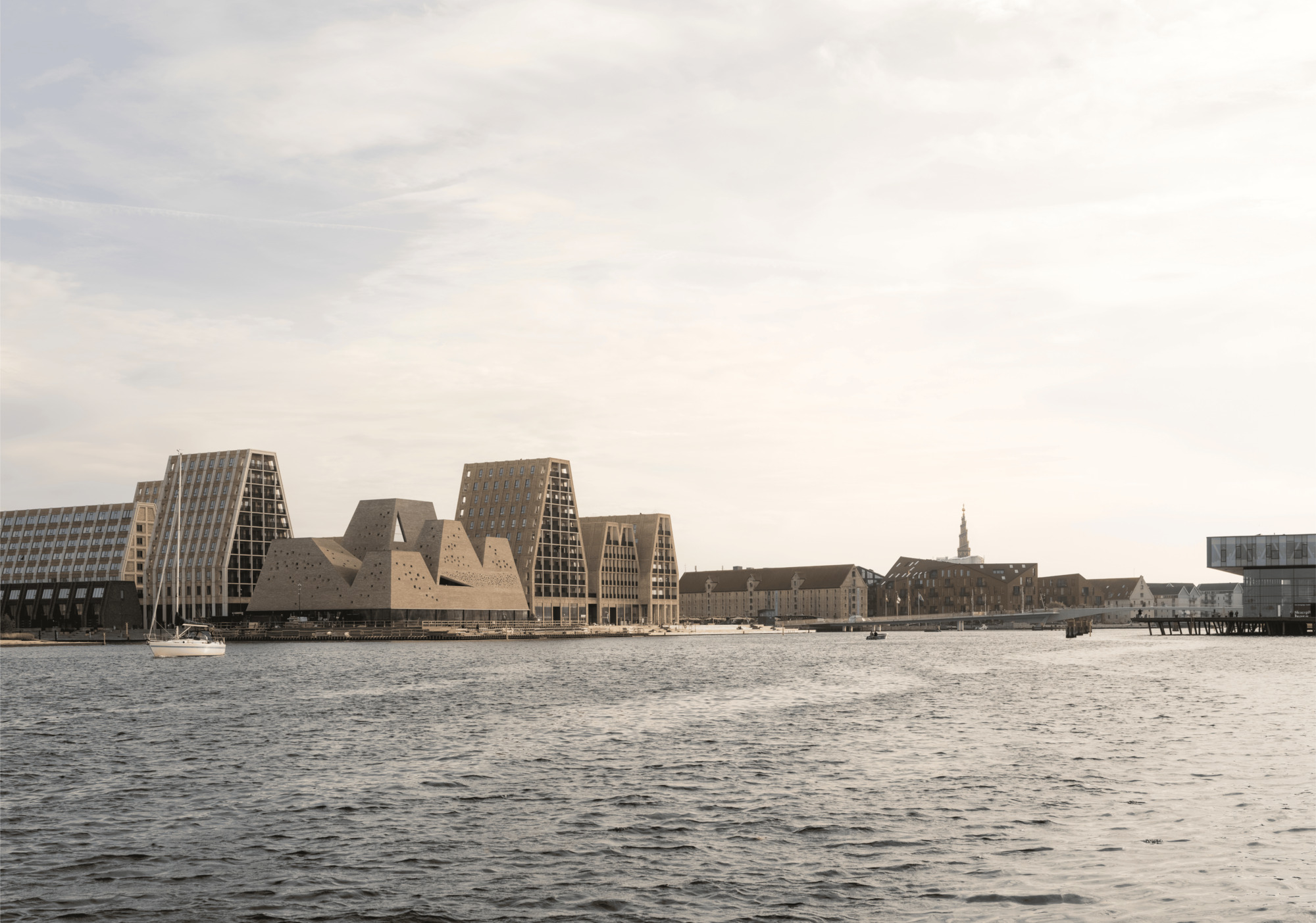
Ten pools, one civic idea
The programme is generous. There are ten swimming pools in total. The ground floor holds a 25-metre fitness pool, a teaching pool and three children's play pools. The first floor is devoted to wellness, with a therapy pool, a hot pool, a cold plunge pool and an open-air valley pool tucked between the towers. A heated outdoor onsen with harbour views, three saunas, a heated stone and a steam bath complete the offering. Up to 380 bathers can use the building at once.
Outside, a timber boardwalk leads to designated harbour swimming and dipping zones — one overlooking Opera Park, another with views of the Royal Danish Playhouse — which Designboom says are expected to open in early 2027.
An architect's view
Lead architect and partner in charge Yuki Ikeguchi of Kengo Kuma & Associates told Euronews the project is part of the city's shift from an industrial port to a cultural waterfront, calling the house "a civic institution dedicated to water and community." That framing matters: this is not a spa tower or a luxury amenity but a public building, meant to host cultural programming that invites people to explore water in new ways.
Engineering behind the calm
Keeping outdoor pools comfortable through a Danish winter is no small task. Designboom reports that the outdoor pools are heated year-round by a ground-source heat pump connected to ten boreholes, each 250 metres deep. The design team includes Cornelius Vöge Atelier for Architecture on early design, Vilhelm Lauritzen Architects as executive architect and MT Højgaard as main contractor, with the Paper Island Water Culture House Foundation as client. Neither Euronews nor Designboom reported a construction cost or ticket prices.
A long road to opening
The project's roots go back to 2015, when a city-led ideas competition for Paper Island drew 160 proposals, most calling for a public swimming facility. Kuma's practice won the architecture competition in 2017. Nine years from competition to opening is long even by architecture's standards, but the result arrives into a city already known for its harbour baths, and into a moment when public wellbeing spaces are an urban priority.
What this means for you
If you are planning a winter trip to Copenhagen, the building gives you a new reason to go: bathing, saunas and cold plunges in a single architectural landmark. Expect demand around opening, since capacity is capped at 380 at a time, and check the operator for tickets and pricing, which have not been published in the coverage reviewed. For designers, KAI is a case study in how a single material, brick, can be reinterpreted through geometry and light, and how public infrastructure can double as a cultural venue.
The takeaway
KAI turns the familiar idea of a swimming hall into an architecture of towers, light and heat. On December 5, Copenhagen will find out whether a building shaped by its pools can become a lasting part of daily civic life.



