Madagascar, Indian Ocean
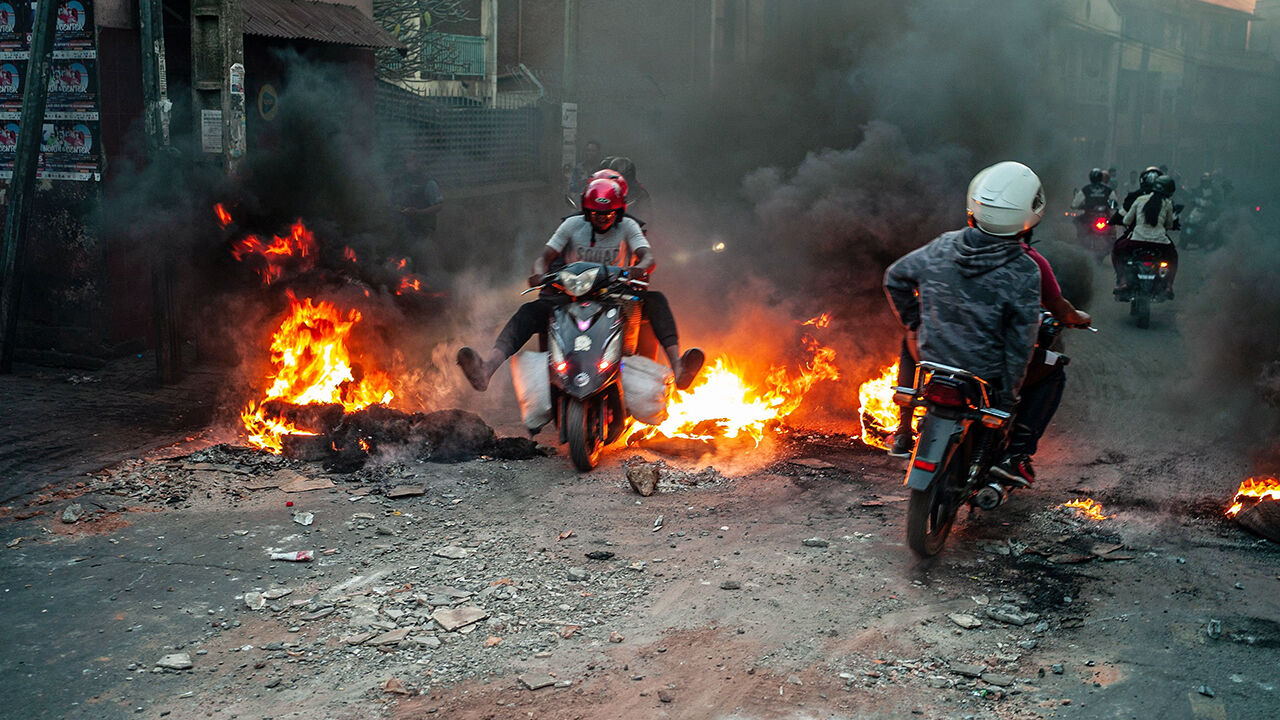
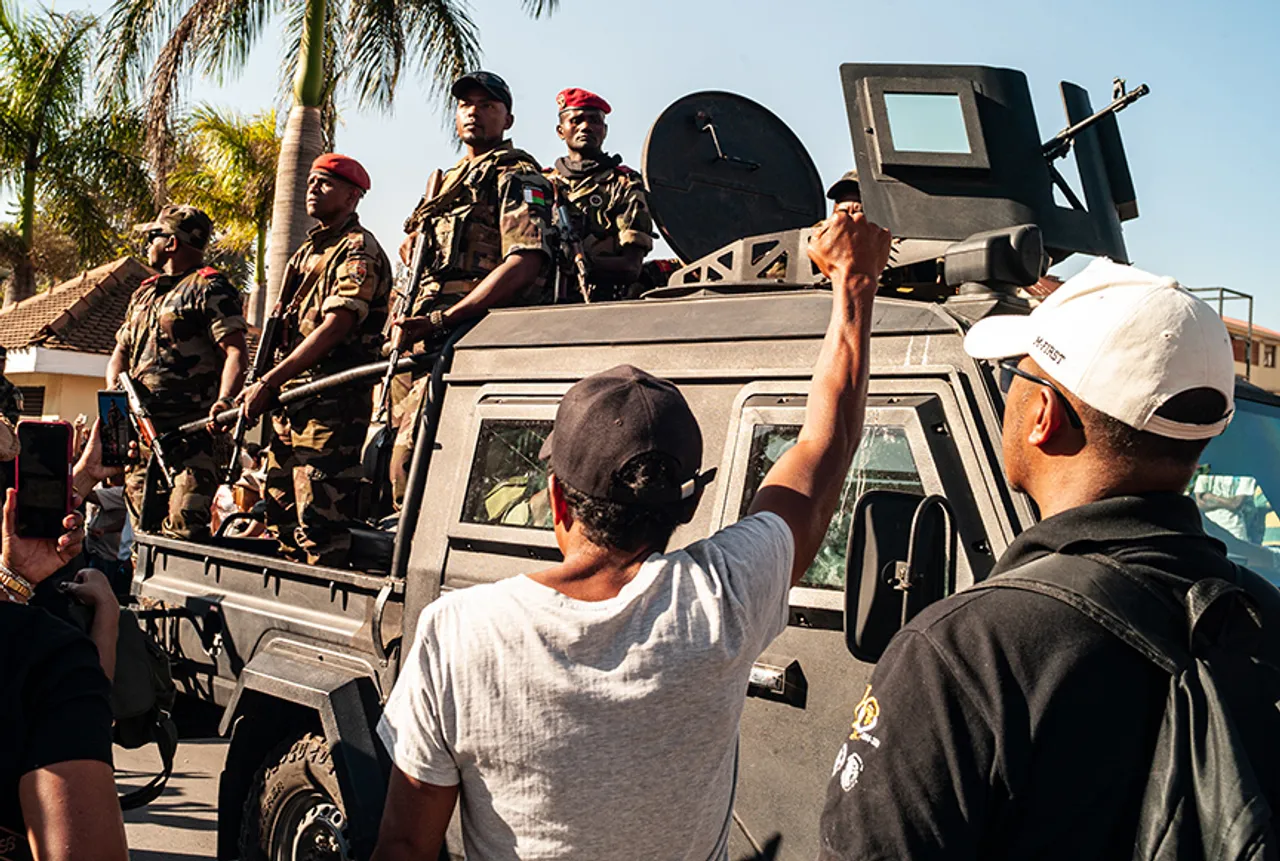
The slogan that carried Madagascar’s September 2025 protests was not about growth rates, debt ratios or exchange-rate policy. It was about taps and light switches. “We don’t want power, we want light,” demonstrators told reporters in Antananarivo as the three weeks of unrest that began on 25 September 2025 built toward the departure of President Andry Rajoelina and, on 17 October, the swearing-in of Colonel Michaël Randrianirina as interim head of state. Almost a year later, the transitional government is discovering that the demand is harder to satisfy than the demand for a change of president. Madagascar’s binding constraint is not the absence of a plan. It is a state that collects too little revenue to run the services whose failure brought people onto the streets, and a national utility that consumes what revenue there is.
A growth record that explains the anger
The macro numbers make the grievance legible. The World Bank’s April 2026 Macro Poverty Outlook puts 2025 real GDP growth at 3.0 percent, down from 4.3 percent in 2024, with manufacturing, tourism-linked services, telecommunications and banking doing the work while crop yields fell to drought and mining sat idle for want of permits. Against annual population growth of about 2.4 percent, that is close to stagnation per head. The long view is worse: GDP per capita in constant 2015 dollars fell from US$812 in 1960 to US$456.5 in 2025, a decline of nearly half over two generations.
Poverty has moved with it. At the US$3-a-day international line in 2021 purchasing-power terms, the headcount rose from 67 percent in 2012 to 69 percent in 2021 and is estimated at 66.5 percent in 2025 — roughly 20.5 million people out of a population of 32.7 million. The Bank projects it will still be near 65 percent through the medium term. Urban living standards have deteriorated alongside rural ones, which is part of why the 2025 protests were an Antananarivo and Toamasina phenomenon rather than a rural one. Meanwhile the labour market must absorb some 420,000 net entrants a year, a number that low-productivity subsistence agriculture cannot take.
Tax revenue is the structural fact underneath. It has run below 11 percent of GDP for a decade, and total revenue and grants slipped to 11.8 percent of GDP in 2025 from 13.0 percent in 2024, with customs duties and import VAT down 0.3 percentage points and project grants down 0.6 points. A state that raises one ariary in nine of national income cannot simultaneously subsidise electricity, rebuild after cyclones and expand schooling.
JIRAMA: the utility at the centre of the politics
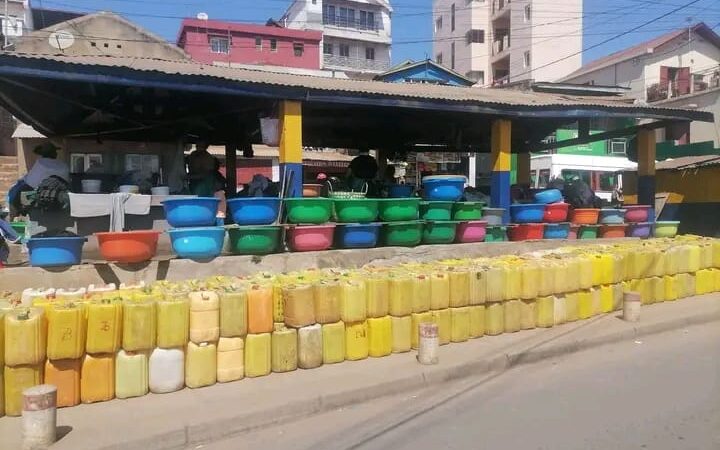
No institution links the macro ledger to the street more directly than JIRAMA, the state water and electricity company. Only about 36 percent of Malagasy have an electricity connection at all, and those who do face routine load-shedding. The IMF’s 2025 selected-issues work on the sector identified the same three failures that have defined JIRAMA for years: insufficient and inefficient generation, heavy losses in transmission, distribution and commercial collection, and tariffs set below cost. Commercial revenue covers roughly half of operating costs; the gap is filled by state subsidies of the order of US$80 million a year, by borrowing, or simply by not paying suppliers. Arrears to the private sector stood at MGA 1,880 billion — about 2.7 percent of GDP — at end-2023.
That arithmetic showed up in the 2025 fiscal accounts. While externally financed investment and non-wage current spending were compressed in the fourth quarter, subsidies to JIRAMA rose, driven by a debt-clearance plan and by more expensive thermal generation. The overall fiscal balance deteriorated to −3.1 percent of GDP, and public debt is estimated at 52.7 percent of GDP for 2025, with the joint World Bank–IMF debt sustainability analysis keeping Madagascar at moderate risk of distress. The utility is thus both the proximate cause of the protests and one of the largest single claims on the budget that would have to fund the answer.
Reform options on the table — concessioning parts of the network, cutting distribution losses toward 12 percent by 2030, building dispatch and load-shedding control centres — are technically unremarkable and politically hard. A transitional administration with a limited mandate and an explicit commitment to fiscal restraint is not an obvious vehicle for raising tariffs on an urban population that has just demonstrated its willingness to bring down a government.
A shock calendar that left no slack
The transition’s first full year was also one of the worst on record for external shocks. Cyclone Gezani made landfall on the east coast near Toamasina on 10 February 2026 with gusts above 250 kilometres an hour. More than 80,000 people were displaced, some 18,000 houses destroyed, and authorities reported that around three-quarters of Toamasina’s infrastructure was destroyed or badly damaged. Damage estimates of roughly US$2 billion would make it the costliest cyclone in Malagasy history — against a 2025 GDP of about US$18.5 billion.
The port city is not an incidental target. Toamasina is Madagascar’s principal maritime gateway and the outlet for the Ambatovy nickel and cobalt operation, which halted in February 2026 and only restarted on 11 June after a four-month shutdown, by which point Sumitomo’s entire stake had passed in May to AMRI, a vehicle of Essenwood Partners and Zungu Investments, alongside Korea’s KOMIR. Cash-crop prices compounded the damage: vanilla remains in a low phase of its price cycle, with export references circulating around US$15 a kilogram for cuts and US$25 for long vanilla, well below the boom-era peaks that once underwrote the SAVA region’s incomes.
Prices at home reflected the same pressure. Headline inflation averaged 8 percent in 2025, easing from 9.5 percent year-on-year in January to 7.2 percent in December, but the World Bank expects it to rise again to 8.3 percent in 2026 as conflict in the Middle East pushes energy and shipping costs up. The central bank raised its policy rate to 12 percent in May 2025 and is expected to hold there. The current account deficit widened to 6.6 percent of GDP in 2025 and is projected near 7.0 percent in 2026; reserves nonetheless improved to 6.8 months of imports, and the ariary gained 2.5 percent against the dollar while losing 8.8 percent against the euro — an awkward split for a country that imports fuel in dollars and sells garments and vanilla substantially into Europe.
The AGOA clock and the garment bargain
Madagascar’s one genuinely labour-intensive export success is textiles. The sector directly employs well over 100,000 workers, predominantly women, in export processing zones around Antananarivo and Antsirabe, with several hundred thousand more livelihoods attached through transport, subcontracting and trade. Much of that output depends on duty-free access to the United States under the African Growth and Opportunity Act, and 2025 output was front-loaded ahead of AGOA’s expiry on 30 September that year. Congress extended the preference to 31 December 2026, with further extension legislation subsequently moving through Washington.
For Madagascar this is the difference between a manufacturing base and a stranded one. The World Bank explicitly lists non-renewal of AGOA beyond 2026 among the downside risks to its 3.8 percent growth projection for the year, alongside institutional fragility, slow reform execution and JIRAMA’s unresolved finances. A country with 420,000 annual labour-market entrants cannot afford to lose the one sector that hires at scale on the strength of a legislative calendar in another hemisphere.
The IMF programme as the referee
The external anchor is the Extended Credit Facility and Resilience and Sustainability Facility package the IMF Executive Board approved in June 2024 — about US$337 million under the ECF and US$321 million under the RSF. An IMF mission led by Constant Lonkeng was in Antananarivo from 26 March to 8 April 2026 for the combined third and fourth reviews. Completion would release SDR 134.4 million, roughly US$183 million. The Fund’s framing was blunt: a myriad of domestic and external shocks has eroded policy buffers, monetary policy should stay tight against emerging inflationary pressure, and domestic revenue mobilisation would need to feature prominently in a supplementary budget.
It did. The 2026 supplementary finance law, presented by Minister of Economy and Finance Herinjatovo Aimé Ramiarison, reorients spending toward road, energy and agricultural investment while committing the tax directorate to raise domestic tax revenue by 1.1 percentage points of GDP over 2026–28, largely by stripping out tax expenditures with no demonstrable economic or social return and by tightening customs and tax collection. It also cuts VAT on credit interest to lower the cost of bank finance for firms. The World Bank’s projections assume revenue recovers to 13.9 percent of GDP in 2026 while the deficit widens to about 4 percent — in other words, that the state spends more and taxes more at the same time.
What would count as success
Growth of 3.8 percent in 2026 and an average 4.2 percent over 2027–28 would be an improvement on the past decade and still too slow to move a 65 percent poverty rate. The more useful tests are narrower and closer to what people actually demanded. Does JIRAMA’s arrears stock fall rather than roll forward? Does the revenue-to-GDP ratio move above the 11-percent ceiling it has sat under for a decade? Does reconstruction in Toamasina restore the port and the power supply rather than only the housing stock? Does the mining permit backlog — reopened on 29 January 2026 after a sixteen-year moratorium, with well over a thousand pending applications — convert into production and royalties under a fiscal regime the public accepts?
Madagascar has had transitions before, in 2009 and after, and each was followed by a period in which political arithmetic crowded out administrative repair. The protests of 2025 were unusual in that their demands were specific and measurable. That is the transitional government’s risk and its opportunity: the public already knows what success looks like, and it is not a growth statistic.
Published By | News Editor