Written By | International News Agencies
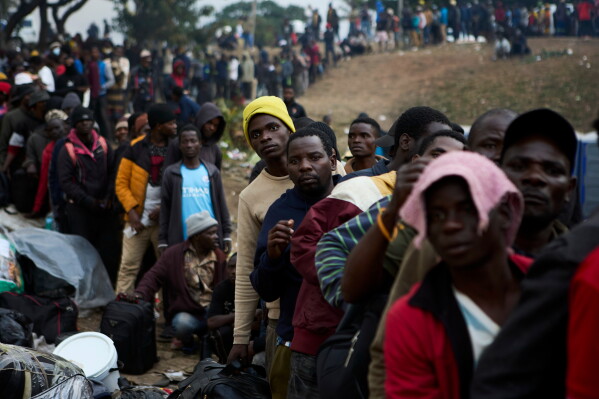
Roughly 400 documented refugees and asylum seekers have been living outside the Home Affairs refugee office for about 15 weeks, according to the Sunday Times
DURBAN
About 100 members of the anti-migrant movement March and March walked from King Dinuzulu Park to a strip of pavement outside the Department of Home Affairs refugee office on Thursday and began carrying refugees' belongings into the road. By the time police had emptied the street with stun grenades, tear gas and rubber bullets, four refugees were in hospital, a police officer had been struck by a stone, a seven-year-old girl had been trampled and a woman had been carried away in an ambulance after fainting.
The movement's answer, delivered on Friday morning, was that it would return.
The confrontation on Che Guevara Road in Umbilo is the sharpest incident yet in a campaign that has run weekly since June, and it arrives two months before South Africans vote in local government elections on Nov. 4 — a date President Cyril Ramaphosa announced and Cooperative Governance Minister Velenkosini Hlabisa gazetted on Aug. 7, in Durban. Whether a vigilante movement can drive municipal politics in the country's third-largest city is no longer a hypothetical question.
Who is on the pavement
Roughly 400 documented refugees and asylum seekers have been living outside the Home Affairs refugee office for about 15 weeks, according to the Sunday Times. They are mainly from the Democratic Republic of Congo, Burundi and Rwanda. They did not choose the site: they fled their homes after violence, evictions and intimidation in the run-up to earlier anti-migrant protests, and they came to a government building because they wanted the government to see them.
Home Affairs has verified that they are in the country legally. Their asks have been consistent — protection from xenophobic attack, and somewhere to live.
Instead they spent a Durban winter on a busy road with a handful of mobile toilets. Two people have died at the site. The most recent death, the Siyafana Sonke Action Campaign said in a statement, was caused by a medical condition "almost certainly worsened by continued exposure to harsh weather and barely sufficient nutrition." Siyafana Sonke is a collective of 160 organizations opposing xenophobia and Afrophobia; its members were standing between the refugees and the marchers on Thursday.
What happened Thursday
March and March advertised the event as a "clean-up." Its own poster said no weapons would be permitted. A number of participants arrived carrying sjamboks and sticks.
The marchers had a police escort of 20 officers on the way to the camp, where they met a cordon of police, metro police and private security. They broke through it despite being outnumbered, and started piling refugees' possessions in the middle of the road while officers looked on, GroundUp reported from the scene.
Rocks then began to fly. A March and March leader was hit in the mouth. Police said an officer was struck by a stone allegedly thrown by a refugee, who was arrested. Two refugees sustained head injuries after being assaulted. Police used stun grenades and tear gas, and later, when tensions rose a second time, fired rubber bullets at the marchers. Ignesia Assagai, a March and March supporter, was hit in the back by one. She told GroundUp she believed the refugees should be sent back to their countries of origin regardless of their legal status.
Col. Robert Netshiunda, the KwaZulu-Natal police spokesperson, said officers "had sufficient deployment and intervened to restore order" and used "minimal crowd management and proportional force." Investigations are continuing, he said, and "anyone found to have incited violence will face the might of the law." The arrested man is to appear in court.
March and March founder Jacinta Ngobese-Zuma arrived after the main confrontation and was furious — at the police. In a social media post she accused the eThekwini Municipality and the police of normalizing lawlessness by allowing the camp to remain, alleged that a firearm had been discharged at the site, and complained that officers said they needed a warrant to search the tents. At the protest she claimed, without producing evidence, that the refugees were responsible for robberies in the area, created a health hazard and hurt local business. She had not responded to GroundUp's questions by the time of publication.
A movement, and a calendar
March and March was founded in Durban in March 2024 by Ngobese-Zuma. It set a deadline of June 30, 2026, for undocumented immigrants to leave South Africa, and turned that deadline into a nationwide protest wave; more than 5,000 people were estimated at its mass demonstration in Durban. On July 1 Ngobese-Zuma announced the campaign would not stop: "Every Thursday, for the next six months, we are marching until they are gone."
Thursday, Sept. 3, was one of those Thursdays. Six months from July 1 runs to the end of December — past the election.
The government has said out loud what the timing suggests. At a briefing of the Inter-Ministerial Committee on Migration, Police Minister Firoz Cachalia said he had taken note of the weekly marches and suggested they carried a political dimension, part of an effort to mobilize ahead of the local government elections. "This is not just about illegal immigration," he said. On the eve of the June 30 deadline, March and March ally Nkosikhona Ndabandaba met President Ramaphosa.
That combination — a cabinet minister naming the electoral motive, and the president receiving the movement's allies — captures the government's difficulty. The Government of National Unity contains parties with sharply different instincts on migration, and every one of them is contesting wards in November in an environment where housing, jobs and service delivery are the dominant grievances.
Siyafana Sonke put the accusation bluntly. The two options the state has offered the refugees — reintegrate into the communities that expelled them, or go to the Lindela Repatriation Centre in Gauteng — smacked, it said, of "cross-party political expediency in an election year." Early promises of alternative emergency shelter, the campaign said, "have now evaporated without explanation or accountability," despite its having supplied the state with a list of sites previously used to house victims of xenophobic violence.
The group also objected to the vocabulary. The language of "cleaning up," it said, is dehumanizing and unconstitutional when applied to a vulnerable minority, and should be retracted. It called for the arrest and prosecution of the leaders of anti-migrant organizations, naming Ngobese-Zuma, Ndabandaba and the broadcaster Ngizwe Mchunu.
The Lindela choice
The most consequential development on Thursday was not the rocks. It was a split among the refugees themselves.
Gerrard Itabelo, speaking for one group of Congolese refugees, said they would accept the government's offer of transfer to Lindela. "We are happy with the government's offer of taking us to the temporary shelter in Lindela," he said. "We will be able to live there, and our children will be able to start school from next year."
Raphael Bahebwa, president of the Congolese Solidarity Campaign and a representative of another group, described the same facility as "the notorious Lindela Repatriation Centre, the violent and corrupt prison where people are taken before being deported," and said the UN had advised the refugees for months not to accept being moved there. "We are all documented refugees, and it is a crime against international law to deport documented refugees," he said. By his count, 105 people have concluded they have no other option and will go. The rest, he said, will stay: they cannot return to countries they fled, and they cannot return to communities that expelled them.
Bahebwa also said he was disappointed that police allowed the violence to break out. Some refugees, he said, have opted for Lindela having given up hope that the eThekwini Municipality will offer them shelter or protection.
The Umbilo Business Association, which has said the camp is hurting local trade, has proposed a different destination: the old Durban drive-in.
What to watch
March and March has promised to come back, and its calendar of Thursday marches runs through the election and beyond. The immediate test is whether policing changes. On Thursday, officers escorted the march, failed to hold the cordon, and made one arrest — of a refugee. Civil society organizations have been asking since June for the ringleaders of anti-migrant campaigns to be charged. If the eventual charge sheet from Che Guevara Road again contains only foreign nationals, that will be read as an answer.
The second test is shelter. Two refugees have died on that pavement. The state's own inter-ministerial committee has been silent on alternative accommodation, according to Siyafana Sonke, while offering a repatriation centre as a humanitarian solution. A documented refugee sent to a facility built for deportation is a policy that will end up in court.
The third is the ballot itself. Cachalia has already characterized the marches as electoral mobilization. If anti-migrant candidates and slates convert Thursday afternoons in Durban into council seats on Nov. 4, the incentive structure that produced Che Guevara Road will be validated — and no party in the Government of National Unity will find it easy to argue with the result.



