HEALTH
For decades, doctors have known that carrying extra weight raises your risk of Alzheimer's disease. What they haven't known — not really, not down to the molecule — is why. Obesity and Alzheimer's have always seemed like distant cousins: one a disease of metabolism, blood sugar, and body fat; the other a disease of tangled proteins deep inside the skull. Two different organs, two different stories.
Now a team of researchers at Houston Methodist says they've found the missing link — a literal molecular courier that carries damage from body fat straight into the brain, disrupts its immune system, and helps toxic proteins pile up in ways that look a lot like the earliest stages of Alzheimer's disease.
The findings, published in the journal Molecular Neurodegeneration, point to a specific class of fat molecule called phosphatidylethanolamines — PEs, for short — as the culprit. And in a twist that has excited researchers and patient advocates alike, correcting the imbalance of these molecules didn't just stop the damage in laboratory models of Alzheimer's. It reversed some of it, restoring memory and brain function in animals that had already shown signs of cognitive decline.
From Belly Fat To Brain Fog: How The Pathway Works
The study, co-led by Stephen Wong, Ph.D., the John S. Dunn Presidential Distinguished Chair in Biomedical Engineering at Houston Methodist, and Li Yang, Ph.D., a research associate at the institution's Chao Center for BRAIN, set out to answer a deceptively simple question: how, mechanically, does fat tissue talk to the brain?
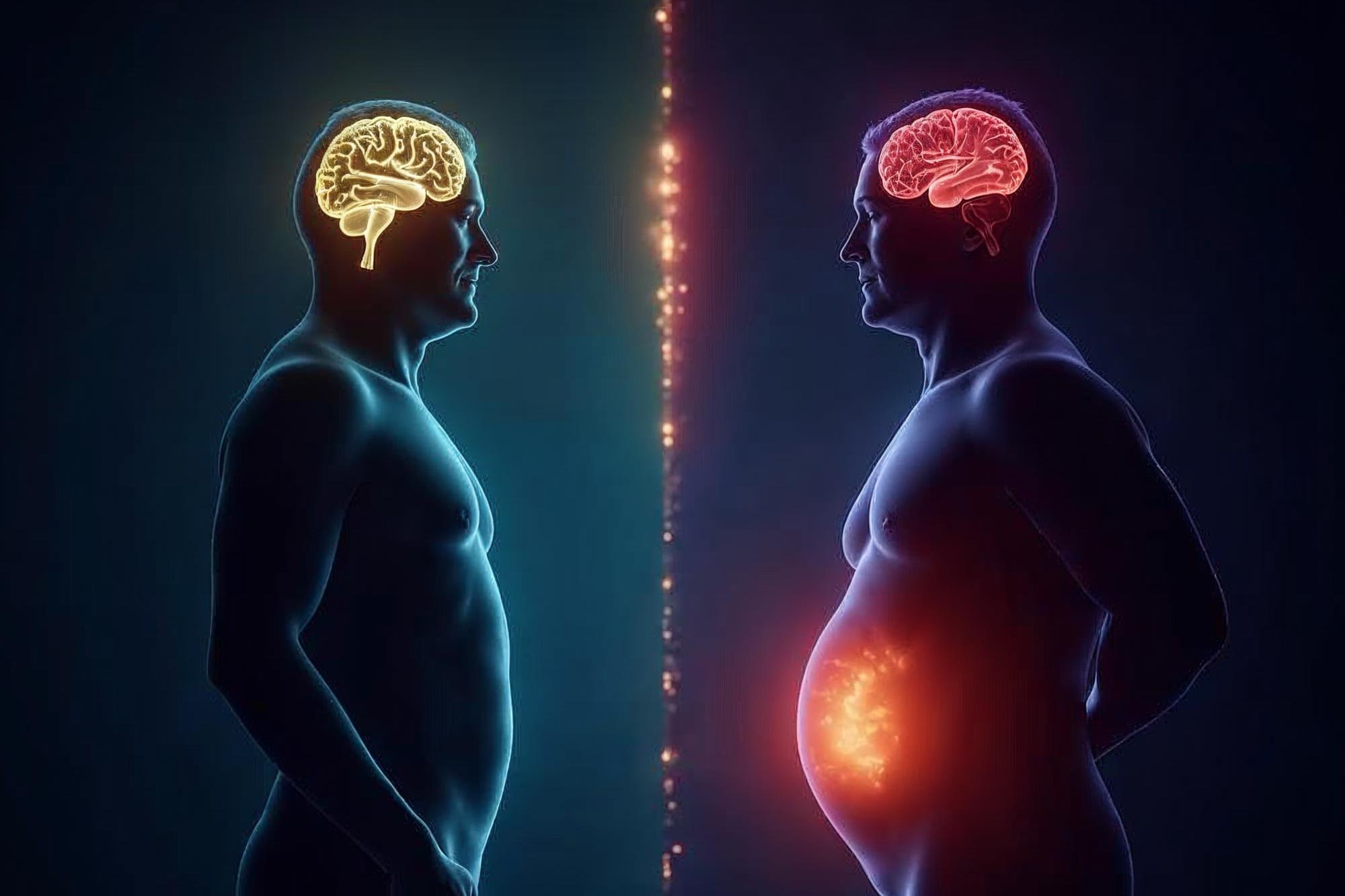
The answer they found runs through phosphatidylethanolamines, a type of lipid found in cell membranes throughout the body. According to the study, obesity drives up the levels of these fat molecules in body tissue. From there, the PEs get packaged into microscopic transport particles — extracellular vesicles, in scientific terms — tiny biological envelopes that cells use to ship material to other parts of the body, including, in this case, across the blood-brain barrier and into the brain itself.
Once inside the brain, the PE-carrying particles seem to wreak a very specific kind of havoc. According to the research team, they interfere with the way brain cells communicate with one another, weaken the brain's own immune defenses, and — most alarmingly — appear to actively encourage the buildup of amyloid protein, the sticky plaque deposits that are one of the defining physical hallmarks found in the brains of Alzheimer's patients.
In other words: the fat isn't just sitting on your hips causing metabolic problems. Under this new model, it's actively sending chemical messengers that travel all the way to your skull and mess with your brain's ability to defend and repair itself.
"Obesity can change how signals travel to the brain," Wong said in comments accompanying the study's release. "The good news is that this may be something we can treat. Instead of looking at Alzheimer's risk tied to obesity as just a metabolic problem, this research suggests we may be able to target the process that connects those changes to the brain."
The Reversal That Has Researchers Excited
The most striking part of the study isn't just that the team found this pathway — it's what happened when they intervened.
When the Houston Methodist researchers worked to restore a healthier balance of phosphatidylethanolamines in their Alzheimer's disease models, they observed measurably less disruption in the animals' lipid regulation overall. But the real headline came next: correcting that imbalance also produced improvements in brain function and cognitive performance — the kind of measures scientists use to track learning, memory, attention, and problem-solving ability in laboratory models.
That detail matters enormously in Alzheimer's research, a field that has spent billions of dollars and decades of effort chasing treatments that can do more than just slow decline — treatments that might actually claw back function that's already been lost. A pathway that is not only linked to disease progression, but appears reversible in animal models, is exactly the kind of target pharmaceutical companies and academic labs race to chase.
Li Yang, one of the study's co-lead authors, was careful to temper the excitement with scientific caution. Much more research, she noted, will be needed before any treatment targeting PEs could be tested in people as either a prevention strategy or an actual therapy. Still, she said, the findings point toward a genuinely new strategy for intervening early in people whose metabolic health — their weight, their blood sugar, their body fat — may be quietly raising their risk of Alzheimer's years or even decades before any memory symptoms appear.
Not The First Clue — But The Clearest One Yet
This isn't the first time Houston Methodist researchers have tugged at the thread connecting body fat and brain disease. Back in October 2025, the same broader research group published findings showing that tiny messengers released by fat tissue — called extracellular vesicles, the same delivery mechanism implicated in this new study — could directly drive Alzheimer's-related changes in the brain. The new phosphatidylethanolamine research builds directly on that earlier discovery, zeroing in on exactly which molecular cargo inside those vesicles is doing the damage.
Taken together, the two studies represent a steadily sharpening picture: obesity doesn't just correlate with higher Alzheimer's risk through vague, indirect routes like inflammation or blood vessel damage. It appears to send specific, trackable, and — crucially — potentially targetable molecular signals directly from fat tissue into brain tissue.
The stakes could hardly be higher. According to the Centers for Disease Control and Prevention, more than 6.5 million Americans are currently living with Alzheimer's disease, a number the agency projects will balloon to nearly 14 million by 2060 as the population ages. Obesity rates, meanwhile, have climbed for decades across the United States and much of the developed world, affecting more than 40% of American adults by some federal estimates. If the two conditions are as mechanically intertwined as this new research suggests, the overlap between the obesity epidemic and the coming Alzheimer's wave could be even larger than public health officials have projected.

Expert Perspective
Outside researchers in the Alzheimer's field have long suspected that metabolic health and brain health were more intimately connected than a simple risk-factor relationship — the kind of loose association where obesity is just one item on a checklist alongside smoking, high blood pressure, and low physical activity. This new study offers something the field has been hungry for: an actual mechanism, a biological chain of custody that can be studied, measured, and — potentially — interrupted with a drug.
The study's funding sources reflect how seriously the Alzheimer's research community is taking the metabolic connection. The work was backed by grants from the Cure Alzheimer's Fund, the T.T. and W.F. Chao Foundation, and the John S. Dunn Research Foundation — a signal that major disease-focused philanthropies see this as a priority avenue worth investing in, rather than a peripheral curiosity.
It also lands amid a broader wave of research probing whether treatments developed for metabolic disease — including GLP-1 drugs like semaglutide, already reshaping obesity and diabetes treatment — might have spillover benefits for brain health. Several research teams globally have tested GLP-1 medications in animal models of Alzheimer's, with some studies showing improved cognition and reduced amyloid buildup, though results across different mouse models have been decidedly mixed. The new PE pathway offers a more specific, mechanistic target than broad metabolic interventions — potentially narrowing the search for an effective brain-protective therapy.
What This Means For You
If you're carrying excess weight and worried about your family history of Alzheimer's, this research doesn't hand you a treatment you can ask your doctor for tomorrow. Phosphatidylethanolamine-targeted therapies remain, by the researchers' own admission, years away from human testing, let alone approval.
But the findings do reinforce something doctors have been saying with increasing confidence for years: what you do for your metabolic health in your 40s, 50s, and 60s may matter more for your brain in your 70s and 80s than previously understood. Weight management, blood sugar control, and cardiovascular fitness are no longer just about preventing diabetes and heart disease — they may be quietly protecting, or damaging, your brain's own immune system decades before any symptoms would ever show up on a memory test.
For the millions of families already navigating a loved one's Alzheimer's diagnosis, the research offers something else: hope that a genuinely new class of treatment — one that intervenes on the metabolic side of the disease rather than only attacking amyloid plaques directly, as most current Alzheimer's drugs do — could eventually reach clinical trials.
The Bottom Line
Alzheimer's research has spent the better part of two decades chasing the amyloid hypothesis, with mixed and often disappointing results. The Houston Methodist findings suggest a different, complementary front may be opening up — one that starts not in the brain, but in the fat tissue around your waist, and travels through a class of molecule most people have never heard of, on a one-way trip toward the organ that makes you who you are.
Scientists caution it's early. But for a disease that has stubbornly resisted new treatment strategies for a generation, "early" and "a genuinely new mechanism" is precisely the kind of combination that tends to get researchers — and patients — cautiously excited.
Published By | Features Editor