Written By | Fashion and Design Desk
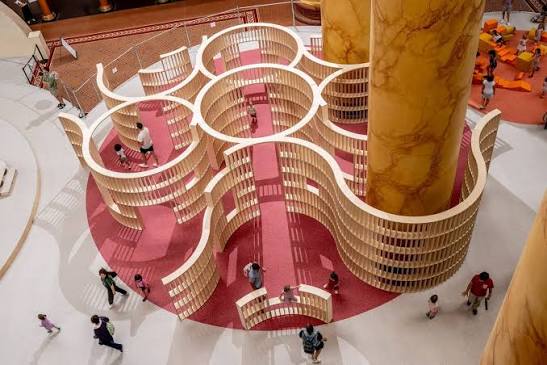
A 14,000-square-foot indoor landscape of slides, tunnels and rope hammocks has taken over the National Building Museum's Great Hall — and it's an unabashed argument for play as design.
Washington, D.C.
Washington's National Building Museum has spent decades explaining architecture to the public through models, drawings and exhibitions. This summer, it decided to let people climb through one instead. THE PLAYGROUND, a 14,000-square-foot installation designed by the New York studio Snarkitecture with design collaborator Gluten, opened July 3 in the museum's cavernous Great Hall and now stands as the largest indoor installation in the building's history — a sculptural landscape of birch plywood, rope, cork and scaffolding built entirely for climbing, sliding, digging and gathering. It runs through August 30.
For a museum whose entire mission is making the built environment legible to non-architects, turning its signature hall into an actual playground is less a gimmick than a natural extension of the premise: if you want people to understand what buildings are made of and how spaces shape behavior, hand them a slide built out of the same materials and let them feel it.
Nine Zones, One Big Idea
The installation is organized into nine distinct activity zones spread across the Great Hall's soaring footprint. The Hill serves as its centerpiece, stacking layers of birch plywood into a sculptural landscape laced with slides, tunnels and gathering spots. From there, visitors can work through a 100-foot obstacle course, scale a 15-foot climbing wall, sink into oversized rope hammocks, shoot hoops on a dedicated sport court, wind through a maze of Wavy Walls, or dig through the Dig Pit, a construction-themed play space filled with natural cork standing in for excavated earth.
Two more zones round out the design: the Adventure Yard, inspired by the adventure-playground movement that encourages kids to shape their own environments through open building and experimentation rather than fixed equipment, and the Tot Spot, a scaled-down area designed specifically for the museum's youngest visitors to climb and discover safely.
"The Familiar Made Unfamiliar"
Snarkitecture co-founder Alex Mustonen framed the project as an extension of the studio's long-running interest in reworking ordinary experiences into something strange and new.
"Snarkitecture has always been interested in the familiar made unfamiliar — environments that invite people to see and experience the world differently. The Playground reimagines the familiar experience of a playground into something unexpected: an invitation for people of all ages to rediscover the joy, creativity, and wonder of open-ended play," Mustonen said.
That phrase — for people of all ages — is doing real work. Snarkitecture's installations have always drawn as many adults as children, in part because the studio treats play not as a category reserved for kids but as a mode of engaging with architecture that adults have simply been trained out of.
A Studio Built on Play
Snarkitecture, founded by Daniel Arsham and Alex Mustonen, built its reputation on exactly this kind of large-scale, materials-driven installation, most famously with The Beach, a 2015 exhibition at this same museum that filled the Great Hall with nearly a million translucent plastic balls standing in for sand and surf. That show became one of the most Instagrammed art installations of its decade and helped cement the museum's now well-established tradition of turning its Great Hall into an immersive summer attraction — a lineage that has included Icebergs, Fun House, and Lawn in the years since.
Materials as Message
What distinguishes THE PLAYGROUND from a conventional pop-up attraction is how deliberately its materials double as an architecture lesson. Scaffolding, birch plywood, cork and rope are all pulled directly from construction sites and lumber yards — the actual raw materials of the built environment — rather than the molded plastic and foam typical of commercial playgrounds. A child tunneling through the Dig Pit is, in a very literal sense, playing inside the vocabulary of a construction site, which is precisely the kind of hands-on translation the museum has built its identity around.
What This Means for Visitors
For families planning a Washington summer trip, THE PLAYGROUND gives the National Building Museum a rare selling point: an indoor, climate-controlled, physically active attraction that runs through the muggiest stretch of the D.C. summer and works for a wide age range in a single visit, from toddlers in the Tot Spot to teenagers and adults tackling the obstacle course and climbing wall. It's also, notably, designed to reward repeat visits — the open-ended nature of the zones means the experience shifts depending on how crowded the hall is and what kids decide to build or attempt that day.
Part of a Bigger Shift
The installation also lands at a moment when design commentators have been describing a broader pivot away from the hyper-polished, screen-native aesthetic that dominated the last several years, toward styles that are more tactile, hand-made and physically engaged — grainy, textured, human-scaled work in place of frictionless digital gloss. THE PLAYGROUND is that shift built at full architectural scale: a design object you're meant to touch, climb over and get slightly out of breath inside, rather than simply look at.
Practically speaking, the installation slots neatly into a Washington summer itinerary: it's indoors and air-conditioned on the muggiest days, works across a wide age range in a single visit, and sits inside a museum that, unlike many of the capital's marquee attractions, rarely tops anyone's must-see list on its own. That calculus has clearly shifted this summer. Through August 30, it's a rare chance to experience a museum as something you play in rather than walk through.



