Written By | International News Agencies
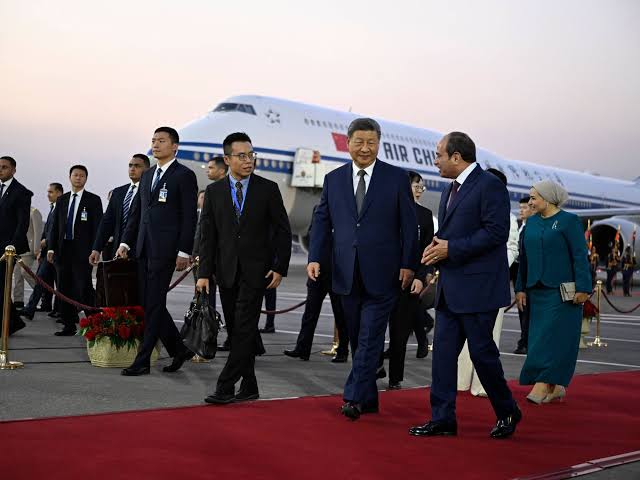
Chinese President Xi Jinping landed at Cairo International Airport on the evening of Tuesday
CAIRO
Background
Chinese President Xi Jinping landed at Cairo International Airport on the evening of Tuesday, September 1, greeted on the tarmac by President Abdel Fattah el-Sisi, a red carpet and a military honour guard. It was Xi's first visit to Egypt in a decade and his first trip to the Middle East since he travelled to Saudi Arabia in 2022. Across the capital, a megalopolis of more than 26 million people, major boulevards were hung with Chinese and Egyptian flags and billboards bearing the two presidents' faces. On Wednesday he was received at the Ittihadiya presidential palace with a 21-gun salute, held wide-ranging talks with Sisi, and later toured the Grand Egyptian Museum overlooking the pyramids at Giza with his wife, Peng Liyuan, alongside the Egyptian first couple.
The choreography was conventional. The subtext was not. China is courting one of Washington's closest and longest-standing Arab partners at a moment when the American-led security order in the region is under more strain than at any point in decades. The United States is six months into a war with Iran that began on February 28 with the launch of Operation Epic Fury and the killing of Supreme Leader Ayatollah Ali Khamenei; Iran has kept the Strait of Hormuz effectively closed in retaliation for most of that period; Houthi attacks have made the Bab al-Mandeb strait treacherous; and Washington's Gulf partners have begun openly shopping for alternatives to the American security guarantee. In August, Saudi Arabia, Turkey and Pakistan signed the Mecca defence agreement, a mutual-defence pact containing a NATO-style Article 5 clause. Officials in all three capitals insisted the pact was not meant to displace existing arrangements. Few analysts in the region read it that way.
The visit also carried a round anniversary: 70 years of diplomatic relations between Cairo and Beijing, marked on Tuesday by friendly opinion pieces the two leaders published in Egypt's state newspapers. Xi wrote that the two countries should "expand the scope of pragmatic collaboration." Sisi praised Chinese investment and restated Egypt's support for Beijing's position that Taiwan is part of China.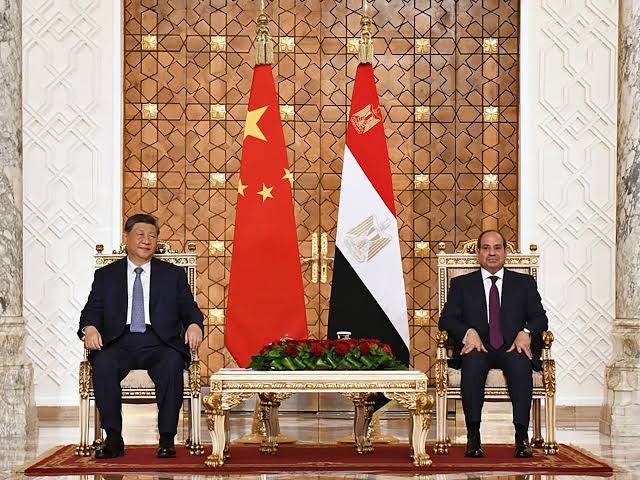
Key Developments
The substantive output of Wednesday's talks fell into three baskets: rhetoric on regional security, money, and defence.
On security, Xi went further than Chinese leaders customarily do on Middle Eastern soil. "We must uphold the principle that the people of the Middle East are the masters of their own affairs, oppose external interference, support regional countries in strengthening dialogue on peace and security," he told Sisi, according to the Chinese state news agency Xinhua. He added that China "stands ready to work with countries in the region to safeguard the security of international shipping lanes, advance development cooperation and eliminate the breeding grounds for conflict." Xinhua also reported Xi urging the two countries to jointly oppose "unilateralism and acts of bullying" and to "work together for a more just and equitable global governance system." None of those formulations names the United States. All of them are understood, in Beijing's diplomatic grammar, to mean it.
Sisi's spokesperson said the two presidents discussed the US-Israel war on Iran and both urged "diplomatic solutions" leading to a "comprehensive agreement to end the war." That is a notably softer posture than Washington's, and it places Egypt — a country that receives roughly $1.3 billion in annual American military aid and is the second-largest recipient of US military assistance — alongside China in calling for negotiated de-escalation rather than continued pressure.
On money, the headline deliverable was an agreement to launch the third phase of the Egyptian-Chinese industrial zone at the Suez Canal, the China-Egypt TEDA cooperation zone at Ain Sokhna. Egyptian officials say the existing zone already hosts about 200 companies with investments of roughly $3.8 billion to $4 billion. Cairo did not publish a figure for the new phase, and a further slate of agreements was announced without details; both delegations had signalled beforehand that artificial intelligence, transport and manufacturing would be covered.
The underlying economic relationship is already lopsided in China's favour and growing fast. China is Egypt's largest trading partner in non-petroleum goods, with bilateral trade reaching nearly $20.7 billion by the end of 2025 according to Egypt's State Information Service. Egypt's own statistics agency, CAPMAS, recorded Egyptian exports to China of $840.8 million in the first half of 2026 — a near-200 percent jump — against imports of $10.4 billion. Beijing has invested more than $10 billion in Egypt overall, including in the New Administrative Capital east of Cairo and an electric rail line serving Nile Delta industry, plus container ports, green hydrogen, iron pipes, tyres and satellites. For comparison, total US-Egypt trade stood at $15.7 billion in 2025.
On defence, the most striking recent data point predates the visit. In August, China and Egypt held a multi-day joint air exercise across several Egyptian bases — the first-ever combat exercise pairing China's J-16 fighters with Egypt's French-built Rafales. For a country whose air force has been equipped and trained largely within the Western orbit, flying alongside Chinese frontline aircraft is a signal that carries well beyond the exercise itself.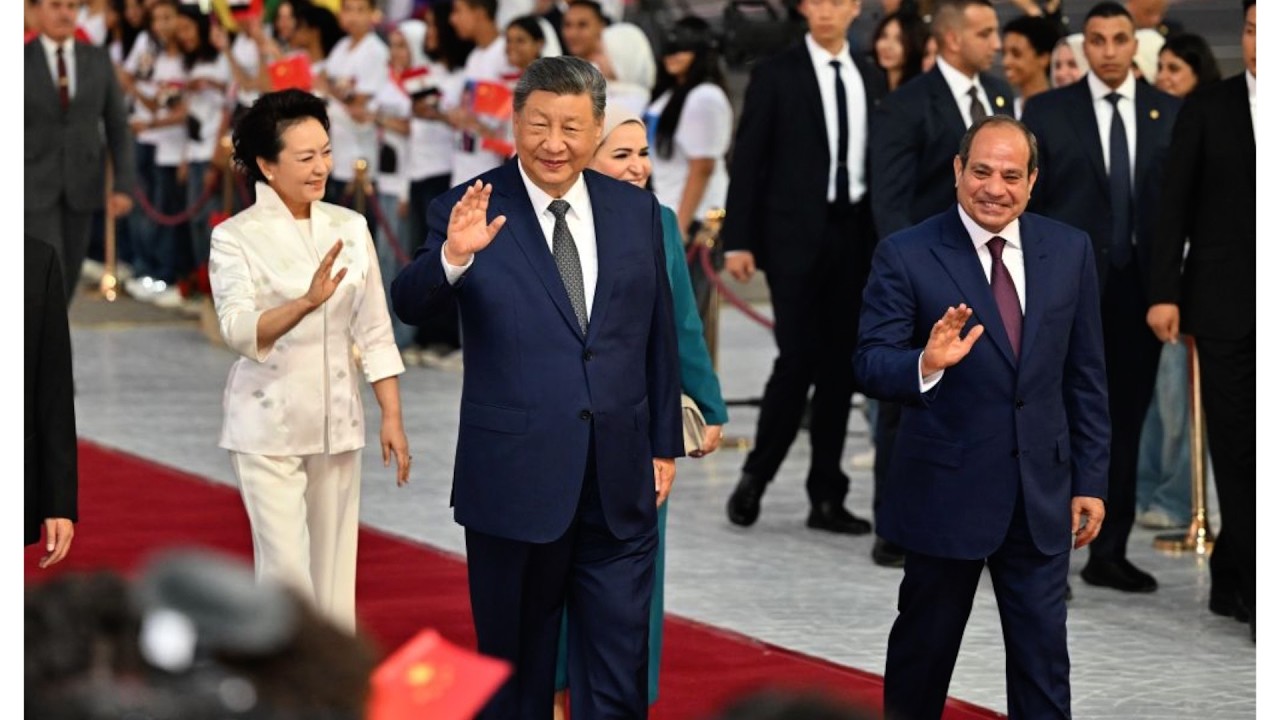
Why Egypt, and Why Now
Egypt's value to Beijing is partly demographic and commercial — 110 million people, a large consumer market, diplomatic weight across the Arab world and Africa — but the immediate draw is geographic. Egypt controls the Suez Canal, and with Hormuz largely shut and Bab al-Mandeb dangerous, the canal is one of the few reliable arteries left for moving energy and goods between the Gulf, Asia and Europe. "China has good reason to strengthen ties with the country that controls the route still open," said Muhammad Zulfikar Rakhmat of Jakarta's Center of Economic and Law Studies, who added that Xi sees Egypt "as a base to reach the wider Arab and African world, at a time when the US has less attention to spare there."
Egypt's need is more acute still. The canal has been a wound rather than an asset for two years: Suez revenues collapsed by roughly half from the 2023 peak of about $10.25 billion as Houthi attacks pushed carriers around the Cape of Good Hope, and Egyptian officials have put cumulative losses in the billions. A partial recovery began in late 2025, but the renewed disruption from the Iran war has kept the canal well below capacity. Cairo badly needs foreign investment and hard currency, and Beijing is offering both without the political conditions that attach to Western money.
Analysts caution against reading the visit as a defection. "El-Sisi's approach is better understood as one of diversification and strategic autonomy," Rob Geist Pinfold, a lecturer in international security at King's College London, told Al Jazeera. "He is trying to hedge without alienating or annoying Egypt's indisputably most important ally, the US." Mirette Mabrouk of the Middle East Institute framed the opening as a response to American ambivalence: Beijing is moving in at a time when "the United States looks like it can't really make up its mind whether it wants to withdraw from the region or be more engaged."
Reactions
Chinese state media presented the visit as proof that Beijing's model of engagement — investment first, no lectures on governance, no bases — is gaining adherents. Amr Hamzawy, director of the Carnegie Middle East Program in Washington, made a version of the same point from the other direction, writing with Kathryn Selfe earlier this year that "China continues to build up its soft power reserves while the United States self-sabotages its own stock."
There was no immediate public comment from the White House. Washington's leverage in Cairo remains substantial — the annual aid package, decades of interoperability, and Egypt's dependence on American goodwill at the IMF — and US officials have generally treated Gulf and Egyptian hedging as irritating rather than disqualifying. But the pattern is accumulating: the Mecca pact in August, Egypt's BRICS membership since 2023, its 2024 Belt and Road agreements, and now a Chinese leader standing in Cairo calling for the region's security architecture to be rewritten without outside powers.
Sceptics note the limits of China's offer. Beijing has no security guarantee to extend, no expeditionary capacity in the region, and a mediation record that has frayed: the 2023 Chinese-brokered restoration of Saudi-Iranian ties, once the showpiece of Beijing's diplomacy, has come apart as Iran attacked Saudi Arabia and other Gulf states during its retaliation campaign against the US and Israel. China's regional influence remains overwhelmingly economic.
What's Next
Xi's Cairo stop is the second leg of a compressed diplomatic run. He arrived from the Shanghai Cooperation Organisation summit in Bishkek, where he sat with Vladimir Putin, Narendra Modi and the leaders of Pakistan and Iran and pressed the case for "irreversible multipolarity." He is due in Washington on September 24 for a summit with President Donald Trump — barely six weeks before the US midterm elections, with artificial intelligence expected to dominate the agenda and US-China tit-for-tat sanctions clouding the run-up.
That sequencing is itself the message. Beijing is demonstrating that it can convene the Global South in Central Asia, cultivate an American ally in North Africa, and then sit down with the American president as a peer, all inside a month. Complicating it is Washington's ongoing "economic onslaught" against Iran's financial links abroad, aimed squarely at buyers of Iranian crude — of which China takes more than 80 percent, usually through indirect channels. Beijing maintains its Iran trade has always complied with international law.
For Egypt, the near-term test is whether the third phase of the Suez industrial zone produces disclosed figures and actual construction, and whether the August air exercise turns into procurement. For the region, the question Xi posed in Cairo — who gets to write the Middle East's security rules — will not be answered by a state visit. But it was asked out loud, in an allied capital, and Washington did not have a ready reply.



