JUBA
Fifteen years after independence, South Sudan's economy is once again being defined by a single commodity and a single pipeline. New data from the African Development Bank (AfDB) and the World Bank show a country whose headline growth numbers are turning sharply positive even as the everyday reality for most South Sudanese continues to deteriorate. Real GDP growth rebounded to 4.0% in the 2024/25 fiscal year, recovering from a 27.6% contraction the year before, and the AfDB's June 2026 Country Focus Report projects growth accelerating to 22.0% in 2025/26 before moderating to a still-strong 6.8% in 2026/27. Yet over the same period, the World Bank recorded extreme poverty rising from 84% of the population in 2024 to 87% in 2025, and roughly 92% of South Sudanese now live below the national poverty line. The gap between macroeconomic recovery and lived deprivation is the defining story of South Sudan's economy in 2026.
A Fragile Return to Growth
The rebound is almost entirely a function of oil. According to the AfDB's South Sudan Economic Outlook (updated June 20, 2026), oil production rose to 156,000 barrels per day in 2024/25, up from just 61,000 barrels per day the year before, as export infrastructure came back online after a prolonged disruption. Oil remains overwhelmingly dominant in the economy: it accounts for more than 80% of GDP, roughly 95% of exports, and between 70% and 80% of government budget revenue, according to IMF estimates. Inflation, which had spiraled to 65.5% in 2024, eased to 22.2% in 2025 as food production and regional food prices stabilized; the AfDB projects it will decline further, to 21.8% in 2025/26 and 16.8% in 2026/27, though these levels remain punishingly high for households already stretched thin. The IMF's own country estimates put 2026 growth at a more modest 4.1%, with inflation near 14.0% — a reminder that even among the major multilateral institutions, forecasts for South Sudan carry unusually wide error bands given the volatility of the underlying data.

The Pipeline Lifeline: A Neighbor's War, A Shared Vulnerability
South Sudan's oil cannot reach world markets without crossing Sudanese territory, and that dependency turned into a full-blown fiscal crisis when Sudan's civil war damaged one of the two pipelines carrying roughly two-thirds of South Sudan's crude to Port Sudan on the Red Sea. The rupture, which began in February 2024, required months of repair work conducted amid active combat and cost the government an estimated $7 million a day in lost revenue, according to reporting from the International Crisis Group and regional energy outlets. Oil finally resumed flowing through the main export pipeline on January 7, 2025, easing the immediate fiscal strain and setting up the sharp 2025/26 growth rebound now being recorded. But the underlying vulnerability has not gone away: South Sudan still relies on a single export corridor through an active conflict zone, and the AfDB explicitly flags continued spillover from the Sudan conflict, alongside internal political instability, as the principal downside risks to its 2026/27 growth projections.
Fiscal and Monetary Strains Beneath the Headline Numbers
Even as oil volumes recovered, South Sudan's fiscal position weakened on a relative basis. The AfDB estimates the fiscal surplus narrowed to 2.0% of GDP in 2024/25, down from 5.8% the year before, despite improvements in tax and customs compliance and reduced revenue leakages; it is projected to narrow further to 1.6% of GDP in 2025/26 before recovering to 3.0% in 2026/27 as oil revenue climbs. The current account swung from a 3.3%-of-GDP surplus in 2023/24 to a 6.5%-of-GDP deficit in 2024/25 as imports rose, with deficits of 0.4% and 1.5% of GDP projected for 2025/26 and 2026/27 respectively. The South Sudanese pound depreciated over the same period, from roughly SSP 3,900 to SSP 4,500 per US dollar, driven by deficit financing and falling foreign exchange reserves. A banking-sector liquidity crisis that emerged in late 2024 — marked by cash hoarding and weak public confidence — prompted the central bank to cut its policy rate from 15% to 13% in mid-2025; asset quality has since stabilized somewhat, with non-performing loans at 1.4% in December 2025. Public debt stood at 54.3% of GDP as of 2024, according to World Bank/IMF joint debt sustainability data.

Growth Without Development: Poverty Deepens
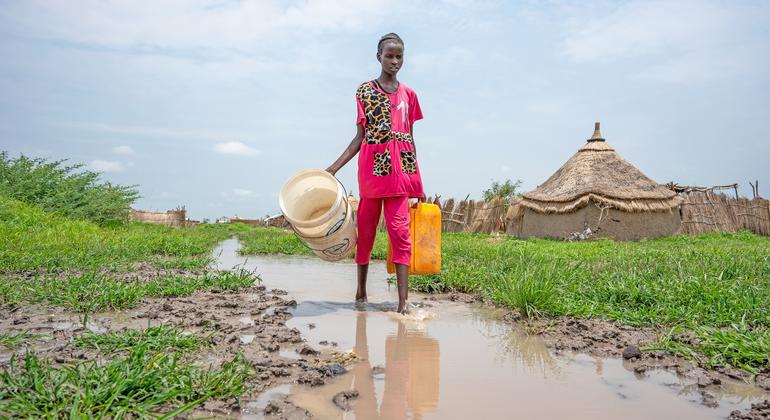
The AfDB's own social assessment is blunt: social indicators have deteriorated even as GDP growth resumed. Unemployment stands at 12.5% nationally and 18.5% among youth. Health outcomes remain poor, with high infant mortality, and inequality is described as high. The World Bank's finding that extreme poverty rose from 84% to 87% between 2024 and 2025 is attributed directly to reduced international aid flows and government wage arrears — meaning the same fiscal and humanitarian financing gaps that are squeezing the state are also squeezing households most directly. With roughly nine in ten South Sudanese now below the national poverty line, oil-driven GDP growth is, for now, doing very little to change everyday material conditions.
A Hunger Emergency Intensifies
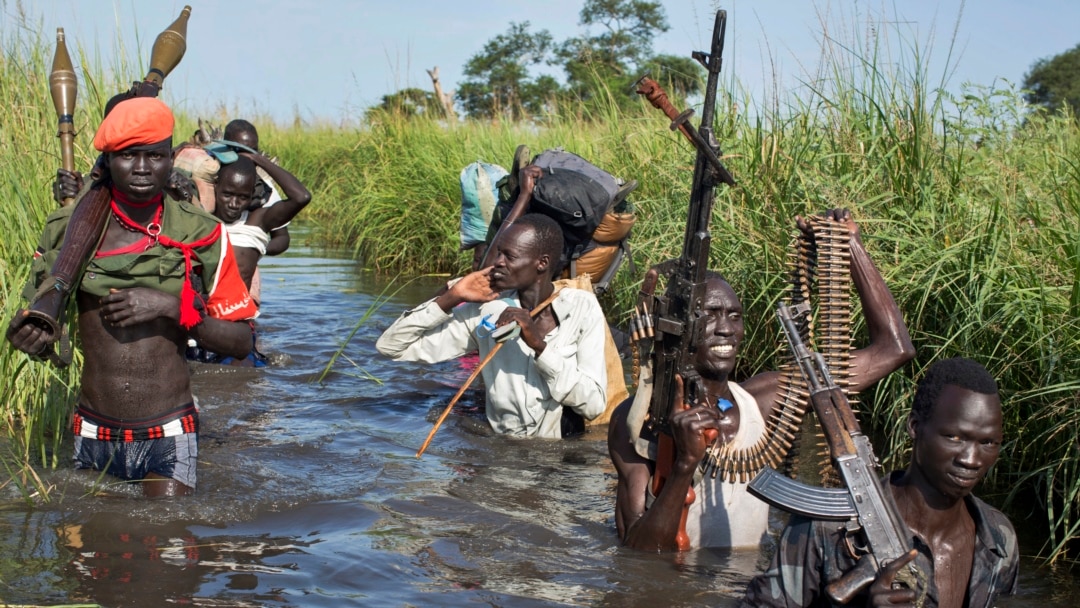
The clearest evidence of that disconnect is the food security data. The Integrated Food Security Phase Classification (IPC) projected in mid-2026 that 7.8 million people — 56% of South Sudan's population — would face high levels of acute food insecurity (IPC Phase 3 or above) between April and July 2026, one of the highest shares recorded anywhere in the world this year. Within that total, up to 73,300 people were classified in Catastrophe (IPC Phase 5), the most severe classification, a 160% increase from the previous estimate. UNICEF has reported that 2.2 million children under five are at risk of acute malnutrition, itself an increase of roughly 100,000 children over a six-month period. The crisis is concentrated in conflict-affected areas of Jonglei and Upper Nile states, where fighting has cut communities off from markets and services, compounding the effects of climate shocks and the broader economic strain from the Sudan war next door. The World Food Programme has warned of a $355 million funding shortfall for its South Sudan operations in 2026, even as it continued to reach hundreds of thousands of people monthly — nearly 875,000 in June alone — with in-kind and cash assistance.
Mobilizing Development Financing at Scale
The AfDB's 2026 Country Focus Report on South Sudan, subtitled "Mobilizing South Sudan's Development Financing at Scale in a Fragmented World," frames the core policy challenge as one of building an economy that can attract capital beyond oil. The Bank's active portfolio in the country stands at roughly $160 million, concentrated in agriculture, skills and social development, and governance. Because domestic resource mobilization is weak — hampered by a large informal economy, thin diversification, and shallow financial markets — and because equity and bond markets are largely absent, the report argues that South Sudan is unusually exposed to the global financial fragmentation and higher borrowing costs that have made external financing more expensive across the developing world. Separately, the AfDB has engaged its African Legal Support Facility to fund a one-year technical assistance project, delivered by the Johannesburg-based Centurion Law Group, to review South Sudan's oil sector laws and build the capacity of its oil sector agencies — an effort aimed at converting the current production rebound into more durable, better-governed revenue over the medium term.
Outlook and Risks
The AfDB describes its own outlook for South Sudan as "cautiously optimistic," and the arithmetic of rebounding oil exports does support a strong 2025/26 and 2026/27 on paper. But the Bank is explicit that this outlook depends on containing spillover from Sudan's civil war and on progress toward the "cessation of hostilities and inclusive political dialogue" that it identifies as prerequisites for lasting stability. Until South Sudan diversifies away from a single commodity moved through a single pipeline across an active war zone, and until fiscal gains translate into reduced arrears, restored aid flows, and functioning food and health systems, the story of 2026 is likely to remain one of two economies moving in opposite directions: a national accounts picture that looks increasingly strong, and a household economy that, for the large majority of South Sudanese, does not.
Published By | News Editor