Written By | Entertainment Desk
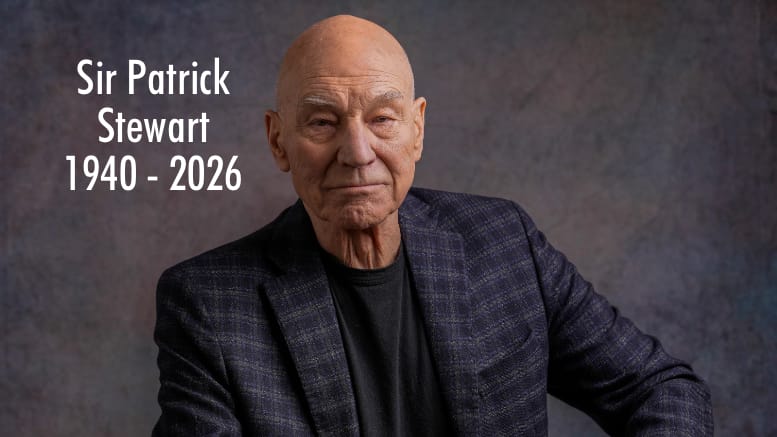
The Yorkshire-born Shakespearean who became Captain Picard and Professor Xavier had been living privately with Alzheimer's disease and Lewy body dementia, his family said.
LOS ANGELES
Sir Patrick Stewart, the actor who gave Star Trek: The Next Generation its moral compass and the X-Men films their wise, wounded father figure, has died at 86. His spokesperson confirmed the death on Thursday; according to CBS News and ABC News Australia, he died at his home in Los Angeles on Wednesday.
A statement posted to his social media channels said his death followed "a brief and poignant journey with Alzheimer's Disease and Lewy Body Dementia." It said his wife, the songwriter and singer Sunny Ozell, was at his side and that he was "held in the warm embrace of family and friends." His diagnoses had not been made public before the announcement.
From Mirfield to the Royal Shakespeare Company
Stewart's story began far from Hollywood, in Mirfield, West Yorkshire. At 12 he joined an amateur drama group, and he later won a scholarship to the Bristol Old Vic Theatre School. He spent 14 years with the Royal Shakespeare Company, playing roles that included Mark Antony, Henry IV, Shylock and Oberon.
The stage never stopped being home. His Macbeth, which travelled from Chichester to Broadway in 2008, earned him his only Tony Award nomination. He also performed a one-man adaptation of A Christmas Carol and appeared in Harold Pinter's No Man's Land and Samuel Beckett's Waiting for Godot opposite his friend Ian McKellen. The pairing of the two men, one of the great double acts in modern theater, became part of the cultural furniture, and CBS once profiled them under the title "Two Sirs."
Those years on stage explain the voice that later made audiences listen. Stewart treated verse as speech and speech as verse, a skill that carried naturally into science fiction, where invented technical language needs someone who can make it sound like conviction. Colleagues have long remarked on that discipline, and it is visible in everything from the bridge of a starship to a Broadway curtain call.
Captain Picard and the power of calm
Then came a part that changed his life. Stewart played Captain Jean-Luc Picard for seven years, across 178 episodes of Star Trek: The Next Generation and four feature films. Picard was an unlikely action hero: a diplomat and a reader of poetry, more interested in negotiation than in firepower. His catchphrase, "Make it so," became shorthand for decisive but reasoned leadership, and generations of fans took it to heart.
What made the performance endure was Stewart's insistence on dignity. He played Picard as a man who could be moved by an argument, and the series rewarded that by building some of its best episodes around talking rather than shooting. Marvel Studios and fellow Star Trek alumni have since described him in terms that echo that quality. Marvel called him "a singular talent" and "a true gentleman."
The role also reshaped what television could be. A weekly science-fiction series about a ship's crew could, in Stewart's hands, devote an hour to a legal question about whether an android had rights, or to a quiet conversation between two people who disagreed. Viewers who remember the franchise for its spectacle often recall its best moments as a face in close-up, thinking aloud.
Professor X and a second act
For a second generation of audiences, Stewart was Professor Charles Xavier in the X-Men films, the telepath who founded a school for mutants and believed in a world where they could live openly. Casting a classically trained stage actor as the movement's conscience helped lend the superhero genre credibility it did not always have in the early 2000s. It was a demonstration that a performer who had begun on Shakespeare could carry a blockbuster franchise without condescending to it.
In 2010, Queen Elizabeth knighted him at Buckingham Palace. He married Sunny Ozell in 2013. Those who followed his career will recall that he had been bald since he was 19, a feature that became part of his screen persona.
The pairing with McKellen on screen also deserves mention. The two actors, who shared stages and a famously warm friendship, were the intellectual heart of the X-Men films' Xavier-Magneto rivalry, a relationship rooted in respect between men who disagreed profoundly. That the same actors later shared a stage in Waiting for Godot, as the ABC report notes, only deepened the sense that this was one of the great working partnerships of modern performance.
The tributes
Tributes have come from across the worlds he inhabited. Hugh Jackman, William Shatner and George Takei, colleagues from X-Men and Star Trek, each paid their respects. Ian McKellen's tribute, reported by Yahoo Entertainment, described his friend as "a man to rely on, to admire and in my case, love." Parade reported McKellen's remark that Stewart "wore his heart on his sleeve."
The loss lands within days of another Star Trek death, that of co-star Walter Koenig, according to ABC News Australia. For fans of the franchise, the week has been one of unusual grief.
Why this one hits hard
There is a reason Stewart's death has prompted such widespread tributes. Few actors have been loved equally by theater audiences and genre fans. He represented a particular kind of authority in popular culture, built on intelligence and restraint rather than aggression, and he never seemed embarrassed by either the starship or the stage.
His final public chapter carries a second lesson. The family's decision to name Alzheimer's and Lewy body dementia in announcing his death is likely to prompt wider conversation about these conditions, which can affect memory, movement and attention. That is our interpretation, not something the family has said.
What this means for you
If you want to honor Stewart's legacy, the work is easy to find. The Next Generation and the X-Men films remain widely available, and his Shakespeare and Christmas Carol performances are well documented. For anyone with a family member facing dementia, the announcement may be a reason to look up local support organizations and to talk openly with relatives about care. Neither requires anything from you but attention.
A final bow
Stewart's best-known line was an order to move forward. In life he did exactly that, from a Yorkshire amateur stage to the bridge of the Enterprise, from the Royal Shakespeare Company to Broadway and back, and through a late career in which he never stopped working. He leaves behind a body of work that will keep playing for as long as there are people who still believe a captain can be gentle, and a leader can be kind.



