Written By |

Justice Celia Nagawa of the High Court’s Family Division ruled in favor of Lugwaro
By Our Reporter
In a significant ruling, a court in Uganda has granted a woman in Ssenge, Wakiso district, the right to share property with her long-term cohabiting partner, igniting a nationwide discussion on the property rights of cohabiting couples. Brenda Aber Lugwaro and her partner, Edward Karema, began their relationship in 2011, moving into the house in question and raising four children together. Despite their deep bond, the couple never formalized their union, opting instead for cohabitation.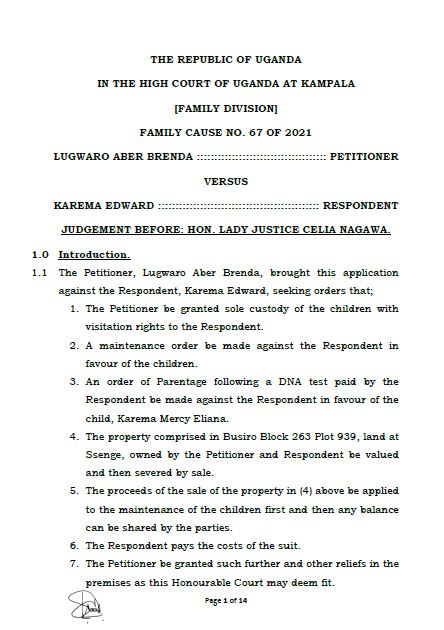
The petition documents
Court documents reveal that the couple cohabited for years, with Lugwaro accusing Karema of abandoning her and their children in 2016, leaving her to fend for the family. Lugwaro remained in their home until 2020, when the COVID-19 pandemic prevented her from returning home due to lockdown restrictions. When the restrictions were lifted, Lugwaro attempted to return to their home, only to find herself denied access by Karema. After seeking help from local authorities, who initially ruled that both parties should have access to the house, Karema continued to bar her from the property and even denied paternity of their youngest child. This led Lugwaro to seek legal redress from the Family Court Division in Makindye, Kampala.
Court’s Decision
Justice Celia Nagawa of the High Court’s Family Division ruled in favor of Lugwaro, ordering the sale of the house and directing that the proceeds be equally shared between the two parties. The judgment was delivered earlier this week. Justice Nagawa adopted a liberal interpretation of property rights, bypassing the strict marriage laws to accommodate the realities of cohabiting couples. Lugwaro had filed a petition seeking the sale of the house they once shared, arguing that they had jointly acquired the property and that Karema had denied her access to it. The property in question is located in Busiro Block 263 Plot 939 in Ssenge, Wakiso district. The case proceeded ex parte, meaning it was decided without Karema’s defense, as he did not file a response.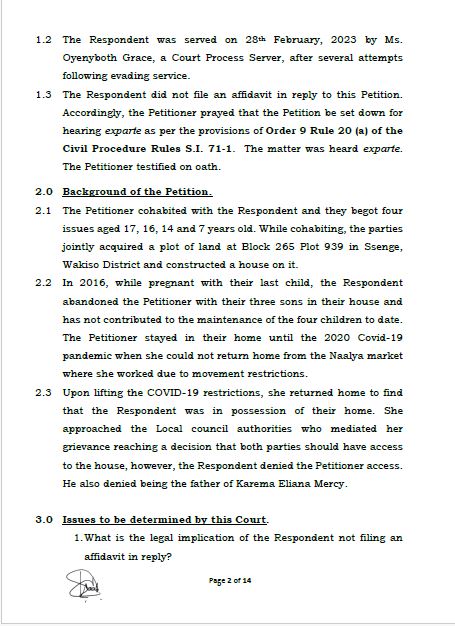
Local authorities in Ssenge noted that Karema’s main argument was that Lugwaro did not contribute financially to the construction of the house. However, Justice Nagawa ruled that Lugwaro was entitled to 50% of the proceeds from the sale of the property, as the certificate of title indicated joint tenancy.
“The petitioner (Lugwaro) and the respondent (Karema) shall both be entitled to 50% of the proceeds from the sale of the property,” Justice Nagawa ordered.
In addition, the judge directed that 10% of Karema’s share of the proceeds be awarded to Lugwaro as compensation for rental payments and displacement from their joint property over the past three and a half years. This means Karema will only receive 40% of the proceeds after the sale.
The judge referenced a 2015 case, Zachary Olum versus Bongomin Odara, where the court recognized two forms of partition of joint property: physical division and partition by sale. She emphasized that both parties had equal rights to the property, including the right to access and share in any sale proceeds.
Given Karema’s denial of paternity for one of the children, Justice Nagawa ordered a DNA test to be conducted at the Government Analytical Laboratory in Wandegeya within seven days to determine the issue of maintenance and custody. If the DNA results confirm paternity, Karema will be required to contribute 80% of the children’s school fees and 50% towards their accommodation and medical care, while Lugwaro will cover their food and clothing.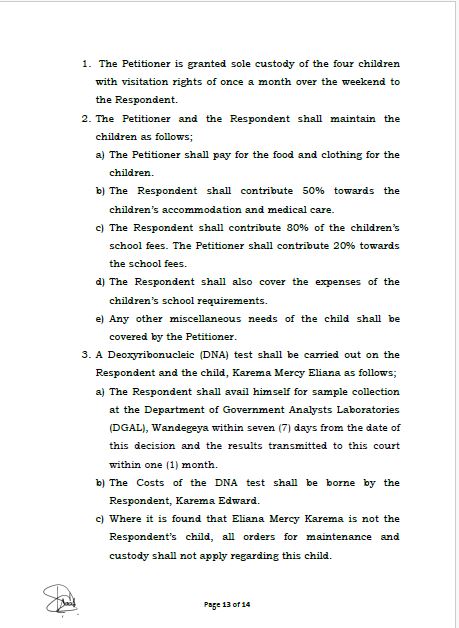
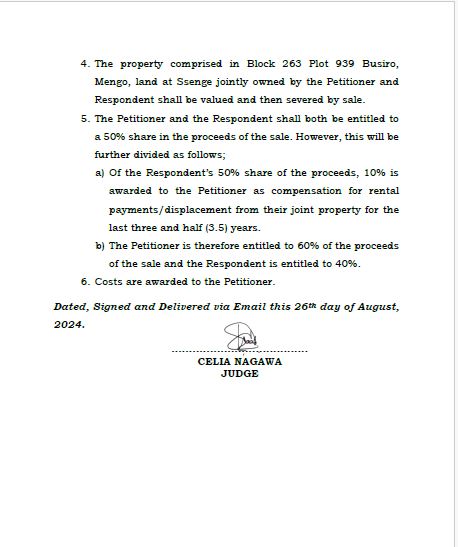
Ruling documents signed by Celia Nagawa
Cohabitation in Uganda
Cohabitation is not recognized as a form of marriage in Uganda, regardless of the length of the relationship or the presence of children. Courts have historically held that cohabiting couples cannot seek remedies under matrimonial property laws unless they can prove financial contribution or joint ownership of disputed property. However, in some cases, such as Moses Kigongo versus Olive Kigongo, courts have granted property rights to cohabitees based on the duration of the relationship and the assumption that the couple was married. In this case, the court ruled that equity favored the defendant, who had lived with the plaintiff for 26 years and shared the property as their marital home. While the Supreme Court has reserved the equitable distribution of property for legally married couples, some judges continue to invoke the doctrine of constructive marriage for long-term cohabiting partners who have not legally married or jointly owned property.
This ruling is likely to have a lasting impact on the legal landscape for cohabiting couples in Uganda, setting a precedent for future cases involving property disputes between partners who are not legally married.
Source: Uganda Legal Information Institute (https:/ulii.org) https:/ulii.org>akn>judgment>ughcfd>source
Torch Media Africa



