Written By | Health News Agencies
The first imported case in East Africa's biggest city lands as Congo's Bundibugyo outbreak tops 8,700 confirmed cases and 4,200 deaths – with no licensed vaccine and no approved cure
HEALTH NEWS
It was a Saturday afternoon when a sick man stepped off a flight into Nairobi. By the following Tuesday, he was dead, buried under strict safety rules, and Kenya had joined the grim list of countries touched by one of the deadliest Ebola outbreaks in modern history.
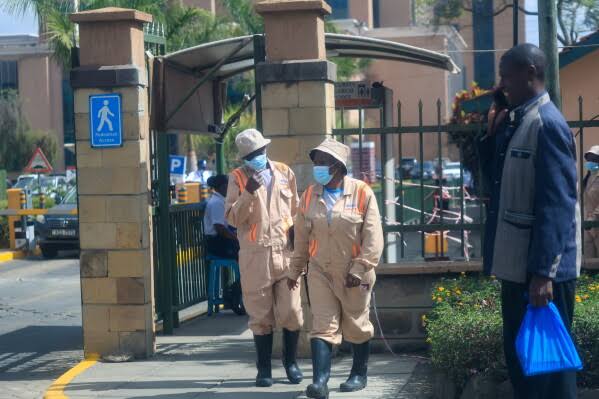
The patient, a Kenyan citizen who had lived in the Democratic Republic of Congo for roughly seven years, had fallen ill about a month before he came home. He had been treated at a string of hospitals in Congo. Then, according to reports, he travelled by road to Kampala in Uganda and boarded a flight to the Kenyan capital, arriving on Saturday 3 October. His relatives drove him straight to Nairobi Hospital, where staff isolated him immediately. On Monday he tested positive for Ebola. He died the same day, and on Tuesday 6 October Health Minister Aden Duale told the nation what everyone had feared: Kenya had its first confirmed case.
Kenya's government was quick to stress that this is not a Kenyan outbreak. Mr Duale said the case was imported. But for a country that has never before recorded an Ebola outbreak, the news sent a shiver through a region already on edge.
The race to find everyone he touched
Within hours, health teams began the painstaking detective work that decides whether a single case stays a single case. Officials have identified 28 contacts – relatives and the health workers who cared for him. All of them are being isolated for 21 days, the full incubation window for Ebola, and will only be released after testing negative.
The net is wider than the hospital. Authorities are also tracing 23 other passengers and four crew members who shared the flight from Uganda. Ministry of Health Director-General Dr Patrick Amoth confirmed the 21-day isolation rule for contacts. Border points have been placed on high alert.
The burial, too, was handled with care. Ebola victims remain highly infectious after death, and unsafe funerals have driven transmission in earlier outbreaks. The man was buried on Tuesday afternoon under public-safety protocols.
Kenya says it was not caught flat-footed. Since the Congo outbreak began in May, laboratories in the country have tested 267 samples at five labs. Every one came back negative until this patient. The World Health Organization says it is working with Nairobi and has delivered about 1,000 Ebola tests and 1,000 personal protective equipment kits to high-risk counties. Africa CDC praised the "rapid identification, isolation and testing of the patient" and has sent a high-level team to help.
Not just any Ebola
Most people know the Zaire strain of Ebola, the one behind the 2014–2016 West African catastrophe. This outbreak is different. It is caused by Bundibugyo virus, a rarer relative of Zaire. And that matters enormously, because the tools that tamed Zaire do not officially exist for Bundibugyo.
There is no licensed vaccine and no specific treatment approved for Bundibugyo virus disease. Doctors in the field are largely limited to supportive care: fluids, treating complications and isolating the sick.
The numbers are staggering. The European Centre for Disease Prevention and Control (ECDC), in its week 41 report, says that as of 7 October the DRC had reported 8,728 confirmed cases and 4,205 deaths. In that single reporting period alone, 63 new cases (33 in Ituri, 30 in North Kivu) and 27 deaths were added. Some 1,066 patients are in isolation in hospital and 2,269 people have recovered. Seven provinces are affected, and 64 of the country's 167 health zones have been hit. Ituri province, where the outbreak began, remains the heart of it, with 6,513 cases and 3,007 deaths, followed by North Kivu with 1,785 cases and 1,021 deaths, and Haut-Uélé with 364 cases and 153 deaths.
How it began
On 5 May 2026, the WHO received an alert about an "unknown illness with high mortality" in the Mongbwalu Health Zone of Ituri province. Four health workers had died within four days. On 15 May, the Institut National de la Recherche Biomédicale in Kinshasa confirmed Bundibugyo virus disease, and the same day the DRC declared its 17th Ebola outbreak. Uganda confirmed two imported cases on 15 and 16 May.
The alarm escalated fast. The WHO Director-General determined the outbreak to be a Public Health Emergency of International Concern, the organisation's highest alert, in mid-May (the ECDC lists the date as 17 May; WHO's own situation report summary gives 16 May). Africa CDC declared a Public Health Emergency of Continental Security on 18 May. The WHO has said it believes the virus may have been spreading as early as late January – months before anyone knew.
Uganda ultimately reported 20 cases between May and June before the WHO declared its outbreak over in late August. Imported or evacuated cases have also turned up in Europe. France reported a doctor with a positive case in June, Germany received a US citizen in July, the Netherlands received a healthcare worker on 1 October, and the UK isolated a precautionary case in July. With Kenya, the outbreak has now reached a fourth country with a case, according to the Associated Press.
"Like fighting a megafire"
Doctors Without Borders (MSF) has described the response as "like fighting a megafire," warning that multiple outbreaks are developing at the same time. The ECDC went further, stating in its report that "it is likely that the outbreak is larger than is currently being reported."
That is the nightmare scenario for public health teams: a virus spreading faster than the surveillance system built to track it, across a region of conflict and displacement where health workers are targets for infection themselves. The original alert, after all, came because four health workers had already died.
The vaccine question
There is hope, but it is cautious. The WHO has said efficacy trials for three candidate vaccines against Bundibugyo should start in the DRC in October or November. Two candidates, one from Moderna using mRNA technology and one from the University of Oxford, have been in safety trials in the UK and Canada.
In the meantime, the WHO and its vaccine advisers have proposed using Merck's Ervebo – licensed against the Zaire strain – only within a research protocol, to test whether it offers cross-protection. Early data, mostly from animal studies, suggests it might. A batch of 16,250 doses arrived in July, and a vaccination campaign for frontline workers began in Kisangani, in Tshopo province, with further doses given in the epicentre in recent weeks. WHO chief Tedros Adhanom Ghebreyesus has been blunt about the limits: "we not know whether it is effective against Bundibugyo." WHO vaccines chief Kate O'Brien has said Ervebo, being already licensed, will "probably" be the first vaccine in the trial.
Until the data are in, nobody can promise the shots work. That is why isolation, contact tracing and safe burials remain the front line – and why Kenya's quick action on its single case matters so much.
What the experts are saying
Official assessments paint a picture of high concern for Africa and low concern for the rest of the world. The WHO has warned that neighbouring countries face a high risk of spread. For Europe, the ECDC rates the risk as low for EU/EEA residents travelling to affected areas and very low for people living in the EU/EEA. Kenya's case, identified at a private hospital within hours of arrival, is being held up by the Africa CDC as a model of how quickly a suspected case should be isolated and tested.
The concern, health authorities note, is not one patient but the pattern. The man lived in Congo for years, was sick for weeks while moving through hospitals, and then crossed a border by road and a second by air. Every extra day of travel multiplies the number of people who might have been exposed.
What this means for you
If you live in Kenya, Uganda, Rwanda, Tanzania, South Sudan or another neighbouring country, the advice is practical: follow your health ministry's guidance, report fever with bleeding, vomiting or severe weakness quickly, avoid contact with the body fluids of anyone who is ill, and never take part in unsafe burial practices.
If you live in Europe or North America, the official risk is very low. Ebola does not spread through the air like flu or measles; it requires direct contact with the body fluids of a symptomatic person, or of someone who has died of the disease. Travellers returning from affected regions who develop a fever within 21 days should call ahead to a healthcare provider and mention their travel history instead of simply walking into a waiting room.
If you are planning travel to eastern DRC, check your government's travel advice first; many countries advise against non-essential travel to the affected provinces.
The next 21 days
For Kenya, the coming three weeks are the test. If none of the 28 contacts and none of the passengers traced from the Uganda flight develops symptoms in that window, the country will have contained its first Ebola case without onward spread – a significant public-health win. If even one tests positive, the story changes overnight.
For the Congo, the challenge is far larger. With 8,728 confirmed cases and more than 4,200 deaths, an outbreak declared in May is still adding dozens of confirmed cases every reporting period, and officials say the true figure is probably higher. The first Bundibugyo vaccine trials could change the course of the epidemic, but not before November at the earliest.
One sick man on one plane has reminded the world that in an age of cheap flights and porous borders, an outbreak in the heart of Africa is never only Africa's problem. Nairobi is waiting – and so is everyone else.



