Written By | International News Agencies
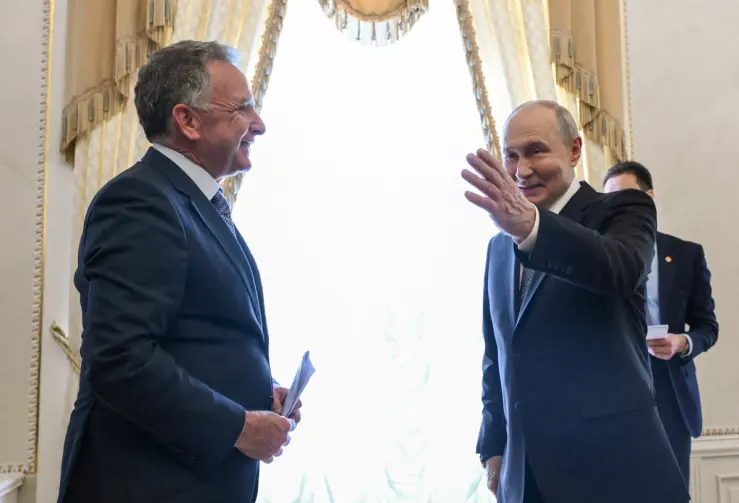
Putin agreed in principle to resume U.S.-brokered trilateral talks with Ukraine, possibly as soon as early to mid-November.
World Politics
Overview
On October 21, U.S. special envoy Steve Witkoff sat down with Russian President Vladimir Putin in St. Petersburg for roughly three hours and left with two concrete results and one political disaster. Putin agreed in principle to resume U.S.-brokered trilateral talks with Ukraine, possibly as soon as early to mid-November. Russia also released Stephen Hubbard, a 74-year-old American who had been held since he was captured in eastern Ukraine in April 2022. The disaster was self-inflicted: Witkoff told Putin, "You talk so much about my president, President Trump, being a humanitarian. You are a humanitarian also, sir, and I salute that." Within hours, senators from both parties were condemning the remark, while Russian missiles and drones were again striking Kyiv and a dozen other Ukrainian regions.
The episode compresses almost every tension in the current phase of the war: a Trump administration eager to show momentum toward a settlement, a Kremlin that treats diplomacy as a way to extract concessions from Kyiv rather than to end the fighting, a Ukrainian government fearful of being negotiated over rather than negotiated with, and a Congress in which Republican skepticism of Moscow has not disappeared even as the White House softens its tone. Reporting from Axios, CBS News and Democracy Now was used for this account; where outlets differ, the differences are noted.
Background: A Month of Mixed Signals
The meeting did not occur in a vacuum. On October 9, Trump and Putin spoke by phone, and the following day Trump confirmed a deal allowing Russian diesel to reach markets under a sanctions waiver, a move the White House justified as a way to ease U.S. fuel prices that have been inflated by the conflict around the Strait of Hormuz. On October 10, Trump said it was "time for Ukraine to get a new president," blaming Ukrainian drone strikes on Russian refineries. President Volodymyr Zelenskyy called the diesel arrangement a gift to Putin and a sign of weakness. Days later he told NPR that Washington had warned it could curtail intelligence sharing unless the refinery strikes stopped, and Ukrainian commanders reported that a speed cap on military Starlink service had grounded some long-range drones.
Against that backdrop, European leaders were attempting to build a unified position. A European Council meeting in mid-October ended without a decision on new money for Ukraine, and on October 20 Zelenskyy met Nordic leaders and European and NATO representatives in Oslo to work on a common "framework agreement" to end the war. Putin's adviser Yuri Ushakov would later say that the Oslo discussions contained little of use, a dismissal that tells us how Moscow views any proposal that originates with Kyiv or its European backers. The Witkoff trip to St. Petersburg therefore arrived at a moment when Washington's channel to Moscow was the most active diplomatic track, and when Europe and Ukraine feared it would run ahead of them.
Key Developments in St. Petersburg
According to Axios, Witkoff presented an updated proposal to end the war and asked Putin to review several documents on settlement approaches; Trump adviser Jared Kushner joined the session virtually. Ushakov told reporters that Putin "agrees in principle" to resume trilateral talks among Russia, Ukraine and the United States, and that Moscow could be ready around November 10, possibly in Abu Dhabi. CBS News reported that a U.S. official described the resumed talks as technical-level, and that Ushakov spoke of an early-November restart with a discussion of a post-war security system. Democracy Now noted that they would be the first such talks since February. The precise date and venue are therefore not settled, and the sources differ slightly on timing.
The Kremlin was careful to temper expectations. Spokesman Dmitry Peskov said Moscow would study the proposals Witkoff brought but that the process would take a long time. CBS reported that Russian officials said a negotiated resolution is "theoretically possible" but that Ukraine must make "necessary decisions," and that its situation "will be worse" if it does not. Ushakov described the proposals, which he attributed to Ukraine and the European Union, as containing little that was useful. In other words, Moscow agreed to talk while signaling that it regards the existing Ukrainian and European positions as non-starters.
Two further threads emerged. Putin reportedly raised the possibility of Russia acting as a mediator between the United States and Iran, a notable offer given the escalating confrontation in the Gulf, and he again floated the idea of a Trump meeting in China in mid-November. That echoes a proposal reported earlier in the week by the Wall Street Journal for a Trump-Putin-Xi summit on the sidelines of the APEC gathering in Shenzhen, an idea Ukraine resists because it would place Kyiv outside the room. Russian officials told reporters such a meeting is possible.
The prisoner release was the tangible deliverable. Hubbard, who had been in Russian custody for more than four years, was freed. Trump said no prisoner swap took place and that the United States gave nothing in return, though CBS reported that he also tied the release to Washington's decision to block new sanctions on Moscow, which is not quite the same as nothing. Russian state media reported that the first shipment of diesel under the October waiver was dispatched on Wednesday, so the diplomatic atmosphere and the economic concessions have moved in tandem.
The "Humanitarian" Remark and the Backlash
Witkoff's toast to Putin was the story's ignition point. Senator Thom Tillis, a Republican from North Carolina, responded with the abbreviation "WTF, Steve?" and later called the comment "embarrassing and outrageous," urging Witkoff to ask the families of children Ukraine says Russia has abducted whether they consider Putin a humanitarian. Republican Senator John Cornyn of Texas wrote that Putin is a "stone cold killer." Democratic Senator Mark Kelly of Arizona asked in what world Putin is a humanitarian and called him a war criminal. Democracy Now described the outrage as bipartisan, which in this case is an accurate description of what was visible on social media rather than of any formal congressional action.
The White House defended its envoy. Vice President JD Vance said he agreed with "saying something nice to a person who just released an American hostage." Trump, asked about it, said "I guess you could say for that particular purpose" that Putin is a humanitarian. The defense is revealing: it frames the remark as a courtesy extended in exchange for a freed citizen, not as a judgment on Russia's conduct of the war. Critics counter that the optics matter in a conflict where Russian strikes on civilians continue, and that praising Putin at the very moment he was negotiating undercuts the leverage the United States would need to extract compromises.
The timing made it worse. Hours after the meeting, Russian drones and ballistic missiles hit 12 Ukrainian regions, including Kyiv, where at least two people were killed and 22 wounded, according to Democracy Now. Other outlets cited slightly different casualty totals across the country, which is common in the first hours of a strike. Russian officials said Ukraine in turn launched hundreds of drones at Moscow and other regions, wounding two people. Neither side showed any sign of pausing operations in anticipation of the new diplomacy.
Reactions From Kyiv and Europe
Zelenskyy has said the most useful next step would be a trilateral meeting with Putin and Trump, a format Russia has so far rejected. As reported by CBS, he also rejected any deal crafted by China, Russia and the United States without Ukraine, said any agreement would require the approval of Ukraine's parliament, and thanked Washington for restoring U.S. intelligence on Russian strikes while noting that access to Starshield satellite data remains limited. He told allies he wants negotiators from all three sides to meet by early November.
The Starlink dispute illustrates why Kyiv is wary. The Wall Street Journal reported that Trump asked Elon Musk to lift restrictions on Starlink use in Ukraine, and Ukrainian officials say service has improved but is not fully restored. A Ukrainian commander separately said dozens of armed drones lost their video feeds at once, reportedly connected to Starlink or Starshield. The upshot is that Ukraine's battlefield capacity is partly dependent on decisions made in Washington and by private companies, which compounds the sense that Ukraine is negotiating from a position of dependency.
European governments, for their part, have been trying to stay relevant. The same week brought news that Ukraine can now buy arms through NATO's centralized procurement agency, and Secretary of State Marco Rubio remarked that Ukraine "would not exist" without American backing, a comment that Kyiv's supporters read as both a reminder of American leverage and a warning.
What Is Contested and What Is Unknown
Several points deserve caution. First, "agreement in principle" is a diplomatic phrase that commits Russia to little. Ushakov's dates are conditional, and the Kremlin has offered no indication that it will move from its core demands. Second, the content of the proposals Witkoff carried is not public. Ushakov attributed them to Ukraine and the EU, but the Oslo framework was drafted by European and Nordic participants, and it is unclear how much of it the U.S. envoy actually pressed in St. Petersburg. Third, the Hubbard release is described in different ways: Trump says there was no swap and nothing was given, while he also ties the release to Washington's sanctions restraint. Finally, whether the sequence of diesel waivers, blocked sanctions and a freed prisoner constitutes a coherent strategy or a series of unreciprocated concessions is the central question of the current debate.
What Comes Next
The most immediate test is whether technical-level trilateral talks actually convene in the first half of November, and whether Ukraine attends on terms it can accept. The Shenzhen APEC meeting on November 18 and 19 is the next potential flashpoint, since a Trump-Putin-Xi encounter would crystallize European fears of a settlement shaped over Kyiv's head. Congress is another variable. Republican senators who rarely criticize the president on foreign policy have shown they are willing to speak out when the language used about Putin crosses a line, and a bipartisan group of senators had already written against the easing of diesel sanctions. If the administration moves toward broader sanctions relief, that resistance could harden into legislative action.
On the ground, the war will not wait for diplomacy. Russia is intensifying strikes on Ukrainian energy and cities heading into winter, Ukraine is hitting Russian refineries and reaching Moscow with drones, and both sides will seek leverage before any table is set. For Trump, who is also confronting low approval ratings two weeks before the midterms and a deteriorating situation in the Gulf, a visible diplomatic opening on Ukraine has obvious appeal. For Putin, the invitation to talk costs little and may buy further relief. For Zelenskyy, the danger is that the process advances faster than the guarantees he needs. The word "humanitarian" will fade, but the question it raised, about what the United States is prepared to give a leader who continues to bomb Ukrainian cities, will not.



