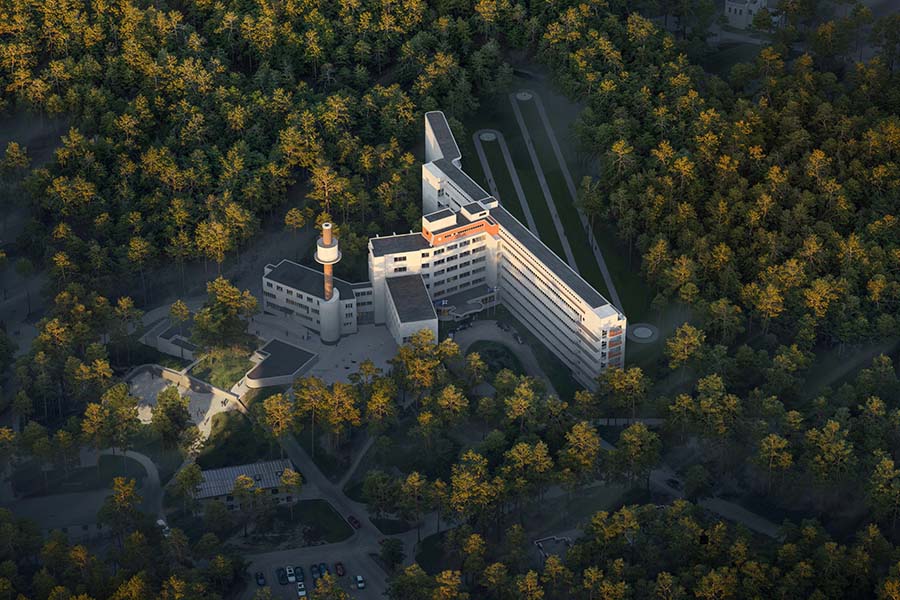
As UNESCO weighs World Heritage status for Alvar and Aino Aalto's Paimio Sanatorium, Snøhetta unveils a masterplan reimagining the modernist landmark as a hotel, cultural hub, and site for global diplomacy.
Paimio, Finland
Few buildings in the history of modern architecture carry as much quiet emotional weight as the Paimio Sanatorium. Designed by the Finnish husband-and-wife team Aino and Alvar Aalto and completed in 1933, the sprawling forest campus was conceived not just as a hospital but as a machine for healing — every handrail, window angle, and wall color engineered to comfort tuberculosis patients in an era before antibiotics existed to cure them. Nearly a century later, as Finland awaits a landmark UNESCO World Heritage decision this month, Norwegian architecture firm Snøhetta has unveiled an ambitious masterplan to give the complex an entirely new life.
From Hospital to Wellness Destination
Snøhetta's vision, developed with Helsinki-based ALA Architects and Mustonen Architects, reimagines Paimio as a hybrid destination combining hospitality, wellness, and cultural programming. The former patients' rooms — famously designed with two-tone ceilings and specially angled sinks meant to minimize noise and discomfort for bedridden residents — will be converted into a high-end hotel. Crucially, the plan keeps the grounds and communal spaces open to day visitors, students, and the local community rather than sealing the site off behind a resort's gates.
Perhaps the most striking element of the proposal is the transformation of the former surgery wing into a flexible, two-story auditorium capable of holding up to 200 people, clad in a birch-slatted wall that echoes the Aaltos' signature material language. The space is designed for both acoustic performances and, notably, technical installations — part of a broader ambition to position the isolated, highly secure campus as a venue for what the design team describes as “soft diplomacy” summits among global leaders.
A UNESCO Decision Hangs in the Balance
The masterplan's unveiling is no coincidence of timing. Paimio Sanatorium was added to UNESCO's tentative World Heritage list back in 2004 as part of the “Aalto Works” nomination, a serial listing spanning thirteen sites tied to the architect's body of work across Finland. A final decision on that nomination is expected this month, and Paimio's role as the flagship, most architecturally significant site in the group means a great deal is riding on how convincingly its future can be secured. Observers close to the process have noted that a stumble at Paimio — whether financial or preservation-related — could jeopardize the prospects of the entire thirteen-site Aalto Works nomination.
That backdrop helps explain the scale of investment behind the project: the revitalization plan calls for an estimated €30 million in private capital, layered on top of a €10 million grant already committed by the Finnish government. It's an unusually large sum for a single heritage-adjacent adaptive reuse project, reflecting both the building's cultural stature and the complexity of retrofitting a century-old medical facility, originally built for a single narrow purpose, into a multi-use public destination without compromising its protected status under Finland's 1993 Building Protection Act.

Design Philosophy: Healing, Then and Now
“The Aaltos designed Paimio around the idea that architecture itself could heal,” project architects have said of the masterplan's guiding logic. “Our task isn't to reinvent that principle — it's to find its next application.”
That continuity of purpose is central to how Snøhetta has framed the project publicly: less a renovation than a reinterpretation. Where the original building used light, air, and color as medical tools against tuberculosis, the new program aims to use the same architectural vocabulary — abundant daylight, forest views, deliberate quiet — in service of contemporary wellness culture, an industry that has exploded globally in the years since the pandemic reshaped how travelers think about rest, recovery, and mental health.
The approach also fits a broader pattern in contemporary architecture: adaptive reuse of mid-century modernist landmarks, once threatened with demolition or neglect, being reborn as boutique hospitality destinations. It's a model that has proven both commercially viable and reputationally safe for heritage sites elsewhere in Europe, offering a template Finland's cultural authorities appear eager to replicate at Paimio.
The Stakes for Finnish Design Heritage
Alvar Aalto remains arguably the single most influential figure in Finnish design history, his fingerprints visible everywhere from furniture still in mass production today to civic buildings across Scandinavia. Paimio's fate is being watched closely not just by preservationists but by the broader Finnish design and tourism industries, for whom Aalto's name functions as a kind of cultural export brand in its own right. A successful UNESCO listing, paired with a well-executed adaptive reuse, would give Finland a marquee architectural destination to rival heritage sites that have long drawn design pilgrims to Italy, France, and Germany.
The project also arrives at a moment when European governments are increasingly willing to underwrite ambitious heritage-to-hospitality conversions as tools of cultural diplomacy and tourism strategy, rather than treating protected buildings purely as static museum pieces. Paimio, if the plan succeeds, would become a test case for how far that philosophy can be pushed on a site of genuine, unimpeachable historical importance — one that spent its original decades treating the sickest patients in Finnish society, not hosting paying guests.
What This Means for You
Design and architecture travelers should take note: if the UNESCO listing is confirmed and funding materializes on schedule, Paimio is positioned to become one of the more significant new wellness-and-culture destinations in Northern Europe over the next several years, joining a growing circuit of architecturally significant hotels that double as pilgrimage sites for design enthusiasts. Even before the hotel phase is complete, the grounds remain open to visitors curious to see one of modernism's most influential — and most humane — buildings in person.
Conclusion
Whatever UNESCO decides this month, Snøhetta's masterplan makes a compelling case that Paimio Sanatorium's next chapter can honor its original mission without freezing it in amber. A building once devoted to curing the body is being reimagined for an age preoccupied with restoring the mind — proof that even architecture built for a single, urgent purpose can find new relevance a century on, provided its stewards are willing to take a considered risk on reinvention.
Published By | Features Editor