Written By | Fashion and Design Desk
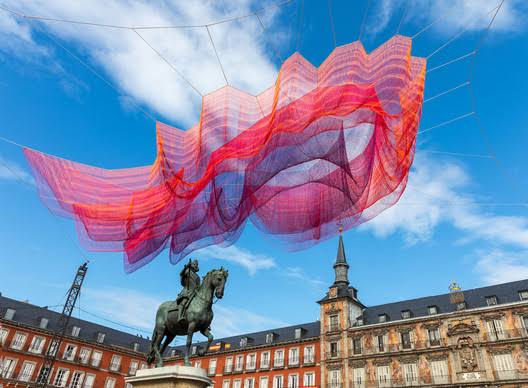
Artist Janet Echelman's monumental net sculpture now floats above one of the city's most contested public squares — the centerpiece of Germany's year as World Design Capital
FRANKFURT
Above the Konstablerwache, one of this city's busiest and most argued-over public squares, something extraordinary now hangs in the air. Suspended between buildings, catching wind and streetlight in equal measure, "A Sky Full of Hope – Earthtime 1.78 Frankfurt" opened to the public on the night of August 11, the latest and most ambitious work yet from American artist Janet Echelman — and the signature commission of Frankfurt RheinMain's year-long reign as World Design Capital 2026.
For a city that has spent years debating what to do with a square long associated more with transience and tension than civic pride, the arrival of a monumental, constantly shifting piece of public art carries a weight well beyond aesthetics.
Engineering that behaves like weather
Echelman has spent more than two decades building a reputation as one of the world's foremost creators of what she calls "aerial sculptures" — vast, gossamer-thin net structures suspended high above public spaces, engineered to move continuously with wind and to transform in appearance as ambient light shifts across the day and night. "A Sky Full of Hope" continues that practice at extraordinary scale, using centuries-old fiber-knotting techniques fused with twenty-first-century digital modeling and aerospace-grade materials, including exceptionally strong but lightweight PTFE and UHMWPE polymers more commonly associated with high-performance engineering than with sculpture.
The result is a work that resists ever being fully photographed the same way twice. As Echelman put it in a recent interview: "My approach to public space is to direct the gaze upward to the sky and let nature be the life-giving force of my work. It constantly changes and is more interesting than any pattern I could design." It is a description that doubles as an artistic philosophy — Echelman has built her entire practice around ceding a measure of authorial control to wind currents and daylight, treating the surrounding atmosphere as an active collaborator rather than a passive backdrop.
A title with a number that means something
The piece's full title carries a specific, deliberate meaning. "Earthtime" is the name of the ongoing series Echelman has developed exploring global interconnectedness — the idea, as she has described it elsewhere, that changes in one place inevitably ripple outward and affect others. The "1.78" in this installation's name refers to the 178 nations represented among Frankfurt's residents, a statistic city officials cite often and with evident pride, and one that speaks directly to the diversity Frankfurt has built much of its contemporary civic identity around. The work's full name — "A Sky Full of Hope" — was chosen to symbolize openness, international solidarity, cooperation, and adaptability, themes that map closely onto Frankfurt's own self-conception as a genuinely international, financially cosmopolitan city functioning at the geographic center of Europe.
The installation was formally commissioned by the City of Frankfurt's Department of Culture and Science specifically for the World Design Capital year, and its August 11 opening — attended by Mayor Mike Josef and Head of Cultural Affairs Dr. Ina Hartwig alongside Echelman herself — was treated as one of the year's marquee civic events, drawing crowds who gathered in the square well past dark simply to watch the structure catch the evening light.
Design for democracy
Echelman's sculpture is the most visually striking single work of Frankfurt RheinMain's World Design Capital year, but it is far from the only initiative underway. The designation, awarded by the World Design Organization and held this year by the greater Frankfurt region, centers on the theme "Design for democracy: Atmospheres for a better life" — an intentionally broad framing that has allowed organizers to fold in everything from urban planning interventions and civic infrastructure projects to public art commissions like Echelman's own.
The choice of theme is notable for how directly it politicizes what might otherwise be treated as a purely aesthetic designation. Rather than showcasing design as a matter of consumer objects or architectural novelty, Frankfurt's program has framed the discipline explicitly as a civic tool — one capable of shaping how a diverse, sometimes fractious urban population experiences shared public space. The choice of the Konstablerwache as the site for the year's most visible commission was itself a statement: the square has long been a flashpoint for competing uses and constituencies, and organizers have been explicit that placing "A Sky Full of Hope" directly above it was meant to reclaim contested ground through shared, non-partisan wonder rather than redevelopment or policing.
Why a suspended net sculpture matters to design, not just art
It would be easy to file Echelman's work under public art and move on, but its selection as the centerpiece of a World Design Capital year is a deliberate statement about where the design world's attention is currently turning. Increasingly, design institutions internationally have been elevating projects that treat public space itself as the primary design object — prioritizing how infrastructure, materials, and civic commissions shape lived experience over more traditional showcases of consumer products or architectural monuments. Echelman's sculpture, engineered with the same rigor as aerospace hardware yet entirely dependent on unpredictable natural forces for its final appearance, embodies that shift about as literally as a single artwork can: a piece of advanced material science handed over, deliberately, to the whims of wind and weather.
What this means for visitors and for Frankfurt
For travelers planning a visit to the region this year, "A Sky Full of Hope" is likely to become one of the signature reasons to route a European itinerary through Frankfurt specifically — a free, ever-changing public artwork visible at all hours, with no ticket or reservation required, situated in the heart of a city center many visitors have historically treated as a transit stop en route to other German destinations rather than a cultural endpoint in its own right.
For Frankfurt itself, the sculpture's success will likely be measured less in tourism numbers than in something harder to quantify: whether a genuinely contested civic square can be reshaped, even temporarily, into a site of shared civic pride simply by directing everyone's attention upward at once. Early crowds gathering nightly beneath the installation suggest, at minimum, that the city has found something Frankfurt residents of wildly different backgrounds are willing to stop and look at together.
"A Sky Full of Hope – Earthtime 1.78 Frankfurt" remains on view above the Konstablerwache throughout Frankfurt RheinMain's World Design Capital year, with public artist talks continuing to be scheduled through the German Design Council.



