MIAMI GARDENS, Florida
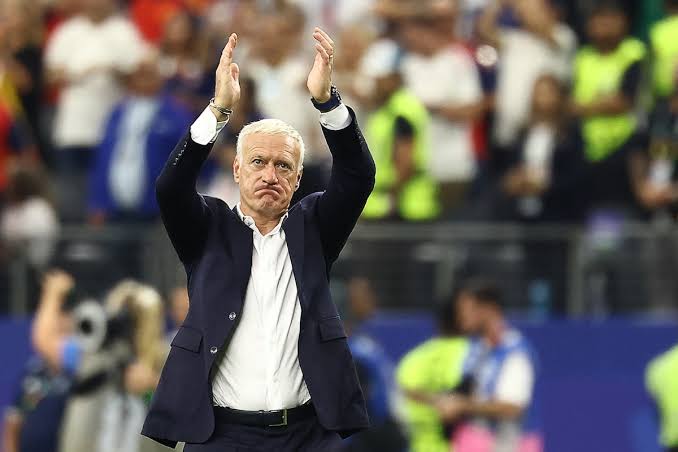
There will be no trophy at the end of this one, no open-top bus down the Champs-Élysées, no anthem blaring over a sea of blue, white, and red flares. And yet when Didier Deschamps walks out of the tunnel at Hard Rock Stadium on Saturday for France's World Cup third-place playoff against England, it will be one of the most quietly momentous nights in the history of French football — the last time the most successful manager the country has ever produced will patrol the touchline for Les Bleus.
Deschamps' France arrived in North America as one of the tournament favorites, riding a wave of swaggering, attacking football that had many pundits penciling them in for a third World Cup final in three cycles. That version of the dream ended in Arlington, Texas, where a clinical Spain side dealt Les Bleus a sobering 2-0 semifinal defeat, denying Deschamps a fairy-tale send-off and instead consigning him to the indignity — however dignified he'll try to make it look — of a playoff for the bronze medal.
It is a script no one in the French camp wanted, least of all Deschamps himself, who has been careful all tournament not to let the noise around his departure become a distraction. But the noise has been impossible to fully silence. Saturday's meeting with England will be Deschamps' 27th World Cup match as head coach, a new record that pulls him clear of Brazil's Carlos Alberto Parreira and West Germany's Helmut Schön among the most experienced World Cup managers in the competition's history. It is a fitting, if bittersweet, coda for a man who led France to the 2018 title in Russia and to the final in Qatar in 2022, only to fall agonizingly short on penalties against Argentina.

A DYNASTY WINDS DOWN
Deschamps took charge of the French national team in 2012, inheriting a squad still scarred by the chaotic implosion of the 2010 World Cup in South Africa, when players staged a training-ground strike and were bundled out in the group stage. What followed was one of the most remarkable rebuilding jobs in modern international football: a European Championship final in 2016 on home soil, the World Cup triumph in Moscow two years later, and a run of near-misses and deep tournament runs that turned France into the standard by which other footballing nations measured themselves.
Over 14 years, Deschamps became only the third man in history — after Brazil's Mário Zagallo and Germany's Franz Beckenbauer — to win the World Cup as both a player and a head coach, having lifted the trophy himself as captain of the 1998 champions. His reign has not been without turbulence: fallouts with star players, criticism over his sometimes conservative tactical approach, and periodic calls from parts of the French press for fresher ideas. But the results have been undeniable, and few would dispute that Deschamps leaves the national team program stronger, deeper, and more consistently competitive than he found it.
ENTER ZIDANE
Waiting to inherit that program is a man whose name has been synonymous with French football glamour for three decades: Zinedine Zidane. The 1998 World Cup winner and Deschamps' former teammate on that triumphant side has been positioning himself for the France job for years, turning down other high-profile vacancies while he waited for this exact opportunity. Zidane, who won three consecutive Champions League titles as manager of Real Madrid before stepping away from the club in 2021, is widely considered French football's worst-kept secret — a succession that insiders describe as an "open secret" rather than an official announcement, pending the French federation's formal process once Deschamps' contract concludes.
The symbolism of the handover is hard to overstate. Zidane and Deschamps shared a dressing room during France's golden generation of the late 1990s and early 2000s, and now one is set to hand the keys of the national team to the other, a passing of the torch between two of the most decorated figures the sport has produced.
"It's an open secret," said one senior figure in French football circles this week, describing Zidane's aura in the game as unique — the kind of presence that can unite a fractured squad and reignite a fanbase's imagination almost by his mere appointment.

WHAT SATURDAY MEANS
For the players on the pitch Saturday, the stakes are more straightforward, if no less emotional. A third-place finish would be France's best World Cup result outside of an outright title or runner-up finish in recent tournaments' memory, a tangible reward for a squad that many felt deserved more than a semifinal exit. England, for their part, arrive at Hard Rock Stadium with similar motivations — a semifinal loss of their own, this one a stunning collapse against Argentina, and a desire to salvage something concrete from a tournament that promised so much.
Neither federation has historically treated third-place matches with much reverence, and rotation is expected on both sides. But for Deschamps, there is no such thing as a meaningless match in his final act. Expect a starting XI that leans on the veterans who have defined his era — the players who trust him most, and whom he trusts in return, for one final 90 minutes together before the France dressing room becomes Zidane's to shape.

THE BIGGER PICTURE FOR FANS
For French football fans, Saturday's match is less about the bronze medal and more about closure — a chance to applaud a manager who delivered a golden decade-and-a-half, before turning their attention to what comes next. The Zidane era, whenever it is officially confirmed, arrives with sky-high expectations: a manager who has never lost a major final as either player or club coach now stepping into international management's most scrutinized job.
For neutral fans, it's a rare chance to watch two heavyweight programs — one departing an era, one poised to begin a new one — play out a game that means everything and nothing at once. Kickoff is set for the early evening at Hard Rock Stadium, one day before Spain and Argentina meet in Sunday's final at MetLife Stadium to decide who lifts the trophy Deschamps once held aloft himself.
Whatever the scoreline, Saturday will be remembered less for the football and more for the farewell — a nod to 14 years that reshaped what it means to wear the French national jersey, and a glimpse of the successor already standing in the tunnel, ready to write the next chapter.
Published By | Sports Editor