Written By |
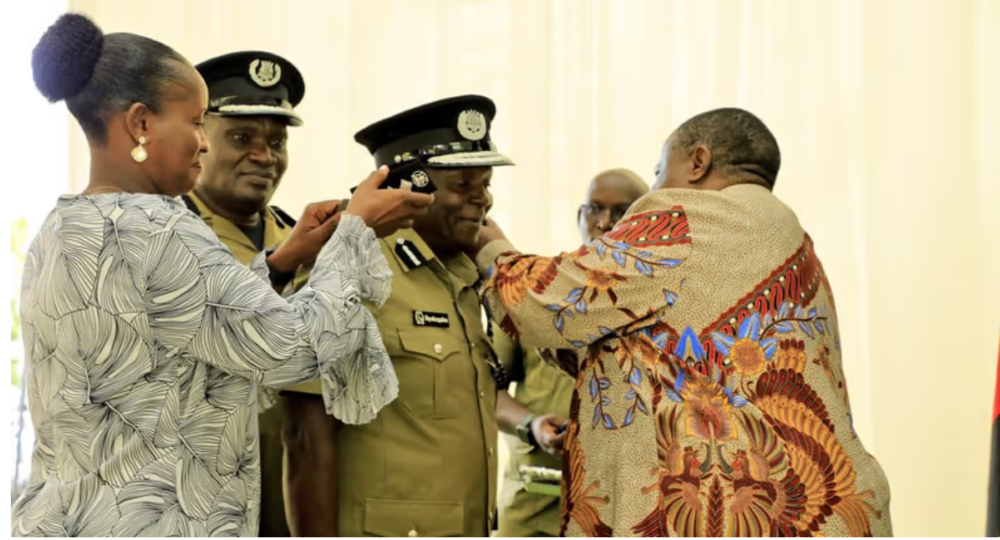
Maj. Gen. Kahinda Otafiire, decorating IGP Abbas Byakagaba during his takeover ceremony at Police headquarters in Nagulu, Kampala on Monday.
Abbas Byakagaba on Monday assumed office as Inspector General of Police at a handover and takeover ceremony, held at Police headquarters in Naguru, Kampala.
The function was presided over by the Minister of Internal Affairs, Maj. Gen. (Rtd) Kahinda Otafiire, Wwho cautioned Police against using excessive force while dealing with opposition politicians.
Gen. Otafiire, emphasized that law enforcement should not resort to brutality but should instead contain those who misbehave.
He highlighted the need for police to adhere to the law and take any inadequacies to the ministry for legislative review.
"Those who enforce the law [should] not break it. If you feel the law is inadequate, bring it to us so we can take it to Parliament for fine-tuning," said Otafiire.
He referenced frequent clashes between police and opposition figures, such as Robert Kyagulanyi of the National Unity Platform (NUP) and Kizza Besigye, the founding president of the Forum for Democratic Change (FDC) which, he said, often tarnish the government's image.
"Don't go and beat Kyagulanyi or Besigye. Just deal with the errant citizens who defy lawful orders. If you have agreed on a venue for their rally, stick to that. Let them get there, shout until they get tired. Political parties are legal, and they have the freedom of expression," Otafiire said.
The ceremony marked the transition of leadership in the police force, following President Yoweri Museveni's appointment of Abas Byakagaba as the new Inspector General of Police (IGP) and James Ocaya as the Deputy Inspector General of Police (DIGP), replacing Martins Okoth Ochola and Maj. Gen. Tumusiime Katsigazi, respectively, a fortnight ago. Several other directors recently appointed were also present.
Otafiire urged the police to respect the constitutional rights of opposition politicians while ensuring they do not inconvenience others. He stressed that combating crime requires collective efforts, including public cooperation.
"You must learn to win the hearts and minds of the population. Police and the army are like fish in water. Fish cannot survive without water. If you abuse the public, you will not succeed," he said.
Commenting on Byakagaba's appointment, Otafiire praised his experience and decision-making skills, particularly during his tenure as counter-terrorism chief, which led to the extension of his contract two years ago.
"We asked him to hang around, keeping him for two years, hence his appointment," Otafiire said.
On issues of welfare, housing, and transport for police officers, Otafiire assured that these would be addressed soon.
The state minister for Internal Affairs, Gen. David Muhoozi, noted that the newly appointed officers have been put to the test after a prolonged period of preparation.
Muhoozi advised the new chiefs to demonstrate grit, steady leadership, a sense of purpose, and strict discipline.
"The police should borrow a leaf from the army when enforcing discipline. When one makes a mistake, the consequences should be extreme," he said, emphasizing that leadership involves identifying and solving problems.
Muhoozi also warned about persistent issues such as corruption, slow response to crime, and involvement in land grabbing.
Byakagaba pledged to work collaboratively with all levels of the police force to enforce law and order.
He outlined his focus on several key areas: improving the mindset of officers, supporting the socio-economic transformation of society, ensuring national security and safety, managing human resources effectively, and improving the working environment for officers.
He also emphasized maintaining anti-crime infrastructure, including investigations, intelligence, forensics, and CCTV cameras, and collaborating with stakeholders.
Expressing gratitude to his predecessor, Maj. Gen. Katsigazi, who held two offices following the departure of Ochola on March 4, Byakagaba applauded him for his contributions and advice, which have been instrumental in his appointment as IGP.
Ocaya, the new DIGP, described his appointment as miraculous and thanked his predecessors for his mentorship, which has shaped his career from a graduate of fine art to a strategic planner in the police force since he joined in 1994.
In his farewell message, Katsigazi recounted several achievements and called for an increase in the number of officers in the force.
He highlighted the current recruitment of 2,500 officers to replace those lost to retirement and attrition.
Katsigazi also called for improvements in the feeding of police officers, noting that many now survive on one meal a day and that some sub-counties lack police presence.



