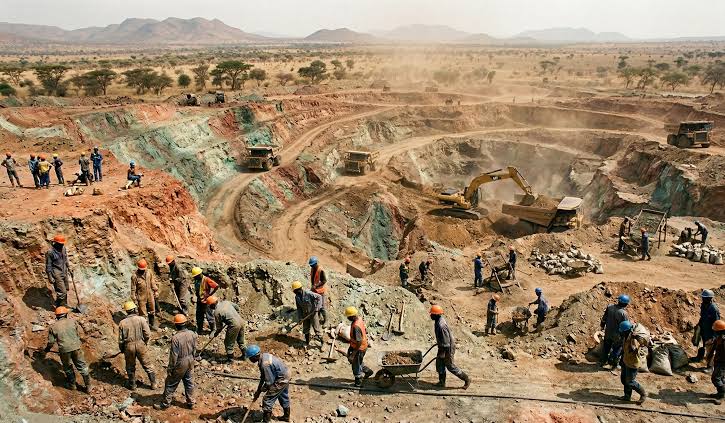
On June 29, 2026, the government of the Democratic Republic of Congo signed an order banning the export of copper and cobalt concentrates, effective immediately. The measure targets the country's vast raw-mineral trade at the very moment the DRC has cemented itself as the indispensable supplier at the center of the global energy transition: the world's largest producer of cobalt, used in electric-vehicle batteries and electronics, and the world's second-largest supplier of copper after Chile. The ban is the boldest expression yet of a strategy Kinshasa has pursued in stages since 2023 — using export policy to force multinational miners to build refining and processing capacity inside the country rather than shipping raw concentrate abroad for value to be added elsewhere.
A Record Harvest, a New Export Regime
The timing is notable because it comes on the back of a genuine production boom. DRC copper output surged to roughly 3.5 million tonnes in 2025, according to industry trackers, reinforcing the country's position just behind Chile as the world's top copper suppliers. Individual mines illustrate the scale: Ivanhoe Mines' Kamoa-Kakula complex alone produced 388,838 tonnes of copper in concentrate in 2025, hitting its production guidance and setting fresh targets for 2026. Mining analysts note that the new concentrate ban is unlikely to disrupt most operators severely in the near term, since the bulk of DRC copper and cobalt is already refined domestically before export; the government has also signaled it will grant one-year export waivers under strategic circumstances, giving companies a transition runway rather than an abrupt cutoff.
The mining sector as a whole is estimated at roughly $10.9 billion in value and accounts for close to half of the DRC's GDP, underscoring both the opportunity and the risk embedded in the export-control strategy: get the policy right, and Congo captures far more of the value chain that today flows to processing hubs in China and elsewhere; get it wrong, and the country risks discouraging the very investment needed to build that processing capacity domestically.
Growth Without Broad Gains
On paper, the macroeconomic picture looks strong. The IMF projects DRC growth of 5.9% in 2026, driven by mining, construction, agriculture, and services, while the African Development Bank likewise expects growth above 5% through 2026-27 as mining investment deepens and non-extractive sectors expand alongside continued reform. Business Day and other outlets have described the DRC as climbing toward the ranks of Africa's ten largest economies on the strength of this mineral wealth.
Yet the human-development numbers tell a starkly different story. Poverty remains high at 81.1% of the population living below $3 a day (PPP) as of 2025, according to World Bank and IMF data compiled in recent country assessments. Analysts attribute this persistent gap to limited job creation within the capital-intensive mining sector itself and to structural weaknesses — weak public institutions, thin non-mining private-sector development, and infrastructure gaps — that have historically prevented resource booms from translating into broad-based income gains. In short, mining-driven growth has repeatedly failed to meaningfully reduce inequality and poverty in the DRC, a pattern the current government says its local-processing and value-addition push is designed to break by keeping more revenue, jobs, and industrial capacity inside the country.
The Cost of Conflict in the East
Compounding the development challenge is the security crisis in the mineral-rich eastern provinces. Renewed M23 rebel activity, resurgent since November 2021, has produced a serious and ongoing humanitarian crisis and, more recently, direct fiscal costs for the central government. The loss of effective control over parts of North Kivu and South Kivu is estimated to have cost the government about 3.7% of forgone revenue — equivalent to roughly 0.4% of GDP — in 2025 alone, according to IMF assessments. That figure captures lost taxation, customs, and mineral-royalty collection in areas where state authority has been displaced, illustrating how conflict in the east directly undercuts Kinshasa's ability to finance the social spending and infrastructure investment its own poverty-reduction strategy depends on.
Fiscal Reform Under an IMF Program
Alongside the export-control push, the DRC has been implementing a fiscal-reform program under an IMF Extended Credit Facility arrangement. The completion of the program's first review in mid-2025 triggered a disbursement of 190.4 million SDR (about $261.9 million), bringing cumulative disbursements under the arrangement to 380.5 million SDR (roughly $523.4 million) as of July 2025. The reform agenda tied to the program includes concrete measures such as a new standardized value-added-tax invoicing system introduced in December 2025 and the phased elimination of various tax exemptions and fuel subsidies — steps intended to widen the government's non-mining revenue base and reduce dependence on volatile commodity receipts. The IMF has also flagged that a global economic slowdown could dampen demand for critical minerals and thus DRC export earnings, a risk that officials in Kinshasa have so far downplayed given the structural, energy-transition-driven demand underpinning cobalt and copper markets.
The Development Bank's Parallel Bet
The African Development Bank has built a large complementary portfolio in the country, with more than $1.45 billion in active projects spanning infrastructure, agriculture, and youth development — investments aimed squarely at the non-mining diversification and human-capital gaps that the poverty data expose. Combined with the IMF's fiscal-reform program and the government's own local-processing mandate, the DRC's current strategy amounts to a three-track bet: force more mineral value-addition onshore through export policy, stabilize public finances through tax reform, and address the social deficit through targeted development financing.
Outlook
Whether that combination can convert Congo's mineral abundance into a genuine improvement in living standards remains the central open question of its economic transformation story. The country enters the second half of 2026 with strong headline growth, a record copper harvest, and a newly assertive resource-nationalist trade policy — but also with four in five citizens still living in poverty and a security crisis in its eastern provinces actively eroding the fiscal base needed to change that. The coming waiver decisions on the copper and cobalt concentrate ban, and whether multinational miners respond by accelerating domestic refining investment rather than scaling back output, will be an early test of whether Kinshasa's strategy is working.
Published By | Business News Editor