Written By | Business Experts
Gold has become the load-bearing pillar of Burkina Faso’s economy
Burkina Faso, a landlocked nation of roughly 23 million people at the heart of the West African Sahel, is in the middle of one of the continent’s most consequential economic experiments. Under military rule since 2022 and cut off from ECOWAS after founding the rival Alliance of Sahel States (AES) with Mali and Niger, the country has simultaneously posted some of the region’s strongest growth numbers, torn up its mining contracts in favor of state ownership, and begun building the institutional scaffolding for a Sahelian economic bloc meant to replace decades of dependence on the CFA franc system. The result is a case study in how resource wealth, geopolitical rupture, and social-spending pressure are colliding in one of the world’s poorest and least secure states.
A Gold-Fueled Rebound
Gold has become the load-bearing pillar of Burkina Faso’s economy. The World Bank’s 2025 country brief put GDP growth at an estimated 5.3 percent for the year, and more recent IMF and World Bank projections for 2026 point higher still — IMF staff project around 5 percent growth in 2026, while the World Bank’s own forecast has run as high as 6.1 percent, driven overwhelmingly by mining output and elevated global bullion prices. Gold production surged 47 percent to roughly 94 tonnes in 2025, according to industry estimates cited in recent market reporting, at the same time that international gold prices climbed roughly 27 percent over the year. As Africa’s fourth-largest gold producer, Burkina Faso now derives about 15 percent of GDP and roughly 75 percent of export earnings from the sector, alongside an estimated 20 percent of formal-sector employment tied to mining and its supply chains.
That windfall has flowed through to the government’s external accounts. The IMF’s February 2026 review noted that the current account, which ran a deficit of 3.4 percent of GDP in 2024, is projected to swing into surpluses of 1.1 percent in 2025 and roughly 0.8 percent in 2026, a reversal almost entirely attributable to gold exports. On the fiscal side, the deficit for 2025 came in within the IMF program ceiling of 4.0 percent of GDP, helped by stronger mining-related revenue, continued wage-bill restraint, and limits on capital spending — a combination the Fund credited with keeping Burkina Faso’s macroeconomic program broadly on track despite an ongoing security crisis that has displaced roughly two million people internally.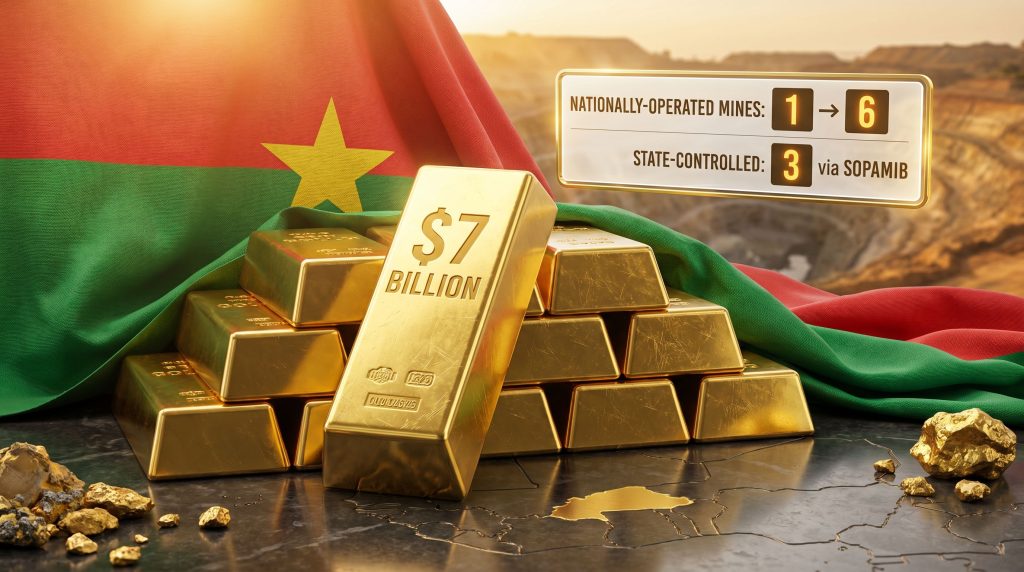
Nationalizing the Mines
The most striking shift in economic policy has been the state’s rapidly escalating claim on the gold sector itself. Since August 2024, the government has nationalized five gold mining assets, folding them into the newly created state miner, Société de Participation Minière du Burkina (SOPAMIB), including two mines previously held by Canada’s Endeavour Mining. The mandatory government equity stake in mining projects, initially set at 10 percent, was raised to 15 percent in 2025, and then, in an April 18, 2026 decree, increased again — to 40 percent state ownership in the case of the Kiaka mine. Government officials have framed each step as a matter of “economic sovereignty,” arguing that a country whose subsoil generates three-quarters of its export income should capture a commensurately larger share of the proceeds, particularly at a moment of near-record international gold prices.
Foreign mining investors and analysts have reacted far more cautiously, warning that the accelerating pace of state intervention — from royalty increases to forced stake sales — is unsettling capital allocation decisions across West Africa’s broader gold belt, where Mali and Niger have pursued parallel nationalization drives of their own. For Ouagadougou, the calculation appears to be that near-term revenue capture outweighs the risk of deterring future exploration investment, especially given the junta’s urgent need for resources to fund both the counter-insurgency campaign against jihadist groups affiliated with al-Qaeda and the Islamic State, and an expanding menu of social commitments.
Building a Sahelian Alternative
Burkina Faso’s economic nationalism is inseparable from its regional project. Since exiting ECOWAS, Burkina Faso, Mali, and Niger have deepened the Alliance of Sahel States, moving beyond a defense pact toward the architecture of an independent economic union. In December 2025 the three governments launched the Banque Confédérale pour l’Investissement et le Développement de l’AES (BCID-AES), a confederal investment bank capitalized at an initial 500 billion CFA francs — roughly $895 million — funded through member-state contributions, with each country expected to channel about 5 percent of annual tax revenue into the institution over time. The bank is intended to finance joint infrastructure and, eventually, underwrite preparations for a proposed common currency, provisionally referred to as the “sira,” that AES officials have described as a gold-backed alternative to the CFA franc.
The currency timeline remains genuinely contested: Malian authorities publicly dismissed as “fake” some 2026 media reports suggesting an imminent sira launch, underscoring how much monetary-sovereignty rhetoric has outpaced the technical and political groundwork required to actually exit the CFA zone. In parallel, the three states have stood up a unified military force of roughly 5,000 personnel under Burkinabe General Daouda Traoré, explicitly designed to operate across the AES’s shared borders against regional insurgencies — a reminder that, in this bloc, security and economic integration are being built as a single project rather than sequential ones.
Poverty, Cotton, and the Social Ledger
Behind the mining and monetary headlines sits a more sobering human development picture. Burkina Faso, along with Mali and Niger, ranks in the lowest tier of the UN Development Programme’s human development index, and IMF documentation shows extreme poverty falling only gradually — from roughly 35 percent in 2022 to an estimated 30 percent in 2025, with poverty still overwhelmingly concentrated in rural, conflict-affected regions. Cotton, historically the country’s other major export alongside gold, has been a more fragile pillar: a weak 2023 harvest, compounded by a late start to the rainy season and insecurity disrupting farming in contested areas, contributed to a downward revision of that year’s GDP growth from 3.6 to 3.0 percent, illustrating how exposed rural livelihoods remain to both climate variability and the ongoing conflict.
On the spending side, the IMF’s program reviews credit Ouagadougou with meeting nearly all of its social-spending floors and structural benchmarks under the Extended Credit Facility arrangement, including commitments on displaced-persons support, the rollout of a Universal Health Insurance Scheme, and human capital development spending, even as the government maintains a ceiling on its primary fiscal deficit. The February 2026 IMF Executive Board decision to complete the fourth ECF review — releasing about $33.2 million — and to approve a new $124.3 million Resilience and Sustainability Facility arrangement running through September 2027, signals that the Fund views the current policy mix, however unorthodox politically, as macroeconomically credible enough to keep supporting.
What to Watch
Three threads will determine whether Burkina Faso’s current trajectory becomes durable transformation or a commodity-driven bubble. First, whether gold prices remain elevated long enough to fund both the security campaign and the social-spending commitments the IMF is tracking, given that a price correction would expose the fiscal space that nationalization has been used to justify. Second, whether the escalating state-equity model in mining deters the exploration investment needed to sustain production once existing deposits mature, a risk flagged by industry observers watching parallel nationalization trends in Mali and Niger. And third, whether the AES’s institution-building — the confederal bank, the unified force, and eventually a common currency — translates into a functioning regional market, or remains, for now, more a statement of political intent than an operating economic union.



