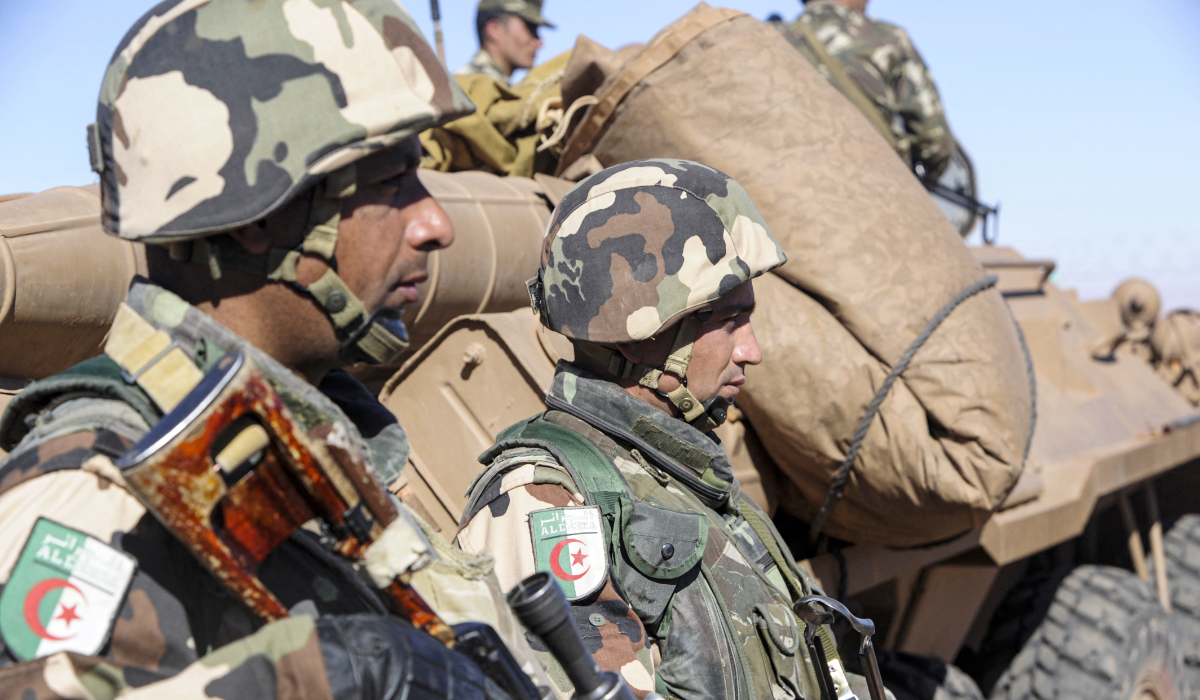
ALGERIA
In the space of a week, Algeria has abandoned two pillars of its foreign policy. It has sent soldiers abroad for what reporters describe as the first time since the 1973 Arab-Israeli war, escorting fuel tankers into Niger. And it has watched the United Nations peacekeeping mission in Western Sahara, long the principal international forum for its ally the Polisario Front, expire after the Security Council deadlocked. Together the developments mark a sharp and risky shift for Algiers, which has traditionally avoided military entanglements beyond its borders.
A convoy into the Sahel
About 60 Algerian fuel tankers, escorted by Algerian soldiers, crossed into Niger and reached Agadez on Saturday, Oct. 31, according to Africanews, which relayed reporting by French broadcaster RFI. The Soufan Center, a security-analysis group, put the number of tankers at about 50, so the exact count is uncertain. Africanews said Nigerien forces welcomed the convoy. The Soufan Center reported that a military convoy had reportedly reached Arlit, a uranium-mining hub, on Oct. 30. Africanews noted that all convoy details came from RFI and had no independent confirmation.
The deployment followed a rapid sequence of decisions. According to the Soufan Center, Algeria and Niger signed a military cooperation agreement on Oct. 21. Both chambers of Algeria's parliament approved the deployment of army units to Niger on Oct. 25, according to Lotfi Sour of the Université Mustapha Stambouli de Mascara, writing in The Conversation Africa. President Abdelmadjid Tebboune authorized the mission the next day, saying it would protect the two countries' shared energy and economic interests.
Much remains undisclosed. "The military mandate, deployment location and rules of engagement haven't been made public," Sour wrote. Neither troop numbers nor the length of the mission have been announced. The Soufan Center reported that some sources say a unit may be based in Niamey, while a parliamentary resolution indicates troops will be stationed in Madama, a former French counterterrorism hub in the north. RFI said an Algerian unit could be expected in Niamey, according to Africanews.

Why now: fuel, gas and rivalry
The most immediate driver appears to be Niger's fuel shortage. The Soufan Center said Niger's single refinery cannot meet domestic demand and that informal imports from Nigeria dwindled after Abuja ended fuel subsidies in 2023. The Soufan Center described the shortage as a more immediate trigger than the insurgencies. Africanews reported that Niger imposed an overnight fuel-sales curfew on Oct. 25 amid a nationwide shortage.
Energy interests run deeper. Algeria's state company Sonatrach holds a production-sharing agreement in Niger and is exploring the Kafra oil block in Agadez, near the Algerian border, according to Sour. Niger is also the planned midpoint of the roughly 4,000-kilometer Trans-Saharan Gas Pipeline, which would carry Nigerian gas through Niger to Algeria and on to European markets, according to the Soufan Center. The project is still under construction.
Rivalry with Morocco overlays the economics. The Soufan Center said Morocco promotes a competing Nigeria–Morocco pipeline and its Atlantic Initiative, and called the Algeria–Morocco rivalry a major driver of Algiers' moves. Africanews linked the deployment to expanding influence in the Sahel from the United Arab Emirates and Libya.
Repairing a ruptured relationship
The move follows a diplomatic breach. In April 2025, Algerian air defenses downed a Malian drone near Tinzaouaten, and Mali, Niger and Burkina Faso, the three members of the Alliance of Sahel States (AES), recalled their ambassadors, the Soufan Center reported. Niger sent its ambassadors back in February 2026, and General Abdourahamane Tiani, who leads the junta that deposed President Mohamed Bazoum in July 2023, made a state visit to Algiers. The two governments agreed to relaunch joint energy projects. Relations with Mali stayed cold until July 2026, when both capitals reinstated ambassadors and reopened airspace.
Early in October, Algeria sent four fighter jets to Niamey a day after Nigerien forces and Russia's Africa Corps contained a coup attempt, the Soufan Center said. That timing signals that Algiers has a strong interest in the survival of Tiani's government. The center argued that instability in Niger threatens the trans-Saharan route.
A crowded and dangerous theater
Algerian troops are entering a crowded security landscape. Russia's Africa Corps has been Niger's main security partner since French forces left in late 2023. China dominates Niger's oil sector, and on Oct. 13 Niamey gave the China National Petroleum Corporation and its partners 45 days to repatriate export revenues and honor contracts, the Soufan Center reported. Armed groups include Islamic State Sahel Province (ISSP), Jama'at Nusrat al-Islam wal-Muslimin (JNIM), Boko Haram, Islamic State West Africa Province and the pro-Bazoum Patriotic Liberation Front. ISSP attacked Niamey's airport and the adjoining Air Base 101 in January, the Soufan Center said. Niger also accused Chad of a drone attack on Oct. 27 that killed two civilians, Africanews reported.
The Soufan Center warned that the deployment could provoke attacks from JNIM and ISSP and said "Algerian troops could be drawn into the very conflict their deployment seems designed to avoid." It added that backlash could come from other state actors and from pro-Bazoum groups that have previously sabotaged the Niger–Benin oil pipeline. Sour made a related warning: "Algeria will have to avoid being drawn into competing camps."
Western Sahara: the UN mission lapses
The deployment came as Algeria suffered a diplomatic setback on its other great file. On Oct. 30 the UN Security Council failed to renew the mandate of the UN Mission for the Referendum in Western Sahara (MINURSO), which had operated since 1991. According to Morocco World News, Russia vetoed a US-drafted resolution that received 11 votes in favor, with China, Pakistan and Somalia abstaining. The draft would have renamed the mission, dropping the "R" for "referendum." The United States then vetoed a Russian draft that would have extended the mandate without structural change, according to the same report. Vote tallies for the Russian draft differ between outlets, so they are not given here. The mandate expired at midnight on Oct. 31, and the Rio Times reported that the mission stopped operating on Nov. 1.
Morocco celebrated. King Mohammed VI's Royal Cabinet announced the "closure of the chapter on the United Nations Mission for the Referendum in Western Sahara" and called for the issue to be removed from the Council's agenda, according to Asharq Al-Awsat. Foreign Minister Nasser Bourita said, "First of all, the R in the mission's name itself no longer makes any sense today." US Ambassador Mike Waltz said, "Of course, the United States supports the principle of self-determination," while arguing there are many ways to express a people's will. Morocco World News, a Moroccan outlet, noted that its account reflects Rabat's framing. UN spokesman Stéphane Dujarric said the date "marks the start of the liquidation period," according to the Rio Times brief.
Algeria's delegate thanked Russia and denounced the Council's failure, per the UN press release as cited by the Rio Times. The Polisario Front had warned before the vote that it would leave the peace process if the US draft passed without substantial changes, and no post-vote statement from it was found. Rio Times reported that France called the abrupt closure "exceedingly alarming," and that Secretary-General António Guterres said the end of the mission does not abrogate the right to self-determination.
Who, if anyone, monitors the ceasefire line is unclear. Fighting resumed in November 2020, and Security Council Report recorded a rocket attack near Smara on May 5 and a drone strike on June 7, according to Rio Times. The legal basis for the wind-down is also uncertain, and no negotiating round is scheduled.

Analysis: a strategic gamble
The Niger deployment and the end of MINURSO are linked by more than timing. Both reflect a contest with Morocco for influence across North and West Africa. Rabat's diplomatic momentum on Western Sahara, including shifts in recognition by several Latin American governments this year, has narrowed Algiers' room to maneuver at the UN. An energy-and-security foothold in the Sahel offers Algeria an alternative arena in which to project power, one where its ties to the AES states are warming again.
But the gamble is large. Sour describes the move as a departure from Algeria's long reluctance to deploy abroad. It places Algerian soldiers alongside a military government and its Russian security partner, in a region where insurgents are escalating, and without published rules of engagement. The Soufan Center concluded that Algeria's focus is on energy assets rather than counterterrorism, yet said deployments can still provoke attacks. Any casualty could turn a limited escort mission into a domestic political question in Algiers, where parliament approved the deployment with few details.
What to watch
The first confirmed troop numbers and basing, particularly any move to Madama or Niamey. Whether JNIM or ISSP target Algerian convoys or personnel. Whether the Trans-Saharan Gas Pipeline timetable firms up. How Morocco, Russia and France respond to Algeria's new posture. And at the UN, what authority governs the MINURSO wind-down, whether the Polisario Front leaves the political process, and whether US-facilitated talks resume.
Published By | News Editor