Written By | International News Agencies

The Missouri Supreme Court sided with Hoskins and Republicans once, back in May, when it let the new map stand for the August primary
Background
Missouri's fight over its congressional map is one front in a much larger, nationally coordinated redistricting arms race that has defined the run-up to the 2026 midterms. It began in earnest last summer when Texas Republicans, at President Trump's urging, redrew their congressional map to create five additional GOP-leaning seats; Governor Greg Abbott signed that map into law on August 29, 2025. Democrats responded in kind: California put a constitutional amendment to redraw its own lines before voters in a November 4, 2025 special election, aiming to create five new Democratic-leaning seats, with Governor Gavin Newsom framing the move bluntly as "two can play this game." Beyond those two marquee fights, roughly eight other states — Republican-led Florida and Indiana among them, Democratic-led Illinois, Maryland, New Jersey and New York among the others — began exploring their own voluntary mid-decade redraws, while Ohio faced a court-ordered redraw under a 2018 constitutional amendment, and litigation churned in Georgia, Louisiana, Utah, Alabama and Tennessee.
Missouri's own map was passed by the Republican-controlled legislature during a 2025 second extraordinary session, again with the backing of President Trump and Governor Mike Kehoe, and was designed to flip a seventh US House seat to Republicans. The principal target was Democratic Representative Emanuel Cleaver's Kansas City-based 5th District, which the new map dismantled by shedding its urban core and stretching the district eastward into rural, heavily Republican territory; under the redrawn lines, roughly 59% of the district's voters would have been new to it, and the changes shifted district assignments for more than a million Missouri voters, close to a quarter of the state's electorate.
Opponents organized quickly. A campaign called People Not Politicians gathered more than 300,000 signatures by December 9, 2025, seeking to force a statewide referendum on the new map under a provision of Missouri's constitution that allows voters to approve or reject "any act of the general assembly." Missouri's Republican secretary of state, Denny Hoskins, sat on the petition for months before rejecting it outright on August 4, 2026 — the very day of Missouri's primary election, which was held under the contested new map — arguing that congressional redistricting was not the kind of legislative act subject to a citizen referendum. People Not Politicians sued, setting up the legal fight that would ultimately reach the US Supreme Court three times over the following seven weeks.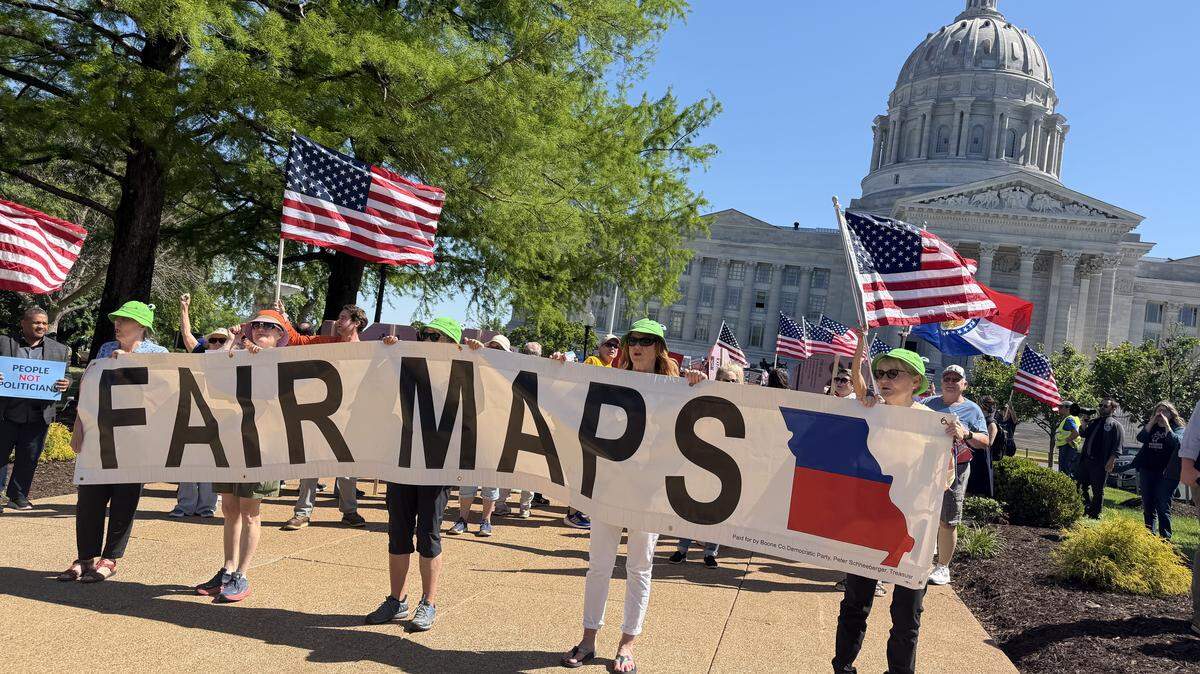
Key Developments
The Missouri Supreme Court sided with Hoskins and Republicans once, back in May, when it let the new map stand for the August primary. But everything changed on September 3, when the state's highest court, in a unanimous opinion written by Chief Judge Ginger Gooch, ruled that the referendum petition was valid after all — finding that "the plain language" of the Missouri Constitution authorizes a referendum as to any act of the general assembly and that no exception applied to congressional maps. The court also rejected a federal constitutional challenge grounded in the US Constitution's Elections Clause, citing a 1916 US Supreme Court precedent that has repeatedly rejected the argument that the Elections Clause bars state referendums on this kind of legislation. The ruling ordered the disputed map's referendum — formally Proposition A — onto the November 3, 2026 ballot, and, critically, required Missouri to revert to its 2022 congressional district lines for this November's general election while that vote is pending.
Missouri Attorney General Catherine Hanaway announced within a day that she would appeal to the US Supreme Court, filing an emergency application on September 4 to restore the new map; President Trump publicly criticized the state court's ruling on social media the same week. Republican-aligned donors poured roughly $3 million into a group called Put Missouri First to fight the referendum at the ballot box, while People Not Politicians and its allies raised about $7 million in response. On September 8, the Supreme Court made its first move, declining to disturb the Missouri Supreme Court's ruling and effectively letting the 2022-map order stand. Two days later, on September 10, the justices intervened a second time, blocking a conflicting order from federal district judge Stephen Clark that would have allowed the new map to be used after all. Separately, Missouri's Supreme Court held Hoskins in temporary contempt after he instructed local election officials to proceed with the contested map despite the court's ruling.
The fight was not over. A three-judge panel of the Eighth US Circuit Court of Appeals ruled the following week that switching congressional maps between the primary and general elections of the same cycle would itself violate the Constitution, and it directed a district court to bar Missouri from using anything except the new 2025 map — effectively reviving the map the state's own top court had just blocked. The panel stayed its own order for a week specifically to let the Supreme Court weigh in again. That set up the third and, so far, final round: on September 25, the US Supreme Court issued a per curiam — unsigned, and effectively unanimous, with no noted dissents — order halting the Eighth Circuit's ruling. "At this late date," the justices wrote, "ordering reversion to the 2025 map in the midst of an ongoing election would usher in electoral chaos," noting that ballots using the 2022 map had already been printed and mailed, that absentee voting was already underway, and that county election clerks had described switching maps again as "practically impossible." The order leaves the Missouri Supreme Court's September 3 ruling as the only operative decision, meaning Missouri's November elections will proceed under the old, 2022 district lines.
Reactions
Representative Cleaver, who is defending his seat against Republican state Senator Rick Brattin, said he pulled his car over to process the news when he heard the ruling, describing the monthslong fight over his district's boundaries as "manufactured chaos" that had "at long last, been brought to a final state," and expressing evident relief that the uncertainty over which map would govern his race was finally resolved. Hanaway's office had signaled it would continue pressing the case through the courts, and Republican strategists broadly framed the outcome as a setback in the party's wider strategy of using mid-decade redistricting to protect its narrow House majority, a strategy that had scored a clear win in Texas but has now stumbled badly in Missouri.
The Supreme Court's Missouri order did not arrive in isolation. The same day, the justices also rejected a separate Trump administration effort to restrict mail delivery of absentee ballots unless recipients' names appeared on state-provided lists, a ruling that split the court, with Justices Alito and Thomas dissenting in favor of letting the administration's rule take effect immediately. SCOTUSblog's analysis of the two rulings together characterized the Court as declining "to become partisan" in either fight over the mechanics of the midterms, reading both decisions as a broader signal that the justices are inclined to protect settled election administration — printed ballots, ongoing absentee voting, existing mail rules — over last-minute changes pushed by either party, a version of the long-standing "Purcell principle" against altering election rules close to an election.
What's Next
Missouri voters still have a decision of their own to make. Proposition A remains on the November 3 ballot, asking them directly whether to approve the 2025 map that Republicans passed and that would replace the state's existing district lines — separate from which map actually governs this year's elections, since that question has now been settled by the Supreme Court in favor of the 2022 lines. A "yes" vote would enact the contested map for future cycles; a "no" vote would reject it, likely locking in something closer to the current boundaries. Cleaver and Brattin will contest the 5th District seat under the old map's lines regardless of how that ballot measure turns out this cycle, since the map fight for 2026 itself is now resolved.
More broadly, Missouri's outcome is likely to reverberate through the national redistricting fight heading into November. It represents a concrete loss for the Trump-aligned strategy of using rushed, mid-decade map changes to squeeze out additional House seats, even as Texas's earlier redraw stands as a clear win for the same strategy and California's Democratic countermove proceeds on its own track. Similar court fights are still working through Georgia, Louisiana, Utah, Alabama and Tennessee, and the Supreme Court's emphasis this week on protecting maps and ballots already in motion — rather than ones still being litigated — suggests that timing, more than the underlying partisan merits, may end up deciding which of those disputes succeed before voters go to the polls in November. With control of the House expected to be decided by a handful of seats, how each of these state-level fights resolves could matter as much to the midterm outcome as any single national trend.