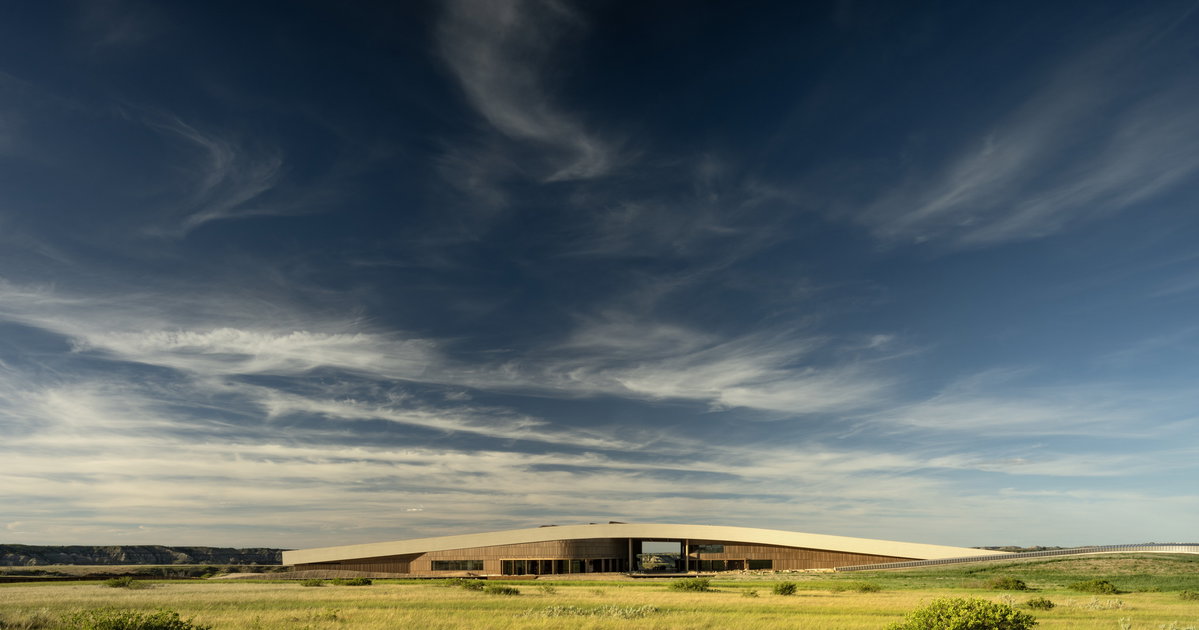
Carved into a butte outside Medora, North Dakota, the 96,000-square-foot museum opened July 4 with a walkable prairie roof, a bid to become the world's only carbon-neutral presidential library — and a 1,776-drone light show over the Badlands.
MEDORA, NORTH DAKOTA — July 5, 2026
On the morning of July 4, 2026 — exactly 250 years after the Declaration of Independence was signed — a crowd gathered on a windswept butte at the edge of Theodore Roosevelt National Park to dedicate a building that seems determined not to be seen. The Theodore Roosevelt Presidential Library, designed by the international architecture firm Snohetta, officially opened its doors to the public, capping a years-long effort to honour America's 26th president in the rugged North Dakota landscape that he credited with making his presidency possible.
From a distance, there is almost nothing to look at — and that is the point. The 96,000-square-foot library and museum rises out of the butte west of Medora beneath a sloping, walkable green roof, its earthen curves reading as another fold in the Badlands terrain. Visitors can hike directly onto the building, across roughly 121,000 square feet of living prairie planted on its roof, and look out over the Little Missouri River toward the horizons Roosevelt rode in the 1880s.
Architecture as Landscape
Snohetta, the Norwegian-American practice behind the Oslo Opera House and the reimagined Times Square, has built a career on buildings that invite people to walk on them. In Medora, the firm has pushed the idea to its logical conclusion: a museum that functions as topography. Two arcing, grass-roofed volumes trace the contours of the butte, framing a central courtyard and orienting galleries toward the national park beyond.
The design language is deliberately humble — timber, earth and glass rather than marble and columns — and deliberately Rooseveltian. This is not a temple to power but a shelter in a landscape, an architectural argument that the most fitting monument to the conservationist president is the view itself. Design critics have described the building as honouring 'the landscapes America chose to protect,' a neat inversion of the traditional presidential library, which typically asks the landscape to honour the man.

The Greenest Presidential Library Ever Built
The building's environmental ambitions are as striking as its silhouette. The library is designed to be the only carbon-neutral presidential library in the world, and it is pursuing an almost unheard-of triple crown of certifications: the Living Building Challenge, LEED Platinum and SITES Platinum. If certified, it will be the only Living Certified presidential library anywhere — and the largest, most complex Living Certified cultural institution in the world.
Those labels translate into concrete choices. The prairie roof insulates the galleries and restores native habitat. The building is engineered to generate and conserve energy on site, harvest and manage water, and source materials free of the toxic compounds banned by the Living Building 'red list.' In a state whose economy runs substantially on oil, the project makes a quietly radical statement: that the legacy of the president who created the U.S. Forest Service and protected some 230 million acres of public land demands a building that gives back more than it takes.
Technology Meets the Strenuous Life
Inside, the museum blends immersive technology with Roosevelt's biography — the sickly child who built himself into a rancher, soldier, reformer and president; the trust-buster and the Rough Rider; the writer who produced roughly 40 books; the conservationist whose grief-stricken retreat to these very Badlands in 1884 reshaped American environmental history. Regional reporting on the opening described a museum that 'blends technology, history and Badlands landscape,' with interactive galleries designed to make a 19th-century life legible to 21st-century visitors.
The location is itself a curatorial decision. Unlike most presidential libraries, planted in the cities where presidents built their political machines, this one sits where Roosevelt lost a wife and mother on a single day in 1884 and came west to grieve. 'I never would have been President,' he later wrote, 'if it had not been for my experiences in North Dakota.' The library takes him at his word.
An Opening Worthy of the Occasion
The grand-opening festivities matched the semiquincentennial moment. A formal dedication ceremony on the morning of July 4 preceded the library's first public admissions, and the day closed with a light show over the Badlands performed by 1,776 drones — a number chosen for obvious reasons — accompanied by the 188th Army Band. National coverage, from cable news to the design press, framed the opening as one of the signature cultural events of America's 250th-birthday weekend.
The project's backers have been explicit about the symbolism of opening on the nation's semiquincentennial: a founding-era number in the sky above a building dedicated to the president who, perhaps more than any other, defined what the country's second century would protect and preserve.
What It Means for Travelers and Design Lovers
For design-minded travellers, Medora — population roughly 120 — just became a pilgrimage site. The library anchors a corner of North Dakota already rich with reasons to visit: Theodore Roosevelt National Park's bison herds and painted canyons, the historic Medora townsite, and now a piece of world-class contemporary architecture you can literally hike over. Summer visitors can pair a morning in the galleries with an afternoon on park trails that look much as they did in 1884.
For the architecture and museum worlds, the building sets a marker. If a major cultural institution can hit Living Building standards on an exposed butte in the northern plains — through brutal winters and scorching summers — the excuses available to projects in milder climates just got thinner. Practical details for visitors: the library sits just west of Medora off Interstate 94, roughly 35 minutes from Dickinson and about two hours from Bismarck, and summer is peak season for both the museum and the adjacent national park.
The Last Word
Presidential libraries tend to be arguments in stone about how a man should be remembered. Snohetta's achievement in Medora is to have made the opposite: a building that steps aside, hands the microphone to the prairie, and trusts the landscape to do the remembering. Roosevelt, who believed the nation's grandeur lived in its wild places rather than its monuments, would likely have approved — and then gone for a hike across the roof.
Published By | Features Editor