Bishkek, Kyrgyzstan
Background
The Shanghai Cooperation Organisation was founded in June 2001 by China, Russia and four Central Asian republics as a modest instrument for settling post-Soviet border disputes and coordinating against what its charter calls the "three evils" of terrorism, separatism and extremism. A quarter of a century later it has become something considerably larger and considerably harder to define: a ten-member bloc spanning roughly half the world's population and about a quarter of global economic output, with India and Pakistan admitted in 2017, Iran in 2023 and Belarus in 2024, and an outer ring of observers and dialogue partners stretching from Turkey to the Gulf.
That expansion is the source of both the organisation's claim to significance and its persistent difficulty in agreeing on anything binding. The SCO now contains two pairs of members — India and Pakistan, and India and China — whose bilateral relations are periodically hostile, alongside a Russia at war in Ukraine, an Iran six months into an air war with the United States, and Central Asian hosts whose economies depend on balancing Moscow, Beijing and the West simultaneously. Consensus decision-making in that room tends to produce documents about logistics corridors and narcotics control rather than about war and peace.
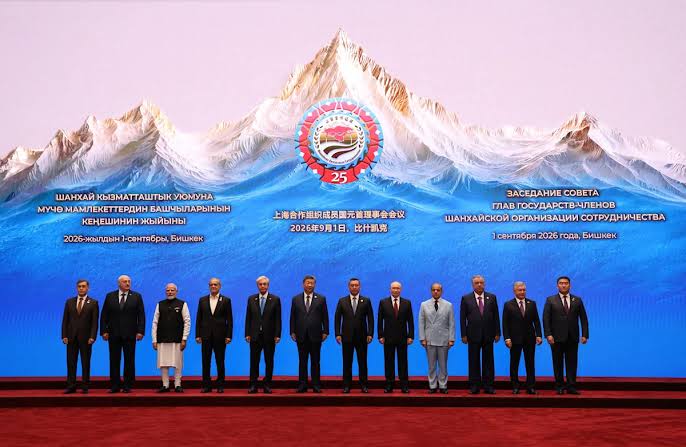
The 26th summit, convened in Bishkek under a Kyrgyz chairmanship and timed to the bloc's 25th anniversary, was therefore always going to be judged on two separate scales: what it actually signed, and what its principals said to one another in the corridors.
Key Developments
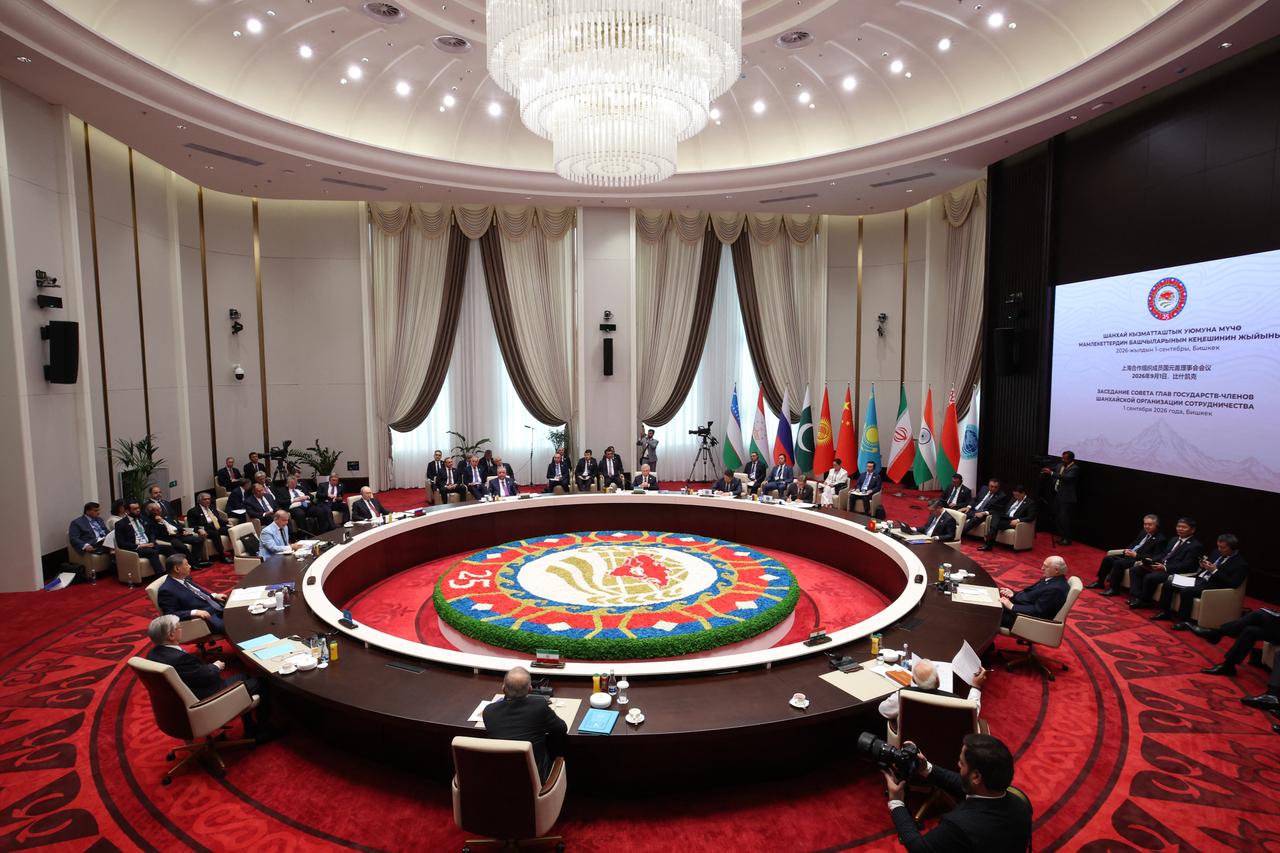
On Tuesday, September 1, the heads of state signed the Bishkek Declaration on the 25th Anniversary of the Shanghai Cooperation Organisation, together with a protocol amending the organisation's founding charter of June 7, 2002. The summit's organising committee, in remarks carried by the Russian state agency TASS, said 27 further documents were adopted alongside the declaration itself.
The substantive content of that package is institutional rather than declaratory. Leaders approved regulations for a new Universal Centre for Countering Security Challenges and Threats to SCO Member States — an attempt to consolidate the bloc's scattered counterterrorism machinery into a single standing body — and separate regulations for the executive committee of the SCO Anti-Narcotics Centre. They adopted a programme on combating drug addiction running to 2030 and a companion programme on coordinating measures against synthetic drugs and their precursors over the same period, a reflection of Central Asian governments' mounting alarm at trafficking routes running north from Afghanistan.
A second cluster of documents is economic and technological. The leaders signed an action plan, described as a roadmap, for developing the member states' ports and logistics centres between 2026 and 2030; a cooperation programme establishing an SCO "Green Technology Corridor" for scientific and technological cooperation over the same window; a plan on ensuring international information security for 2026 to 2028; and an initiative on the conservation and sustainable management of biodiversity running to 2031. Separately, the parties signed a declaration on strengthening multilateral partnership for nuclear and physical nuclear security, and a statement by the Council of Heads of State on developing cooperation in energy systems.
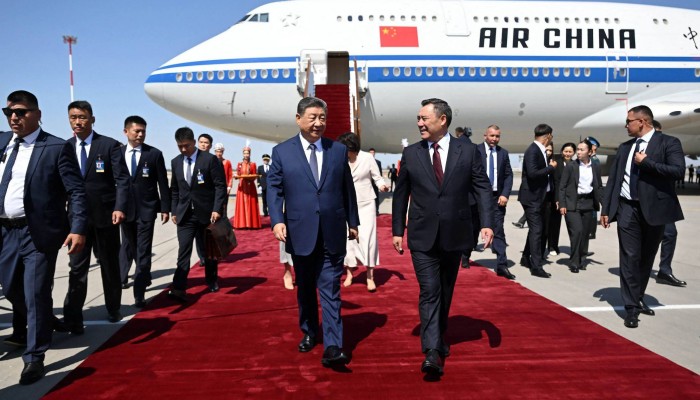
The rhetorical framing came, predictably, from Beijing and Moscow. Speaking at the summit and at the associated "SCO Plus" session, Chinese President Xi Jinping argued that a multipolar world is an irreversible trend grounded in sovereign equality and mutual respect, called on major powers to uphold rules and the rule of law, and said that hegemony, unilateralism and protectionism run counter to the tide of history. He described the SCO as a priority platform for high-quality construction of the Belt and Road Initiative and for advancing China's Global Development Initiative, and said Beijing is ready to help build the organisation into a vehicle for its Global Security Initiative. Russian President Vladimir Putin, for his part, told the session that the SCO has become an independent centre of the emerging multipolar world and is effectively the largest regional association not only in Eurasia but globally.
India took a different tack. In his address, Prime Minister Narendra Modi delivered an unusually pointed passage on terrorism, telling the plenary that "terrorism continues to pose a serious challenge to humanity" and that "in our fight against it, we cannot limit ourselves to a mindset of action and reaction. We must dismantle the entire ecosystem of terrorist financing, recruitment, radicalisation, and safe havens." He added that member states "must speak with one voice that there can be no room for double standards on this serious issue" and that countries which "make terrorism a tool of their policy" must be told plainly that "terrorism cannot be a strategic asset for anyone." The formulation is a familiar Indian argument aimed principally at Pakistan, and its delivery inside an SCO plenary that includes Islamabad was the summit's sharpest moment of open friction.
Modi also framed India's approach around three pillars — security, connectivity and opportunity — pressed for people-to-people ties as the centre of the bloc's work, and confirmed that India will host the first session of the SCO Civilizational Dialogue Forum, an initiative New Delhi proposed a year ago. He departed Bishkek for New Delhi on Tuesday afternoon.
The Bilateral Track
As is usual at SCO summits, the bilateral meetings on the margins carried at least as much weight as the plenary. The most watched of these was the encounter between Putin and Xi, which the Kremlin had signalled in advance would address the long-stalled Power of Siberia 2 pipeline — the project intended to carry some 50 billion cubic metres of Russian gas a year to China via Mongolia, and the most consequential single item in the Russia-China economic relationship since Western markets closed to Gazprom.
No agreement was announced. Reporting from the summit indicates the two sides remain deadlocked on the same question that has blocked the project for years: price. China currently pays roughly $258 per thousand cubic metres under existing contracts, against something closer to $420 charged to other international buyers, and Beijing is understood to be seeking both a comparable discount and fixed offtake volumes for the new line — terms that Gazprom cannot underwrite without substantial state support. China's foreign ministry spokesman Guo Jiakun said only that Beijing is ready to deepen practical energy cooperation with Russia, Power of Siberia 2 included, on the basis of mutual respect and mutual benefit. That is the language of a negotiation continuing, not one concluding. Discussions are expected to carry over to the Eastern Economic Forum in Vladivostok, which opened on September 1 and runs to September 4 and includes the eighth Russia-China Energy Business Forum.
Putin used the bilateral track for a series of other approaches: he proposed making the Russia-China visa-free regime permanent, met Modi and — according to the Kremlin — briefed him on the progress of Russia's operations in Ukraine while thanking him for his expectations of Putin's planned visit to the BRICS summit in New Delhi later this month, and held meetings with the Kazakh, Uzbek and Armenian leaders. Kremlin spokesman Dmitry Peskov, asked why the bloc keeps attracting new applicants, replied that its participants adhere to an approach "based on mutual respect rather than rules imposed by a boss on vassals" — the standard Russian framing of the SCO as the anti-G7.
The presence that drew the most outside attention, however, was Iran's. President Masoud Pezeshkian travelled to Bishkek hours after Iranian ballistic missiles were fired at United States bases in Jordan in retaliation for an American strike on Larak Island, telling reporters before departing Tehran that Iran is "not looking for war, but we will give a decisive response to the aggressors." In Bishkek he said Tehran seeks a peaceful settlement of its conflict with Washington rather than a continuation of the war, and argued that forces within the United States are seeking escalation for advantage. He met Putin on the summit's margins. Peskov, asked whether Moscow might mediate between Tehran and Washington, said it remains difficult to speak of mediation at this stage.
Reactions and Assessment
The gap between the declaration's language and the summit's actual output is the story analysts will argue over. On one reading, the Bishkek package is exactly what a functioning multilateral organisation produces: a charter amendment, a consolidated security centre, sequenced programmes on narcotics, ports, information security and green technology, and a nuclear-security declaration. These are unglamorous instruments, but they are the kind of institutional plumbing that the SCO has historically lacked and that distinguishes a standing organisation from an annual photograph.
On a less generous reading, the summit demonstrated precisely the ceiling the bloc keeps hitting. Its two largest economies could not close their flagship energy project. Its newest major member is at war and left without a mediator. Two of its members traded barely coded accusations over terrorism from the same podium. And the declaration, like its predecessors, addresses the wars in Ukraine and the Persian Gulf — the two conflicts that most directly involve SCO members — only obliquely, because there is no formulation on either that all ten capitals would sign.
Western governments issued no substantive response to the declaration, consistent with a pattern of treating SCO summitry as symbolically important but operationally thin. That posture may be increasingly hard to sustain. The bloc's combined weight, the steady accretion of observers and dialogue partners, and the fact that its members are now the principal buyers of discounted Russian and Iranian energy give its coordination mechanisms real economic consequence even when its communiqués are vague.
What Comes Next
Three threads run out of Bishkek. The first is the pipeline: whether the Vladivostok forum produces movement on Power of Siberia 2, or whether the project remains what sceptics have long called it — a Russian negotiating asset that Beijing has no urgent reason to buy. The second is the Iranian file, where Pezeshkian's dual message of restraint and retaliation, delivered from a summit hosted by two of the five permanent Security Council members, tests whether the SCO can convert convening power into diplomatic leverage. The third is India's position, which grows more awkward as the bloc's centre of gravity shifts toward an explicitly anti-Western framing that New Delhi, mid-negotiation with Washington on trade and defence, has no interest in endorsing.
For now, the organisation has what it came for: a signed declaration, an amended charter, and a twenty-fifth anniversary observed in the presence of Xi, Putin, Modi and Pezeshkian together. Whether that constitutes an emerging pole of world order or a well-attended reminder of how little its members agree on is a question the next twelve months, and the projects signed this week, will begin to answer.
Published By | News Editor