Written By | Fashion and Design Desk
For nine days this month, a bamboo structure clad in Indian police shields and farmers' woven rain capes stood on the Strand between Somerset House and India House.
LONDON
Most festival pavilions are built to be liked. That is their function: a photogenic object in a public place, pleasant to walk through, gone in a fortnight.
The Pangolin Shield was built to be uneasy, and it chose its ground carefully. It stood from 12 to 20 September on the newly pedestrianised stretch of the Strand, directly outside Somerset House — the building from which the British Navy was administered during the colonial period — and a short walk from India House, home of the Indian High Commission. Between those two addresses sits about two hundred years of a relationship that Britain has never fully described to itself.
Studio Saar, working with the structural engineers Atelier One, put a building there made of the tools of that relationship.
What It Was Made Of
The structure underneath is a bamboo grid shell — chosen, the designers have said, because bamboo is light, strong, fast-growing, biodegradable and geometrically generous in a way that steel is not. The cladding is where the argument lives.
The first layer is made from traditional Indian police shields, constructed from lathis — the bamboo batons that police forces in South Asia have used for crowd control for more than a century. The lathi charge is not an abstraction in Indian history. It is a specific, repeated, documented thing.
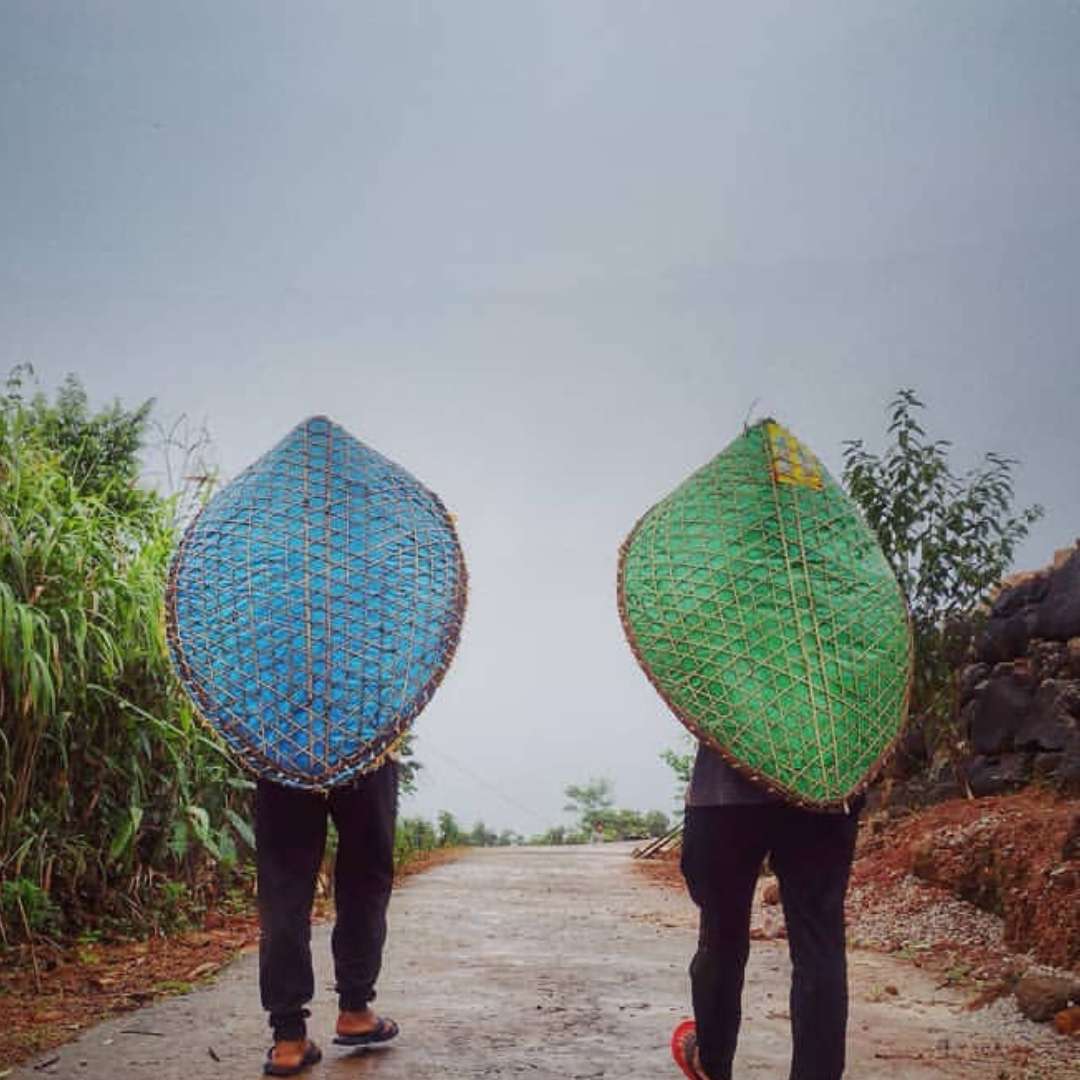
Over those shields sits a second layer: knups, the woven rain shields that farmers in north-east India wear across their backs in the fields during monsoon. They are agricultural garments — protection from weather, made by the people who use them.
Two kinds of shield, stacked. One is held by the state and pointed at a crowd. The other is worn by a farmer bent over a field. The pavilion does not explain which is which; standing under it, you work it out by looking.
Why a Pangolin
The form comes from the pangolin, and the choice is not decorative.
The pangolin is the most trafficked mammal on earth. Its defence is to curl into a ball, presenting an armour of overlapping keratin scales — a strategy effective against predators and worse than useless against humans, who simply pick the curled animal up and carry it away. The thing that protects it is exactly the thing that makes it portable.
Cladding a building in overlapping shields and calling it a pangolin is therefore a bleak joke about armour, and about the difference between defending yourself and being collected.
The stated themes are colonial legacies, power, ecological exploitation and the movement of people and beings across borders. Those four sit together more tightly than a list suggests. The pangolin trade, the lathi, the monsoon farmer and the Strand are all, in different registers, about who is permitted to move and who is handled.
The Engineering Argument
It would be easy to read the Pangolin Shield as political sculpture that happens to be building-shaped. That undersells what Atelier One, led by its founder Neil Thomas, contributed.
Bamboo grid shells are structurally demanding. The material's properties vary along its length and between culms in a way that engineered timber and steel do not; the joints do the hard work; the geometry has to be computationally resolved before anything is cut. Contemporary practice has advanced enormously here in fifteen years, and the results still rarely appear in the centre of a Western capital in front of a general public.
That matters for a boring reason: bamboo is one of the very few structural materials that sequesters carbon while growing at a rate measured in years rather than decades. Every serious demonstration of it as a load-bearing material in a high-visibility Northern European setting moves the regulatory and insurance conversation slightly. The Pangolin Shield was an argument about empire. It was also a load test.
The Festival Around It
The Pangolin Shield was one of this year's Landmark Projects, the category London Design Festival reserves for large-scale commissions meant to anchor the programme. The rest of the week ran in a similar register — smaller, quieter, more interested in making than in spectacle. Among the most discussed were the One Tool Stool exhibition, in which Royal College of Art students each designed and built a stool using a single tool, and a fictional 1930s hotel suite constructed as the setting for the first editions collection from Lobby, a new design platform.
There is a through-line. A stool made with one tool, a rain shield woven by the farmer who wears it, a bamboo shell whose joints are the whole structural story — the festival's strongest work this year was consistently about the relationship between the person making something and the thing made. That is not nostalgia. In a year when most design conversation has been about generative tools and speed, it reads as a deliberate counter-position.
What You Can Take From It
The pavilion is down now. So what is the use of reading about it? Two things, practically.
First, the material. Bamboo is no longer a gesture toward sustainability — it is a structural system with real engineering behind it, and the work being done on grid shells is increasingly relevant to ordinary buildings. If you are commissioning or renovating anything in the next few years, what the structure is made of is now a live question rather than a settled one.
Second, the siting. The pavilion worked because it stood between two specific buildings whose histories it was arguing with. That is a transferable idea and a cheap one. Public art and temporary architecture in Britain are overwhelmingly sited by convenience — where permits are easy and footfall is high. Placing an object where it has something to say about its address costs nothing extra and changes everything about what it means.
A pavilion is a temporary building with a permanent afterlife in photographs, which is usually its problem. The images flatten it. What you get afterwards is a shape.
This one resists that, because the shape is not the point. The point was two layers of shield, one issued and one woven, stacked over a frame of the same material the batons are made from, standing between the Navy's old offices and the Indian High Commission. You had to be there, and now you can't be. That is also, probably, part of the argument.



