Written By |

The findings, published in the American Journal of Human Biology, suggest that individuals exposed to higher levels of testosterone in the womb tend to consume more alcohol as adults
Ever wondered why some people have an insatiable love for beer? New research suggests the answer could lie in our biology, with a surprising link to prenatal testosterone exposure.
A study by scientists at Swansea University reveals that our drinking habits might be influenced before we’re even born. The findings, published in the American Journal of Human Biology, suggest that individuals exposed to higher levels of testosterone in the womb tend to consume more alcohol as adults.
Finger length as a clue
The research focused on the 2D:4D digit ratio—the comparative length of the index and ring fingers—which is believed to reflect the balance of testosterone and estrogen exposure in utero.
Led by Professor John Manning, an evolutionary biology expert, the team measured the finger lengths of 258 university students (89 men and 169 women) and recorded their weekly alcohol consumption.
The results showed that participants with longer ring fingers relative to their index fingers—a "low digit ratio"—consumed more alcohol. This was particularly pronounced in men with long ring fingers on their right hand.
“Alcohol consumption is a major social and economic problem,” said Professor Manning. “Understanding why individuals differ in alcohol use is vital. It appears these differences might be set in the womb.”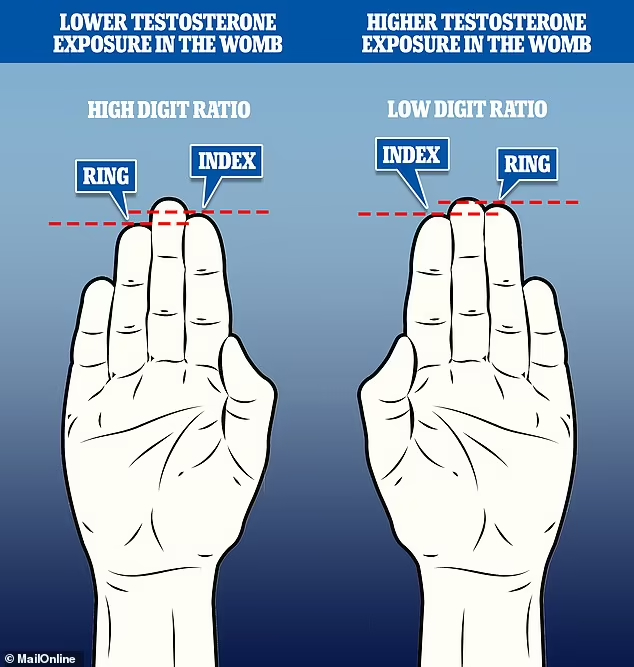
Testosterone and alcohol tolerance
The exact reason for the link remains unclear, but Professor Manning theorizes that higher testosterone exposure could influence alcohol tolerance. Testosterone may enhance the activity of stomach enzymes that reduce alcohol absorption, making individuals with higher levels of the hormone more likely to drink.
“Enzymes in male stomachs can reduce alcohol absorption by 30%, whereas females absorb more into the bloodstream,” Manning explained.
Beyond Beer: Other trends linked to finger ratios
The study adds to a growing body of research linking the 2D:4D ratio to various physical and behavioral traits, including athletic performance, income, diet preferences, and even anxiety levels.
For instance, previous studies found that women with longer ring fingers have better grip strength, and men with the same trait tend to prefer "masculine" foods like steak over salad.
Interestingly, earlier research by Swansea University also linked longer ring fingers in children to mothers with higher incomes, suggesting that maternal hormone levels during pregnancy may influence developmental traits.
Cautions and future research
The researchers admit that their study sample—university students—may not fully represent the broader population. Moreover, while the findings highlight a correlation, more research is needed to establish a direct causal link between prenatal testosterone exposure and adult drinking habits.
How to measure your digit ratio
Curious about your own 2D:4D ratio? To measure, locate the crease at the base of your fingers (closest to your palm). Measure the lengths of your index and ring fingers from this point to the tips, and divide the ring finger length by the index finger length.
If your ring finger is longer than your index finger, it might hint at higher prenatal testosterone exposure—and, according to this study, possibly a stronger inclination toward a pint of beer.
While this quirky discovery offers fascinating insights into our biology, it also underscores the complex factors that shape human behavior, from prenatal development to societal influences. Cheers to science for shedding light on why some of us are predisposed to raising our glasses!
Source: Daily Mail



