Written By | International News Agencies
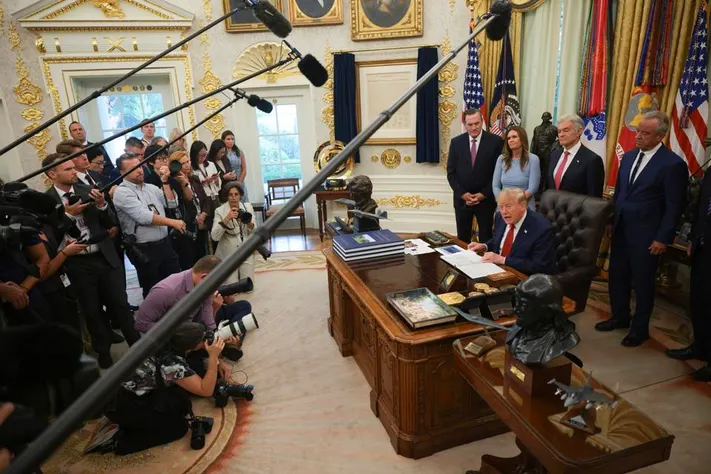
After CNN, MS NOW and Politico were stripped of their White House passes, the five broadcast networks suspended the television pool.
Daily World Politics
Background
On Friday 18 September, President Donald Trump announced on social media that he was banning CNN, MS NOW and Politico from the White House “effective immediately,” citing what he described as their constant reporting of “fake news,” and warning that other outlets could follow. At the time it was not clear the declaration had any mechanism behind it. Asked in the Oval Office to name a story that had prompted it, he cited no single article but “cumulative stories” over the past several years. He denied the intent was intimidation and said of the measure’s prospects in court, “I think it’s good to point it out whether it survives or doesn’t.” CNN reporters remained on the grounds that day, and the episode looked for a few hours like rhetoric.
On Saturday it acquired teeth. MS NOW’s Akayla Gardner, CNN’s Betsy Klein and Politico’s Cheyenne Haslett each attempted to enter the White House grounds to cover the news and were turned away by the Secret Service, which seized their press passes. The three organisations were, in effect, removed from the building.
That left an operational problem the administration may not have anticipated. Day-to-day coverage of an American president is not conducted by whichever outlets happen to be present; it is conducted by the White House press pool, a rotating group of roughly twenty journalists who accompany the president through his public appearances and share their reporting, photographs, audio and video with every other newsroom in the country. The television component of the pool relies on five networks — ABC, CBS, CNN, Fox News and NBC — which take turns supplying the live feed and, crucially, the microphones. CNN was on the rota. It had been scheduled to cover the president’s trip to New York for the United Nations General Assembly.
Key Developments
When the White House barred CNN from fulfilling that assignment, the other networks declined to replace it. In an email to members on Monday, the current chair of the television pool — Fox News’s Washington bureau chief, Bryan Boughton — wrote: “Effective today, the TV pool will not be covering events designated as pool coverage of the President. This follows the White House’s position preventing CNN from fulfilling its assigned pool duties.” There would be no substitute crew, and the networks would suspend their own pool coverage indefinitely.
The five issued a joint statement: “The public has a vital interest in receiving accurate, independent information about its government. No administration should restrict a news organisation because it objects to its reporting.” That ABC, CBS, CNN, Fox News and NBC — commercial rivals with sharply divergent editorial identities, Fox News included — acted together is the detail most media observers seized on. Coordinated action of this kind among the broadcast networks has almost no recent precedent.
Other newsrooms followed in their own currencies. The Associated Press, Agence France-Presse, the Washington Post and the New York Times each declined to publish photographs of presidential events on Monday. C-SPAN said it would not carry the president’s White House helipad ribbon-cutting because it depends on the television pool and had no feed.
The consequences were visible within hours, and audible only in the negative. The ceremony for the new granite helipad on the South Lawn — a project Trump has taken a personal interest in — was streamed solely on the White House’s own website. Without pool microphones, the president’s remarks were completely inaudible. Later the same day he held a press conference at which, according to Axios, the White House-provided video again carried no usable audio. The president of the United States spoke in public twice on Monday and the public could not hear him either time. His departure for the United Nations proceeded without live television coverage, though the UN’s own cameras were expected to carry the General Assembly proceedings themselves, limiting the blackout’s reach in New York.
On Monday evening the White House responded by switching on a round-the-clock video stream it called “Trump TV: The Essentials Station,” promising “top videos, major remarks, and must-see highlights streaming 24/7 and updated in real time.” When it came online it was showing archive footage of a speech the president delivered at Mount Rushmore on 3 July.
Also on Monday, CNN, MS NOW and Politico filed suit against the administration, seeking an emergency order restoring their access. “This ban could not be a more direct assault on the First Amendment nor a more blatant violation of our most fundamental constitutional principles,” the organisations said in their filing. The case argues violations of both the First Amendment and the due process guarantees of the Fifth, and rests substantially on a 1977 decision of the D.C. Circuit Court of Appeals holding that the White House cannot arbitrarily deny a journalist a press pass without due process. The emergency request goes before a federal judge in the District of Columbia and could produce hearings and argument from the government as soon as this week. The three outlets have retained Ted Boutrous, the First Amendment lawyer who represented CNN against the first Trump administration in the 2018 Jim Acosta case — which CNN won.
Reactions
Vice President JD Vance defended the ban and dismissed the outlets as purveyors of “effectively far-left propaganda.” He drew a distinction the administration has leaned on throughout: “They can still report. They still have the access to free speech. They’re just not going to get an office in the White House anymore.” The argument is that a press pass is a privilege rather than a right, and that withdrawing one restricts no one’s speech. The 1977 precedent the plaintiffs cite was written to address precisely that claim.
Jacqui Heinrich, the Fox News anchor who serves as president of the White House Correspondents’ Association, said the WHCA “stands in defense of our colleagues at CNN, MS NOW, and POLITICO who are being singled out for doing their jobs.” Jameel Jaffer of the Knight First Amendment Institute has described the original ban as “doubly unconstitutional,” on the grounds that the press pool functions as a public forum from which the government may not exclude outlets on the basis of viewpoint.
Seth Stern, chief of advocacy at the Freedom of the Press Foundation, made the case that the pool matters well beyond Washington. “This isn’t just DC insider access journalism,” he told Axios. “If you’re living in Wyoming or Arizona or Chicago, it’s very likely that the White House news you’re reading originates from the press pool.” He conceded the pool has been degraded by the president’s own conduct — “the press pool is not getting honest and thoughtful insights from this president” — but argued that this does not make it dispensable: “The way this president behaves is a news story.”
One of the pool reporters, Axios’s Brittany Gibson, described the arrangement from inside it: the pool is “a collaborative effort amongst the nation’s top news outlets” whose daily reports of what reporters can see, hear and photograph are “carefully and quickly shared for the public record” as part of holding the office accountable. The pool also performs mundane but load-bearing functions — recording when the presidential car arrives somewhere, ensuring a camera exists if the president must address the country without notice.
What’s Next
The legal question is likely to be resolved quickly and, on the available precedent, not in the administration’s favour. Courts have repeatedly held that journalists cannot be barred from covering the White House on the basis of what they publish, including in litigation arising from this administration’s exclusion of the Associated Press in February 2025 over the wire service’s refusal to adopt the term “Gulf of America,” a case still working its way through appeal. The 2018 Acosta ruling went the same way. A district judge weighing an emergency motion has a well-marked path.
The harder question is what happens to the pool. The networks have suspended coverage “indefinitely,” which means the blackout holds as long as CNN is excluded — but it is a costly posture for organisations whose business depends on covering the president, and the administration has demonstrated it is willing to fill the gap with its own cameras. The risk the correspondents’ association has warned about for eighteen months is not that the White House silences the press but that it replaces it: in February 2025 the administration took control of pool composition from the WHCA, and “Trump TV” is the logical continuation. A government-produced feed carries no hostile questions and no independent audio, and it is what the public got on Monday.
There are two further variables. The president has already named the New York Times and the Washington Post as “crummy” and warned that other outlets could follow the three already barred; each addition widens the coalition against him. And the Pentagon has pursued a parallel campaign, with Defense Secretary Pete Hegseth inviting reporters who dislike the new credentialing rules to “self-deport from the Pentagon.” Whether the networks hold their line through a UN week and a contested midterm autumn, and whether the courts move fast enough to matter, will determine whether Monday was an aberration or a template.



