Background
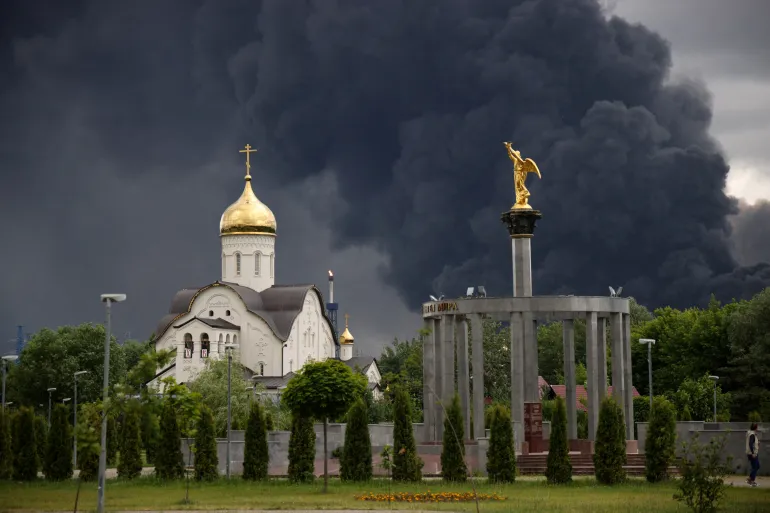
Now in its fifth year, Russia’s full-scale invasion of Ukraine has increasingly become a war fought as much over energy infrastructure as over territory. Since 2024, and especially since early this year, Ukraine has dramatically escalated a campaign of long-range drone strikes against Russian oil refineries, storage depots, and export terminals — attacks Ukrainian President Volodymyr Zelensky has described as “long-range sanctions” intended to choke off the revenue and fuel supplies that sustain Moscow’s war effort. An Associated Press count found more than 50 reported Ukrainian strikes on Russian oil infrastructure since late March alone, reaching facilities as far as 700 kilometers from the front line, including refineries in Krasnodar Krai on the Black Sea coast and Yaroslavl Oblast, hundreds of miles north of Ukraine.
The strategy reflects a broader shift in Ukrainian military doctrine, relying on a secretive and rapidly scaling domestic drone-production program to strike targets Russian air defenses have historically struggled to protect, given the sheer size of the country and the number of facilities to defend. Unlike frontline territorial gains, which have moved slowly and at enormous cost to both sides, the refinery campaign has produced measurable, nationwide effects on the Russian economy within a matter of months — a rare instance in the war of a strategy translating quickly into visible pressure on Russian civilian life.
Ukraine has relatively little to show for the strategy on the battlefield map itself, where the front line has shifted only marginally over the past year despite enormous casualties on both sides. That stalemate has pushed Kyiv toward strategies that impose costs on Russia away from the trenches, and the refinery campaign — alongside continued Western sanctions on Russian oil exports and the shadow fleet that helps move them — represents the most visible of those efforts. Ukrainian officials have been careful to distinguish the campaign from direct attacks on civilians, framing refineries, depots, and export terminals as legitimate military-economic targets given their role in funding and fueling the invasion.
Key Developments
By late June, Russian crude oil processing had fallen 25% year-over-year to 3.95 million barrels per day, the lowest level in more than two decades, according to industry estimates cited by the Associated Press. Gasoline production dropped 17% to roughly 850,000 barrels a day, well short of the roughly 1.03 million barrels a day Russia produced over the same period last year and short of domestic demand. The shortfall has triggered fuel rationing across more than half of Russia’s regions, spanning Moscow and Leningrad in the west, the Volga region, southern Russia, occupied Crimea, and as far as Siberia and the Far East. Gas station chains in cities including Ryazan and Nizhny Novgorod have imposed purchase limits of 10 to 20 liters per customer, and some stations have run out of gasoline entirely while offering only diesel.
Videos circulating on social media and picked up by Western outlets showed physical altercations breaking out among drivers waiting in long lines at gas stations, a striking image for a country that ranks among the world’s largest oil producers and exporters. One resident of Siberia, identified only as Tanya, 29, told the outlet east2west she waited 13 hours for half a tank of fuel, telling reporters, “He should stop this senseless conflict and let us live normally” — a rare instance of open public frustration directed at President Vladimir Putin over the war’s domestic costs.
Putin himself acknowledged the shortages publicly for the first time in comments to a state television interviewer over the weekend of June 27-28, describing the situation as a “temporary deficit” that the government would address by importing additional fuel from allied countries and accelerating repairs to damaged refineries. It marked a notable shift from the Kremlin’s earlier posture of minimizing the war’s impact on ordinary Russians, and came just as Zelensky announced that Ukrainian forces had struck two additional refineries overnight, in the Krasnodar region — about 300 kilometers from the front line — and Yaroslavl Oblast, roughly 700 kilometers away, underscoring the campaign’s reach deep into Russian territory far from the active front.
Western analysts say the fuel crunch has begun to affect Russian military logistics as well as civilian life, slowing resupply efforts and adding pressure on the Kremlin at a moment when the broader war remains at a grinding stalemate along most of the front line. The refinery campaign runs alongside a fragile, separate track of U.S.-brokered de-escalation efforts in the Middle East and periodic diplomatic contacts over Ukraine, though no comprehensive ceasefire or peace framework for the Russia-Ukraine war itself has emerged.
Reactions
Zelensky has framed the refinery campaign as central to Ukraine’s strategy for ending the war on favorable terms, warning in public remarks that “Moscow will burn” if Putin continues the invasion, and describing each successful strike as a direct reduction in the resources fueling Russia’s war machine. Ukrainian officials have increasingly presented the campaign not just as a military tactic but as a form of economic pressure intended to build domestic Russian opposition to the war, citing incidents like the gas station altercations as evidence the strategy is reaching ordinary citizens in a way frontline combat has not.
The Kremlin, for its part, has sought to downplay the severity of the crisis even while acknowledging it exists, with state media emphasizing the temporary nature of the shortages and government plans to import fuel and expedite repairs. Russian officials have not detailed which countries would supply emergency fuel imports, though energy analysts have pointed to potential arrangements with Belarus and other allied states. Some Russian regional officials have quietly extended rationing measures they initially described as short-term, suggesting local authorities do not expect a quick resolution.
International energy analysts, including those cited by outlets such as Al Jazeera and OilPrice.com, describe the crisis as unprecedented for a major oil-exporting nation and note it complicates Russia’s ability to sustain both its export revenues — a critical funding source for the war — and adequate domestic fuel supply simultaneously. Some Western officials have pointed to the crisis as evidence that sanctions and Ukrainian strikes together are having a cumulative effect on Russia’s economy that direct battlefield gains have struggled to achieve.
What’s Next
Ukrainian officials have signaled the refinery campaign will continue and likely intensify, with Zelensky’s government treating it as one of the few asymmetric advantages Ukraine holds against a numerically larger adversary. Kyiv’s drone production capacity has scaled substantially over the past year, suggesting the tempo of strikes seen in recent weeks — multiple refineries hit within days of each other — may become the new normal rather than a temporary surge.
For Russia, the immediate challenge is logistical: repairing damaged refining capacity while sourcing emergency imports fast enough to prevent further public unrest heading into the country’s peak summer travel season, when fuel demand typically rises. Should shortages persist or worsen, analysts expect rationing to expand into additional regions and potentially affect industries beyond personal transportation, including agriculture and freight, both of which depend heavily on diesel.
Politically, the open frustration captured in viral videos of gas station altercations represents a rare crack in the Kremlin’s tightly managed public narrative around the war, though there is little indication it currently threatens Putin’s grip on power. Whether the fuel crisis translates into broader pressure on the Kremlin to negotiate an end to the war, as Ukrainian officials hope, or is instead absorbed as one more managed hardship in a war now in its fifth year, is likely to become clearer over the coming weeks as both the strikes and the shortages continue. No new diplomatic initiative specifically targeting the Russia-Ukraine war was announced alongside these developments, leaving the refinery campaign as the most active front in the conflict for now.
Published By | News Editor