Written By | Tech Wiz
Egypt has become the single largest destination for African fintech capital
Egypt's technology sector in 2026 is being pulled in the same direction by three separate forces at once: a fintech industry attracting the largest funding rounds in African tech, a government-led push to turn the country's geography into hyperscale data-center capacity, and a national digitization drive aiming to put hundreds of government services online by the end of the year. Individually, each is a familiar African tech-development story. Together, they are turning Cairo, Alexandria, and the Suez Canal corridor into one of the continent's most closely watched digital growth bets.
Fintech Pulls Ahead of the Pack
Egypt has become the single largest destination for African fintech capital. Of the eight largest disclosed fintech funding rounds announced across the continent in the first half of 2026, four went to Egyptian companies, together worth a combined $171.4 million — a concentration of capital that outpaces every other African market on a per-round basis. The number of fintech startups and licensed payment-service providers operating in the country has grown more than fivefold in recent years, and Egypt's ecosystem now spans over 177 companies across more than 14 distinct fintech subsectors, from consumer lending and merchant payments to buy-now-pay-later and remittances.
The clearest proof point for the ecosystem's maturity is MNT-Halan, a Cairo-based fintech that has reached a $1 billion valuation and stands among the handful of unicorns in the broader MENA region. Having raised roughly $550 million in funding to date, MNT-Halan is targeting a further 40% expansion of its financing portfolio over the coming year, aiming for a total book of $4.5-5 billion by the end of 2026 — a scale that few African fintechs, including those in Nigeria and Kenya, currently approach. Beneath that flagship, smaller deals continue to close: in late July 2026, Fincart, an Egyptian startup building an AI-powered operating system for e-commerce merchants, raised a $2.8 million seed round to expand its platform across Africa and the Middle East, part of a broader wave of investor interest that Egyptian ecosystem trackers describe as concentrated around fintech, proptech, healthtech, edtech, mobility, and applied software.
Betting on Hyperscale: Egypt's National Data-Center Strategy
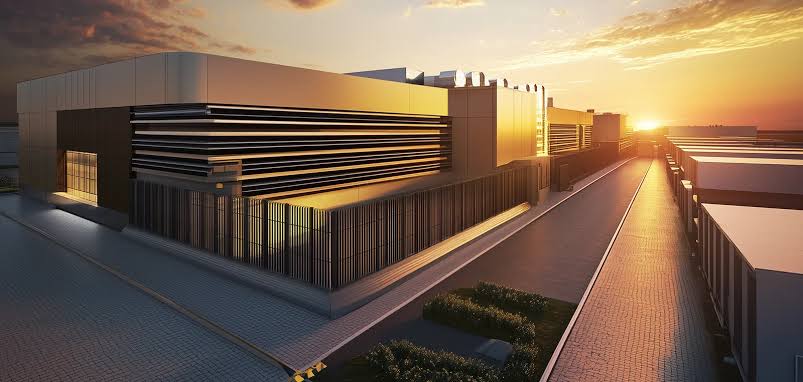
Egypt's government has moved to formalize what had been a piecemeal data-center buildout into a coordinated national strategy. In mid-2026, the country's ministers of electricity and renewable energy, communications and information technology, and investment and foreign trade met at the Ministry of Electricity's New Administrative Capital headquarters, under presidential direction, to align a unified national data-center and cloud-computing framework — an explicit recognition that power availability, telecom infrastructure, and investment incentives all need to move together if Egypt is going to compete for hyperscaler capacity against Gulf rivals.
The centerpiece project so far is NEOIX.AI's proposed 150-500 megawatt hyperscale data-center campus in the New Administrative Capital, which has received formal endorsement from the Ministry of Communications and Information Technology as a cornerstone of the national digital-transformation push. Market researchers value Egypt's current data-center market at roughly $241.6 million as of 2025, projecting growth to about $500.2 million by 2034 at a compound annual growth rate near 8.17% from 2026 onward — modest in global terms, but the underlying strategic logic is less about the current market size than about position: Egypt sits at the crossing point of Europe, Asia, and Africa, and both the Suez Canal Economic Zone and the Cairo-Alexandria corridor are being marketed to hyperscalers and colocation operators as the natural landing ground for capacity meant to serve all three continents at once.
The Cable Landings That Make the Strategy Possible
None of Egypt's data-center ambitions work without the subsea cable capacity to back them, and 2026 has been a landmark year on that front. Telecom Egypt and the Medusa Submarine Cable System, under an agreement first signed in September 2023, are extending the Medusa cable to a landing at Port Said, linking multiple Mediterranean cities into the Egyptian network by 2026. The Africa-1 cable system, roughly 10,000 kilometers in length and also targeting 2026 completion, will connect Africa, the Middle East, and Europe with Telecom Egypt as a core participant, while the EAGLE cable — a Telecom Egypt-backed system connecting Egypt and Albania — is likewise slated for completion this year. Combined, these systems reinforce Egypt's long-standing role as one of the world's most important subsea cable junctions, a position that predates the current data-center push but that the government is now explicitly trying to monetize through onshore compute capacity rather than simply collecting transit fees.
Digital Egypt 2026: E-Government and Digital Identity
On the public-sector side, Egypt's Ministry of Communications and Information Technology is pursuing what it has branded the "Digital Egypt 2026" push: full automation of government services paired with seamless digital-identity verification. The country plans to expand the number of services available through the unified Digital Egypt platform to more than 270 by the end of 2026, up from 242 currently and roughly 100 as recently as 2025 — services spanning ID renewals, tax payments, business licensing, and civil registry functions. The government reports that the existing digitized services have already cut citizen wait times by roughly 40% and administrative costs by about 25% compared with in-person processing.
The identity layer underpinning that expansion is advancing in parallel. Egypt's Ministry of Communications is developing a digital identity card intended to enable remote identity verification so citizens can access government services entirely online, while the Central Bank of Egypt has unveiled a companion platform — a mobile application called Haweya — designed to support remote electronic Know-Your-Customer (eKYC) checks. Haweya is intended to let users open accounts across all 37 licensed Egyptian banks, verify documents, subscribe to telecom services such as new SIM cards, and access other government and private-sector services without an in-person visit, a financial-inclusion play that dovetails directly with the fintech sector's own growth ambitions. Egypt's broader AI strategy, layered on top of this digitization push, targets $42.7 billion in AI-related economic value and aims for the technology sector to contribute 7.7% of GDP by 2030.
Cairo's Startup Infrastructure: Accelerators, Funds, and a Growing Bench
Supporting all of this is an increasingly dense startup-support infrastructure centered on Cairo. Flat6Labs, launched in 2011 by Sawari Ventures, remains the ecosystem's most established seed-stage investor and accelerator, currently managing eight seed funds totaling $85 million in assets under management, backed by more than 25 institutional investors. In May 2026, Flat6Labs partnered with Cityscape Egypt to launch the third edition of the Egypt PropTech Challenge, while InvestIT — a joint investment-readiness program run by ITIDA, the Technology Innovation and Entrepreneurship Center (TIEC), and Flat6Labs — continues to prepare ICT-enabled startups for institutional funding rounds. Beyond Flat6Labs, Cairo's investor base now includes Algebra Ventures, Endure Capital, Foundation Ventures, Falak Startups, Cairo Angels, Nclude, Camel Ventures, Cubit Ventures, and 138 Pyramids, a bench deep enough that ecosystem trackers now describe Cairo as a full-stack startup hub rather than a single-accelerator story. MNT-Halan's unicorn status functions as the ecosystem's proof of concept: evidence, as local investors frame it, that a company solving a distinctly Egyptian financial-access problem can scale into a billion-dollar outcome rather than being capped by domestic market size.
The Throughline: Infrastructure First, Then Scale
What ties Egypt's 2026 tech story together is sequencing. The government is trying to lock in physical and regulatory infrastructure — subsea cables, hyperscale power and data-center capacity, a unified digital-identity and e-government layer — at the same time private capital is proving out commercial demand through fintech. If the national data-center strategy delivers the megawatts NEOIX and its peers are promising, and if the Medusa, Africa-1, and EAGLE cable landings complete on schedule this year, Egypt will have assembled the physical backbone to match the commercial momentum fintech has already generated. The open question, as with any infrastructure-led strategy, is execution speed: hyperscale data-center projects and multinational cable systems have a long history of slipping their targeted completion dates, and Egypt's 270-services-by-year-end e-government goal will be a near-term test of whether the country's digitization ambitions are keeping pace with its announcements.




