ADDIS ABABA
Ethiopian federal forces and allied militias have taken control of Mekelle, the capital of the Tigray region, after the Tigray People's Liberation Front (TPLF) pulled its fighters out of the city, Al Jazeera reported on Oct. 4. The TPLF described the retreat as temporary, saying its regional administration had "temporarily moved out of Mekelle" and would "operate from somewhere else." The capture is the most dramatic episode so far in a conflict that has unraveled the 2022 Pretoria peace agreement in barely two weeks and that has already pulled in Eritrea, Egypt and Sudan through diplomatic rupture and mutual accusation.
For Prime Minister Abiy Ahmed, the retaking of Mekelle is a symbolic and military victory. For the region, it raises a harder question: whether holding a city can end a war in which the other side has, by its own account, simply relocated.
A peace that did not hold
The Pretoria agreement, brokered by the African Union in November 2022, ended a 2020-2022 war that Al Jazeera describes as having killed hundreds of thousands of people and displaced millions. The deal silenced the guns but left central disputes unresolved, among them contested territories, the return of displaced people and the disarmament of Tigrayan forces.
The agreement frayed steadily. In July 2026, the TPLF declared that the accord had "effectively collapsed," accusing the federal government of failing to implement its provisions, according to Al Jazeera. Sporadic clashes and drone strikes followed.
The decisive break came on Sept. 23, 2026, when, according to Al Jazeera's reporting, seven armed and political groups formed an alliance aimed at removing Abiy from power. Al Jazeera's account of the TPLF's role, and a separate report from Dawan Africa, indicate that the TPLF joined six other armed groups in that coalition, which the Dawan report calls the "Alliance for Survival." Heavy fighting began the same day. Dawan reported that Tigrayan forces recently seized airports in Mekelle, Aksum and Shire before the federal counteroffensive reversed their gains.
The fall of Mekelle
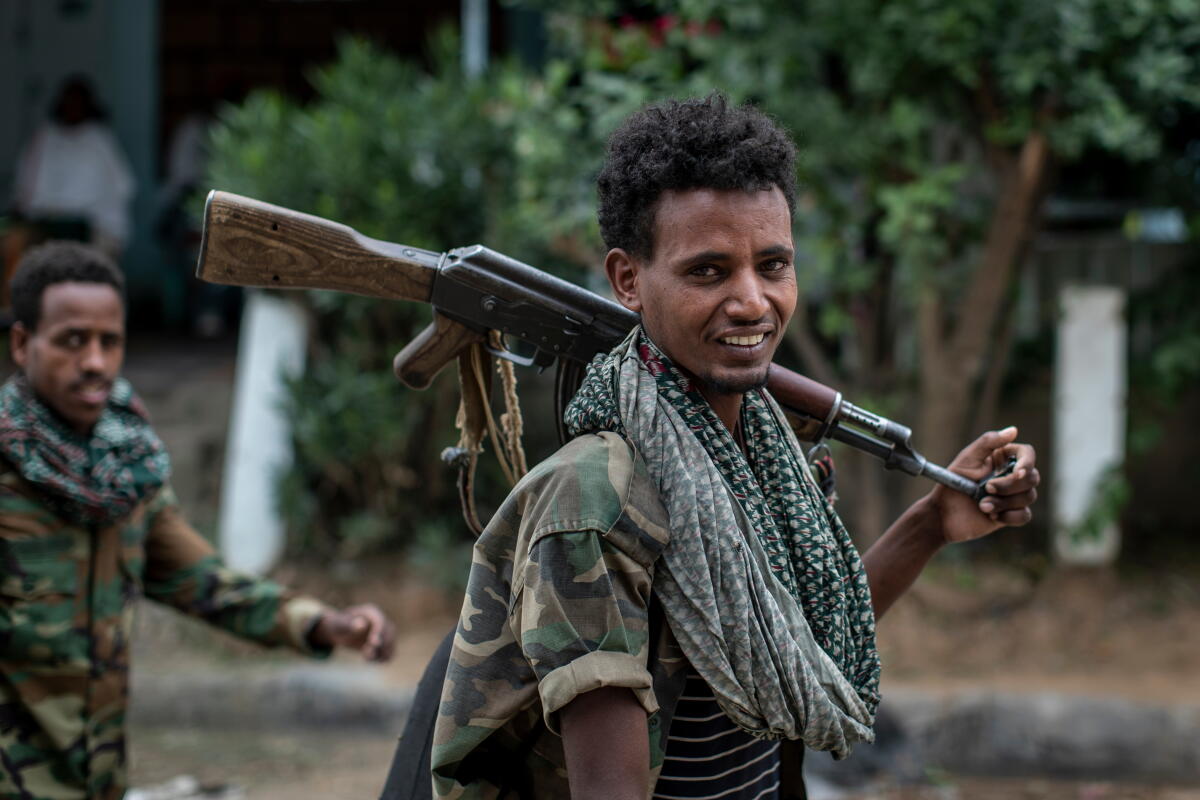
Federal forces and pro-government militias first retook Alula Aba Nega Airport, about 10 kilometers (6 miles) east of Mekelle's center, Al Jazeera reported on Oct. 3, citing sources with knowledge of events who spoke to Reuters, humanitarian organizations and local residents. Journalists documented TPLF fighters "abandoning their posts and heading home," the outlet said.
By Oct. 4, Al Jazeera reported that the advance had reached the city center. Multiple sources, including pro-government militia fighters, the Ethiopian military, humanitarian groups and residents, confirmed government control, with reporting attributed to AFP and Reuters. Al Jazeera's Oct. 5 coverage said allied Tigray Peace Force fighters took part in the capture. Al Jazeera describes the Tigray Peace Force as allied with the federal side. Al Jazeera also documented looting of government facilities and abandoned police stations and government offices in the city.
The TPLF's statement framed the withdrawal as tactical. That framing matters, because it signals that the group intends to keep fighting from elsewhere rather than negotiate from a position of weakness.
Residents quoted by Al Jazeera expressed dismay. "It feels like we are back to square one," a Mekelle resident said. "We have already seen what war can do to this city." A Shire bajaj driver said he felt "very heartbroken knowing that Tigray has gone back to full-scale war."

A war across three regions
Unlike the 2020-2022 conflict, this one is not confined to Tigray. Al Jazeera reports that fighting spans the Tigray, Amhara and Afar regions. In Amhara, around North Wollo, the Ethiopian military claims to have killed roughly 270 Tigrayan fighters and wounded more than 200. That figure is a military claim, and Al Jazeera did not independently verify it.
In Afar, an offensive threatens supply routes from Djibouti, the port through which Ethiopia, a landlocked country, imports fuel and goods. That detail underscores the economic stakes: a prolonged disruption on that corridor would be felt well beyond the northern front.
The conflict has also reached the capital's doorstep in a less conventional way. Al Jazeera reported that explosions were heard in Addis Ababa near military headquarters on Oct. 1, and that opposition sources claimed responsibility for drone strikes. The claim has not been independently confirmed in the sources reviewed for this story.
The human toll
The humanitarian picture is already grim. Al Jazeera reported that at least 52 civilians have been killed, and that Doctors Without Borders (Médecins Sans Frontières) has reported a surge in wounded patients. Amnesty International has documented what it called "credible reports of destruction of civilian objects through shelling and air strikes, intensified forced conscription."
allAfrica's daily roundup also cites a United Nations warning that the fighting threatens humanitarian operations. An Addis Ababa shopkeeper told Al Jazeera, "If the war becomes bigger, ordinary people will suffer," while a college student said, "I fear seeing another Sudan," a reference to the war that has displaced millions since April 2023.
Eritrea, Egypt and Sudan
The regional dimension distinguishes this crisis from the last one. On Oct. 1, Ethiopia's Foreign Ministry closed its embassy in Asmara and declared 10 Eritrean diplomats persona non grata, giving them 48 hours to leave, according to Dawan Africa. Addis Ababa accused the diplomats of "direct and indirect acts of hostility and belligerence" in violation of the Vienna Convention on Diplomatic Relations.
Eritrea responded that it had "no option but to reciprocate in kind and sever all diplomatic ties with Ethiopia." Al Jazeera, in its Oct. 3 report, said Asmara accused Ethiopia of a "years-long agenda of incessant hostility" and of arming anti-government fighters. Eritrea denies supporting armed opposition groups. Ethiopia, for its part, accuses Eritrea of backing the TPLF.
Ethiopia has also accused Sudan and Egypt of backing the opposition coalition, Al Jazeera reported. Khartoum and Cairo denied involvement. Egyptian President Abdel Fattah el-Sisi called for "dialogue, not confrontation" on cross-border challenges, and the U.S. State Department warned that the tensions "have the potential to affect the entire region."
The rupture with Eritrea is especially striking given the history. Abiy and Eritrean President Isaias Afwerki signed a peace agreement in 2018 that ended two decades of hostility following the 1998-2000 border war, and Abiy received the Nobel Peace Prize in 2019 for it. That detente has now fully collapsed.
Laura Hammond of SOAS University of London told Al Jazeera that "risks that conflict will spread to other countries ... are already playing out," adding that there is a "strong possibility that Eritrea will become more involved ... if it continues much longer."
What the government wants next
According to Al Jazeera, the federal government plans to establish a new interim administration in Tigray and to hold regional elections within months. That plan is a political bet as much as a military one. Installing an administration in a region whose dominant party has just been driven from the capital, and has vowed to fight on, invites questions about legitimacy. A vote held while fighting continues, with civilians displaced and communications disrupted, would be difficult to run credibly and easy for opponents to dismiss.
The TPLF's July declaration that the Pretoria agreement had collapsed gives Addis Ababa an argument that it is no longer bound by the deal's power-sharing logic, while the TPLF's membership in an alliance seeking Abiy's removal gives the government a justification to treat the movement as an insurgency rather than a negotiating partner. Both sides now appear to regard the 2022 framework as dead, which leaves no agreed mechanism for a ceasefire.
Analysis: three tests ahead
Three questions will shape the next phase.
The first is whether the TPLF and its allies can sustain an insurgency. Retreating from a city is not the same as being defeated. The coalition's reach across Afar and Amhara suggests a capacity for dispersed operations that the 2020-2022 war, which centered more tightly on Tigray, did not feature. The government's claim of heavy enemy losses in North Wollo cannot be tested from the outside.
The second is whether Eritrea escalates. Ethiopia and Eritrea fought a border war from 1998 to 2000. A severed diplomatic relationship removes the channels that might otherwise contain a dispute. Hammond's warning that Eritrea may become more involved the longer the fighting lasts is the scenario regional diplomats will be watching most closely.
The third is whether any mediator has standing. The African Union brokered Pretoria, but the agreement's collapse leaves it with limited leverage and no obvious new framework. The U.S. warning and el-Sisi's call for dialogue show that outside powers are alert to the danger, but neither amounts to a diplomatic initiative.
What to watch
Observers should watch for the formation and composition of the interim administration in Tigray; any TPLF announcement of where its leadership has relocated; the status of the Djibouti supply corridor through Afar; whether Eritrea or Egypt takes any step beyond rhetoric; and whether humanitarian agencies regain access to the civilians caught in the fighting. Further explosions or drone strikes in Addis Ababa would signal that the war is reaching the center of Abiy's power.
Ethiopia's government has won a city. Whether it can win the peace, in a country now fighting on several fronts and estranged from a neighbor it once embraced, remains the open question.
Published By | News Editor