Written By | Business Experts
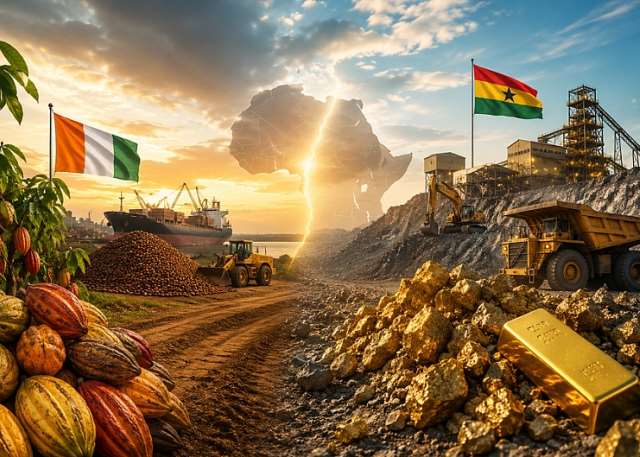
How West Africa's gold powerhouse is exiting its worst crisis in a generation, and what its cocoa squeeze reveals about the limits of a commodity-led recovery
BUSINESS NEWS
On July 27, 2026, the IMF's Executive Board closed the book on one of Africa's most closely watched economic recovery programs. The Board completed the sixth and final review of Ghana's 39-month, $3 billion Extended Credit Facility (ECF) arrangement, concluded the 2026 Article IV Consultation, and reviewed Accra's request for a new 36-month Policy Coordination Instrument (PCI) to anchor reforms once the ECF expires. The review unlocked a final disbursement of SDR 265.9 million — about $371 million — completing the full $3 billion facility approved in May 2023 at the height of Ghana's debt crisis. It is a symbolic bookend: the country that entered 2023 as a cautionary tale of debt distress is now positioning itself, cautiously, as a post-program economy.
From Debt Distress to Moderate Risk
Ghana's comprehensive external debt restructuring is now largely complete. According to the IMF, debt relief agreements consistent with the terms negotiated through the Official Creditor Committee have been signed with more than half of Ghana's bilateral creditors, and agreements-in-principle covering a similar share of external commercial creditors have also been reached. That progress, combined with a swing in the primary fiscal balance to surplus and reserves that have nearly doubled since 2023, has allowed the IMF to formally reclassify Ghana's risk of debt distress from 'high' back to 'moderate' — a designation with real consequences for future borrowing costs and investor sentiment.
The macro numbers back up the reclassification. Headline inflation, which had spiraled above 50% during the crisis, fell to 5.4% at the end of 2025 and held at 5.3% in June 2026 — a level Ghana has not sustained in years. The cedi has mirrored that stabilization: after collapsing to roughly GH¢16 to the dollar in October 2024, it recovered to about GH¢11.45 by May 2026, helped along by record global gold prices, which briefly topped $5,000 an ounce in February 2026, and by the credibility effect of the IMF-backed reform program itself.
Growth: A Strong 2025, A Deliberate Cooldown in 2026
Ghana's real GDP grew 6% in 2025 and accelerated further to 6.4% year-on-year in the first quarter of 2026, driven by broad-based activity across mining, services and agriculture. Forecasters expect that pace to moderate this year: the IMF now projects growth of about 4.8% for 2026, underpinned by firmer exports, easing inflation and a gradual recovery in domestic confidence. The World Bank has revised its own 2026 forecast upward to 4.8%, from an earlier 4.6% projection, framing the deceleration not as weakness but as a transition 'from a strong post-crisis rebound to a more sustainable medium-term growth path.' The African Development Bank is more optimistic still, projecting 5% growth in 2026 rising to 5.4% in 2027, which would place Ghana among the stronger-performing economies in West Africa.
Underpinning both the 2025 rebound and the cedi's recovery has been an export windfall from gold, cocoa and hydrocarbons that pushed Ghana's current account into surplus in 2024 and 2025, aided by import compression and lower global oil prices. But that export story now has two very different halves — one gilded, one squeezed.
Gold's Record Year — and a Widening Lead
Ghana produced a record roughly 6 million ounces of gold in 2025 — about 170 tonnes — up 23% to 25% from 4.82 million ounces in 2024, cementing its position as Africa's top gold producer. The government has set a national production target of 6.5 million ounces for 2026. Newmont's Ghanaian operations, which include the newly commercial Ahafo North mine alongside the established Ahafo South complex, produced 358,000 ounces in the first half of 2026 alone, reaching 47% of its annual company target; Newmont expects Ahafo North to deliver about 315,000 ounces and Ahafo South about 440,000 ounces for the full year. Gold Fields' Tarkwa mine, Africa's largest open-pit gold operation, contributed roughly 11% of national output in 2024 with production of 521,700 ounces. With gold prices at generational highs, this production surge has been the single biggest driver of Ghana's export receipts, reserve accumulation and currency stabilization.
Cocoa's Reversal of Fortune
Cocoa tells the opposite story. International cocoa prices, which had spiked to extraordinary highs in 2024, have since collapsed — from about $9,155 per tonne in June 2025 to roughly $4,272 per tonne in June 2026, a fall of more than half in a single year that has cut Ghanaian farmers' realized prices by an estimated 52% year-on-year. Ghana's cocoa regulator, COCOBOD, is nonetheless closing in on its 2025/26 harvest target of 650,000 metric tonnes, and the government is using the moment to push a longer-standing structural goal: processing at least 50% of the national cocoa crop domestically, starting with the 2026/27 season, backed by a new local financing model intended to improve processors' access to beans and working capital.
That push has regional momentum behind it. In 2026, Ghana joined Nigeria, Cameroon and Côte d'Ivoire — together representing roughly two-thirds of global cocoa production — in forming a Cocoa Value Addition Alliance at the Cocoa Value Addition Summit in Abuja, aimed at coordinating pricing policy and increasing Africa's share of the global cocoa value chain. The economic logic is reinforced by the African Continental Free Trade Area (AfCFTA), under which raw commodity exports continue to face tariffs and quotas in many markets while processed goods gain preferential access — a structural incentive for producer countries to move up the value chain rather than simply exporting beans.
The World Bank has backed the transition with real capital: a $500 million facility to build agricultural feeder roads, including in cocoa-growing regions, and $200 million in International Development Association financing for the Ghana Tree Crop Diversification Project, aimed at modernizing agriculture and accelerating industrialization in the sector.
The Growth That Hasn't Reached Everyone
For all the macro progress, Ghana's recovery has not yet translated into broad-based improvements in living standards. The African Development Bank's country data puts poverty at 29.5%, unemployment at 13.1% (rising to 14.8% for women and 32% for youth), and a Gini inequality measure of 43.5% — a combination the AfDB itself flags as evidence of 'noninclusive growth.' Reversing that will require sustained disinflation and job creation well beyond the mining and finance sectors that have led the recovery so far.
Ghana's social protection architecture is being leaned on to close that gap. The Ghana Productive Safety Net Project (GPSNP) has strengthened systems intended to raise the productivity of poor households and their access to basic services, while the Ghana National Household Registry (GNHR) has improved the targeting of social protection programs so that support reaches the households that need it most. The IMF's own assessment is that continued strong growth and lower inflation should support further poverty reduction over the medium term — but it is a bet on continuation, not a guarantee.
What Comes Next
The proposed 36-month Policy Coordination Instrument is the clearest signal of how Accra wants the next phase to look: a program that keeps upper-credit-tranche-quality policies in place and continues to catalyze donor and market financing, without the emergency financing and binding conditionality of a full IMF-supported program. It is, in effect, Ghana asking to graduate from crisis management to reform stewardship. Whether that succeeds will hinge on three things visible in the data already: whether gold's windfall is invested productively rather than simply propping up the currency, whether the cocoa processing push actually captures a larger share of value before the next price cycle turns, and whether growth above 4.5% a year finally starts moving the poverty and youth unemployment numbers that have proven far stickier than inflation or the exchange rate.



