Written By |
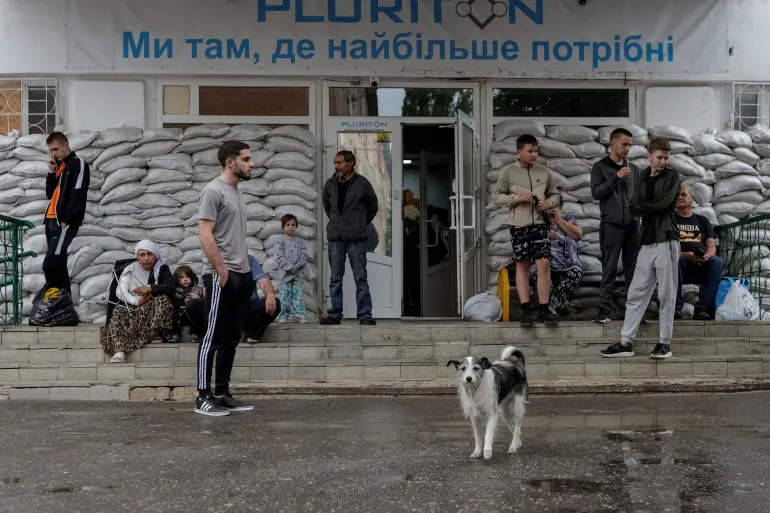
People stand outside a refugee centre in Sumy, northeast Ukraine, where troops were pushing back another Russian advance this week
The Hague, Netherlands – As Europe pledges billions in military support to Ukraine to compensate for waning U.S. aid, Russian President Vladimir Putin has openly reaffirmed his desire to annex the entire Ukrainian territory, intensifying concerns across NATO and beyond. Speaking at the Saint Petersburg Economic Forum on June 20, Putin declared: “I have said many times that the Russian and Ukrainian people are one nation. In this sense, all of Ukraine is ours.” He added ominously, “Wherever a Russian soldier steps, it is ours.”
The statement drew sharp condemnation from Kyiv. Ukraine’s Foreign Minister Andrii Sybiha responded: “Wherever a Russian soldier steps, he brings only death, destruction, and devastation.” President Volodymyr Zelenskyy echoed this, warning that Putin’s ambitions extended beyond Ukraine, including Belarus, the Baltic states, Moldova, the Caucasus, and parts of Central Asia.
Europe steps up
Ahead of NATO’s annual summit in The Hague (June 24–25), Secretary-General Mark Rutte revealed that European and Canadian allies have already pledged $35 billion in military support to Ukraine this year—approaching last year’s total of $50 billion, with more expected.
This surge in aid is compensating for a lack of concrete military support from the United States. Despite Ukraine’s urgent appeals, the Trump administration has only committed to selling F-16 parts and has made no firm promise of supplying critical air defense systems like the Patriot interceptors. Trump, when asked about it this week, said only: “We’re going to see if we can make some available. They’re very hard to get—we need them too.”
Russia rejects ceasefire without western arms embargo
Kremlin spokesperson Dmitry Peskov reiterated Russia’s ceasefire condition: an end to the flow of Western weapons into Ukraine. As fighting continues unabated, Ukraine reports engaging 695,000 Russian troops on its territory, with another 52,000 trying to open a new front in the northeastern Sumy region.
Zelenskyy noted that despite limited Russian advances near Sumy, Ukrainian forces had managed to push them back between 200 and 400 meters—typifying the ongoing military stalemate along the 1,000-kilometer frontline.
Cities under siege
Russia continues to bombard Ukraine from the air. On June 19, missiles struck a residential building in Kyiv, killing 23 people and injuring 172. Overnight drone attacks targeted Odesa and Kharkiv, collapsing a four-story building and injuring firefighters. A drone strike on Kyiv this week killed at least seven people, while another in Dnipropetrovsk killed 20 and injured nearly 300. Zelenskyy condemned the attacks, calling them acts of terror with no military justification.
Ukraine ramps up drone, missile production
In response, Ukraine is accelerating its domestic weapons production. Ukrainian drones struck the Shipunov Instrument Design Bureau in Tula—a major Russian arms manufacturer—on June 18 and 20. These strikes reportedly damaged warehouses and disrupted production.
British and Norwegian officials this week announced new technology-sharing agreements to support Ukraine’s drone and surface drone industries. Zelenskyy also revealed plans for domestic missile manufacturing, including the Sapsan—a ballistic missile with a 480 kg warhead and a 500 km range, potentially capable of striking deep into Russian territory. “We want 0.25% of the GDP of each partner state to be allocated to our defense industry for domestic production next year,” Zelenskyy said.
NATO and EU membership still contentious
Ukraine’s aspirations to join NATO and the EU—long cited by Russia as a justification for war—remain a central issue. Despite public support, U.S. Defense Secretary Pete Hegseth has admitted NATO membership is not part of the current peace framework. Nonetheless, Secretary-General Rutte reiterated NATO’s full commitment to Ukraine’s defense.
Ukraine’s EU accession process also hit a roadblock last week as Slovakia vetoed the opening of new negotiation chapters and blocked the EU’s 18th sanctions package against Russia—arguing its dependence on Russian energy. Slovak PM Robert Fico further shocked the bloc by suggesting Slovakia might consider leaving NATO, saying “neutrality would benefit Slovakia very much.” Austria’s former defense minister warned this could trigger Austria to pursue NATO membership, showing how divisions within the EU may inadvertently reshape the alliance.
Trump’s changing tone
Trump, once an admirer of Putin, appeared to shift his stance. “I consider him a person that’s, I think, been misguided,” he said. “I thought we would have had that settled easily. Vladimir Putin really has to end that war.”
But Trump also hinted at uncertainty about America’s future role in the conflict, as Europe takes on a larger share of responsibility. This week, NATO allies, including Germany, agreed to raise defense spending to 5% of GDP by 2035—a major shift in strategic priorities and a concession to Trump's repeated demands for greater European burden-sharing.
Source: Aljazeera



