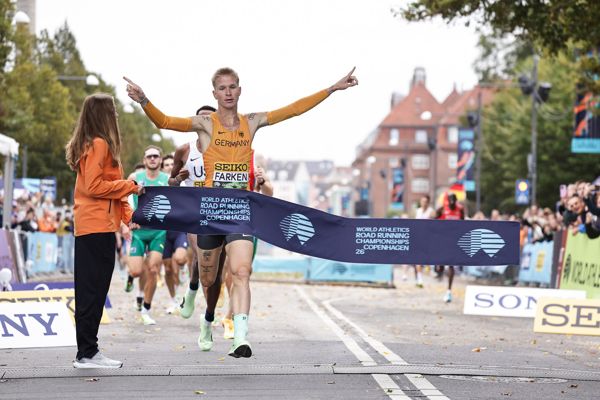
On a V-shaped course through Copenhagen's Osterbro, Robert Farken ran the second-fastest road mile in history to break Yared Nuguse - and road running's youngest world championship finally found the moment it needed.
COPENHAGEN
For three and a half minutes on Saturday morning, Yared Nuguse looked like a man running away with a world title. He had gone to the front from the gun, exactly as he said he would, and the field behind him had stretched into a ragged V along Osterbrogade, one of Copenhagen's grand shopping streets, closed to traffic and lined four deep with people who had come out of the cafes to watch.
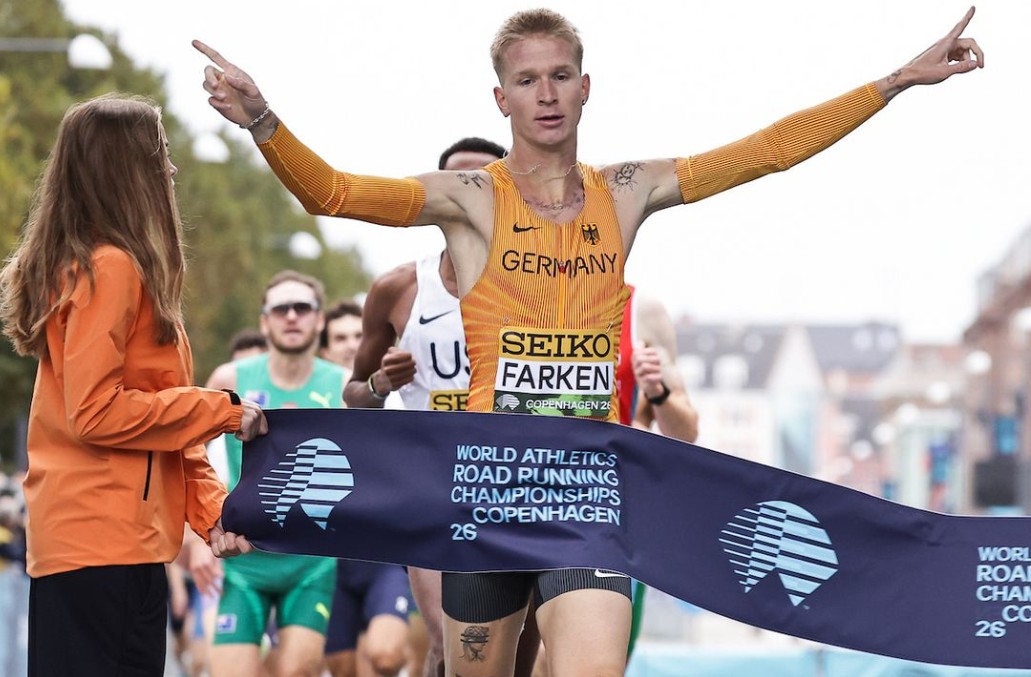
Then, with perhaps 250 metres left and the floodlights of Parken Stadium rising ahead, a 28-year-old from Leipzig who had not been in anybody's headline preview arrived at his shoulder and kept going.
Robert Farken won the men's road mile at the World Athletics Road Running Championships in 3:51.80 - a German record, a world lead, and the second-fastest road mile ever run by anyone. Only Elliot Giles' world record of 3:51.3 sits above it. Nuguse, the Olympic 1500m bronze medallist who had spoken openly before the race about attacking that record, gritted his teeth, held his form and took silver in a season's best 3:52.33.
Three and a half minutes, one decision
The men's race was the opposite of cagey. Nuguse hit the front immediately, his long stride opening a gap that looked, for a while, like a statement. Jake Heyward tucked in a stride behind. Farken settled into third and waited.
The Copenhagen course is a strange and rather brilliant piece of design: runners go out along Osterbrogade, hit a turnaround at roughly 2:15, and come back down the same street to a finish near the stadium. The whole field passes the same crowd twice, in opposite directions, and every athlete can see exactly what the race is doing to everyone else.
Coming out of the turn with about 600 metres to run, Nuguse's advantage began to evaporate. Farken was visibly gaining with every stride - not lunging, not kicking, just steadily eating into a lead that had looked decisive 90 seconds earlier. When he finally went past, he went past cleanly, and the race was over.
Farken's 2026 has been the season of his career. He finished sixth over 1500m at last year's World Championships in Tokyo and has since rewritten the German record books, clocking 3:30.09 for 1500m and 3:46.82 for the mile in London in July. Remarkably, he had also finished 11th at the World Athletics Ultimate Championship in Budapest just six days before he lined up in Copenhagen. Championship running is usually a game of freshness. Farken won this one on fatigue.
The bronze that made history
Behind the two favourites came the result that will be read out in one small country for years. Ruben Querinjean of Luxembourg, a 24-year-old better known as a steeplechaser, took bronze in a national record of 3:52.77 - the first global senior athletics medal won by a Luxembourg man since Josy Barthel's Olympic 1500m gold in 1952.
Querinjean has had an outstanding year: European steeplechase silver in Birmingham last month, then a Luxembourg record of 8:05.36. Nobody had him down for a mile medal. That is rather the point of the event.
The depth behind him was extraordinary. Morocco's Anass Essayi ran a personal best 3:53.28 for fourth, France's Flavien Szot a national record 3:53.44 in fifth, Oliver Hoare an Australian record 3:53.65 in sixth. Eight men broke 3:55 in a single race. On a road.
Twenty minutes earlier, the same corner
The men's race was, in its shape, a copy of the women's race that preceded it - and the copying was almost eerie. Agathe Guillemot of France made her winning move at very nearly the same point on the course, sweeping past long-time leader Freweyni Hailu with about 25 seconds left to run and finishing alone in 4:22.74.
That is a European record, a world lead for the year, and the first global title of Guillemot's career. It puts her fourth on the all-time road mile list, 1.76 seconds off Diribe Welteji's world record. Hailu, who took silver in the same event two years ago in Riga, finished 1.61 seconds back in 4:24.35 and settled for silver again.
Two races, two athletes from countries with no particular tradition in the discipline, two decisions made at the same bend.

Why the road championships exist at all
The World Athletics Road Running Championships are still young, and still slightly odd in the eyes of traditionalists. Six world titles are decided across two days - men's and women's mile, 5km and half marathon - with the 5km races and Sunday's half marathons still to come in Copenhagen. Nearly 500 elite athletes are entered.
But the elite fields are not really the headline number. Around 60,000 recreational runners are taking on the same courses this weekend, on the same closed streets, often within an hour of the professionals. That is the argument the championships are making: that road running is the one sport where the world's best and a man from accounting can, functionally, enter the same race.
It is also why the mile - a distance most track fans associate with a lane and a bell - works so well out here. It is short enough to watch in one piece, long enough to hurt, and it can be staged down a high street. Saturday's two races were decided in front of people standing on the pavement outside a bakery.
What this means if you have never watched a road mile
Two things are worth taking from Copenhagen, even if you do not follow athletics.
The first is that the road mile is quietly becoming one of the most watchable events in the sport. You do not need to understand splits or lap counts. You can see the leader. You can see who is closing. The whole thing resolves in under four minutes, in public, at eye level.
The second is about what happened to Nuguse, which is the part that will stay with people. He ran the race he promised to run. He went to the front, he pressed, he never stopped pressing, and he ran a season's best - and he still lost, because someone behind him judged the same course better. That is not a failure. It is the reason anyone watches.
The 5km titles and Sunday's half marathons, where Agnes Ngetich headlines a formidable field, will decide who leaves Copenhagen with the biggest reputation. But the moment has already happened. It happened on a shopping street, on a Saturday morning, with the crowd close enough to touch.
Published By | Sports Editor