Written By | Staff Writer
South Africa, Nigeria, Kenya and Ethiopia show how safety nets are being rebuilt for an era of stalled poverty reduction, tighter budgets and retreating aid
Economic & Social Transformation
Two announcements in the space of a week framed the problem neatly. On 21 October, South Africa's Finance Minister Enoch Godongwana used his Medium-Term Budget Policy Statement to extend the R370-a-month Social Relief of Distress (SRD) grant for yet another year. Five days later, on 26 October, the World Bank's Poverty, Prosperity, and Planet Report 2026 warned that global progress against extreme poverty has stalled: about 811 million people, roughly one in ten worldwide, live on less than US$3.00 a day, a number that has barely moved since the pandemic. By 2030, the Bank estimates, 87% of the world's extremely poor will live in Sub-Saharan Africa or in fragile and conflict-affected settings.
The Bank's prescription is jobs: per-capita growth would need to average about 4% a year, roughly double the rate of the past 25 years, to cut extreme poverty to 3% by 2050. But jobs take time, and in the meantime the continent's households are carrying fuel shocks, food-price spikes and climate stress. That is the gap safety nets are supposed to fill, and it is a large one. The International Labour Organization's most recent regional estimates put social protection coverage in Africa at roughly 17%, the lowest of any world region and well below the 40% goal set in the ILO's Africa Regional Social Protection Strategy.
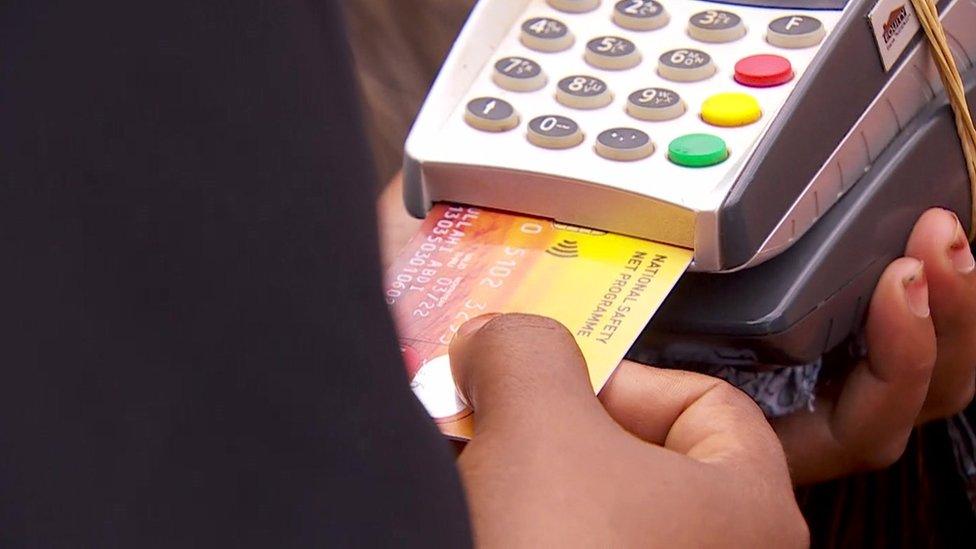
What is changing in 2026 is not simply whether governments pay cash to poor households — many now do — but whether those payments are becoming durable institutions, financed from domestic budgets and run on reliable digital rails, rather than emergency programmes that rise and fall with donor cycles and political calendars. Four very different countries illustrate where that transition stands.
South Africa: the 'temporary' grant that became a fiscal fixture
The SRD grant was introduced in 2020 as a pandemic stopgap. Six years on it supports around eight million working-age South Africans and has become one of the largest unconditional transfers to the unemployed anywhere on the continent. The February 2026 budget allocated R36.9 billion to keep it running at R370 per person per month until 31 March 2027. The October mini-budget has now pushed it another year beyond that, while a replacement model remains under review.
The detail of the MTBPS is revealing. Take-up was lower than projected, so the SRD allocation was trimmed from R36.9 billion to R35.6 billion, and the overall social assistance budget for 2026/27 fell from R292.8 billion to R289.8 billion. Treasury expects the total number of social grant beneficiaries to decline from 17.8 million in 2026/27 to 17.1 million by 2029/30, and projects R13.1 billion in savings between 2027/28 and 2029/30 from enhanced biometric enrolment and beneficiary verification. A new government data platform, MzansiXchange, will cross-check grant recipients against other public records and, in principle, link SRD beneficiaries to jobs, training and enterprise support. Some of the expected savings — R6.2 billion — are earmarked for preventing violence against women and tackling child malnutrition, including R1.6 billion over the medium term for district health programmes supporting pregnant women and young children.
Conspicuously absent was any detail on President Cyril Ramaphosa's State of the Nation promise that the SRD would become a permanent 'livelihoods' grant. The bigger fiscal wildcard sits in the courts. In January 2025 the High Court found the grant's means-test threshold, value and income-verification rules invalid; the government appealed, and the Supreme Court of Appeal heard the case in August 2026, with judgment pending. If the ruling stands, Treasury estimates that between three million and 13 million additional people could qualify and the annual cost could roughly double, from about R36 billion to R74 billion. South Africa's dilemma is the continent's in miniature: a transfer that is too small to lift people out of poverty — R370 is far below any credible food poverty line — yet politically impossible to withdraw and fiscally daunting to expand.
Nigeria: scale arrives, reliability does not (yet)
Nigeria's challenge is the opposite of South Africa's: building a system from a far lower base, at speed, for a population several times larger. The federal government's shock-responsive cash-transfer programme, coordinated through the National Social Safety-Nets Coordinating Office and backed by the World Bank, targets 15 million households, with payments typically described as ₦25,000 tranches totalling ₦75,000 per household. Eligibility depends on inclusion in the National Social Register and verification through the National Identification Number or Bank Verification Number.
The World Bank's October 2026 Nigeria Development Update, Beyond the Federal Purse, reports that the federal government had disbursed ₦658.9 billion to 10.46 million poor and vulnerable households by September 2026, using biometric and digital verification for identification and payment. That is substantial progress from the roughly 9 million households reported reached earlier in the year — though, as the Bank itself signals, the figure is the government's own and not an independent audit.
The Bank's caveats are where the real policy agenda lies. It wants improvements in coverage, adequacy and the regularity of payments, and it recommends dedicated social protection budget lines at both federal and state level, with government funding rising gradually so the system can move 'beyond emergency responses'. An earlier Bank assessment found that while 56% of social protection beneficiaries were poor, only 44% of total benefits reached poor households — a targeting leak that digital ID alone will not fix. With the government now targeting 7% growth in 2027 and pledging to expand targeted transfers, the test is whether transfers appear as a predictable line in the 2027 budget rather than as episodic disbursements.
Kenya: small, steady and mobile-money native
Kenya's flagship Inua Jamii programme is modest in scope but instructive in delivery. It pays KSh2,000 per payment cycle to people aged 70 and over and to people living with severe disabilities. Government releases in 2026 show a remarkably stable roster: KSh2.54 billion for 1,213,214 beneficiaries in the January cycle, KSh2.426 billion for 1,213,161 in February, KSh2.42 billion for the April cycle, and KSh2.426 billion for 1,213,156 beneficiaries in the June cycle. Payments flow through eCitizen and M-PESA, which keeps transaction costs low and reduces leakage at the point of collection.
Two weaknesses stand out, however. The first is timing: the June 2026 cycle only began paying out on 3 August, a lag that matters a great deal to an elderly household budgeting week to week. The second is breadth: a roster of about 1.2 million in a country of more than 50 million leaves working-age poor households, informal workers and children largely outside the cash-transfer net. Kenya has the payment rails for a much larger programme; what it lacks is the fiscal space and the political choice to fund one.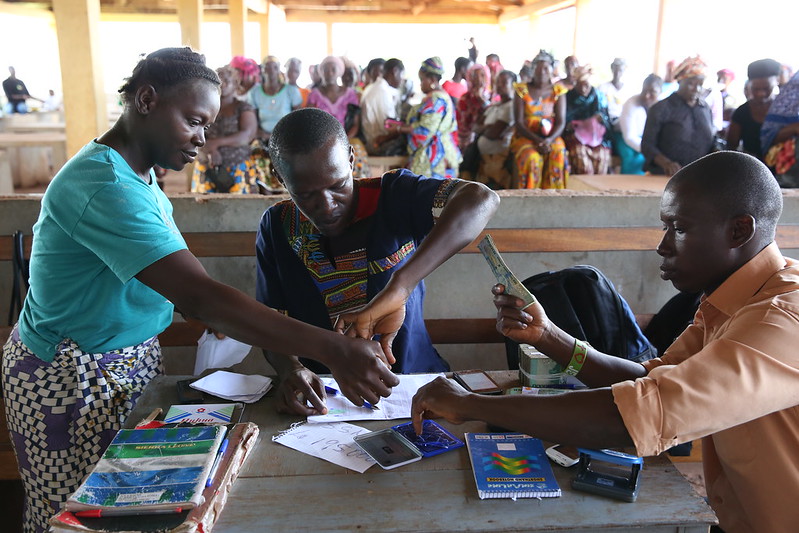
Ethiopia: Africa's oldest safety net under conflict and fuel stress
Ethiopia's Productive Safety Net Programme (PSNP), launched in 2005, is the continent's longest-running large-scale safety net and a global reference point for linking transfers to public works. On 3 March 2026 the World Bank approved a US$200 million IDA credit for its sixth phase, PSNP 6. The design is ambitious: climate-smart public works intended to provide income for six million people while rehabilitating watersheds and degraded land, and livelihood support to help about 700,000 people start or expand small businesses, with a focus on women and youth. Over two decades the programme has provided crisis response to more than 23 million people and expanded financial inclusion for 1.45 million households.
Yet design and delivery have diverged sharply this year. According to a FEWS NET outlook reported by Addis Standard, public works transfers have been halted across most of the country since January 2026, as conflict and fuel shocks disrupted operations — leaving vulnerable households without support during the lean season. New programme rules, reported in October, also bar public works in areas with suspected landmines until clearance is issued. The IMF, in its 2026 country report, has urged Addis Ababa to safeguard social protection spending even as fuel subsidies are phased out. Ethiopia shows that even a mature, well-designed system remains fragile when the state's operational reach is contested.
Three tensions that will define the next phase
What to watch
Over the coming months, four markers will show whether Africa's safety nets are institutionalising or stalling: the Supreme Court of Appeal's SRD judgment and whether Treasury finally specifies a permanent successor grant; whether Nigeria's 2027 federal and state budgets contain dedicated, ring-fenced social protection allocations; the resumption of PSNP public works transfers in Ethiopia; and whether Kenya closes its payment-cycle lag. The World Bank is right that jobs are the long-run route out of poverty. But in a decade when growth is likely to disappoint and aid is shrinking, the quality of the continent's cash-transfer institutions will determine how many households fall back into poverty before those jobs arrive.



