World Politics Briefing
Background
The conflict now convulsing the Middle East traces back to the collapse of years of fitful diplomacy over Iran's nuclear program. After indirect U.S.-Iran talks in Oman in February 2026 appeared briefly promising — Tehran reportedly floated unexpected concessions, and a follow-up round was scheduled in Vienna — President Donald Trump said he was "not thrilled" with the pace of negotiations. On February 28, 2026, the United States and Israel launched a coordinated air campaign against Iran, codenamed Operation Epic Fury by Washington and Operation Roaring Lion by Israel. The strikes targeted Iran's nuclear infrastructure at Natanz, Isfahan and Fordow, along with missile production sites and air-defense networks, and came after Iran's regional position had already been weakened by the 12-day war with Israel in mid-2025, prolonged sanctions, and the diminished standing of allied militias following the Israel-Hamas war.
Iran's retaliation was swift and wide-reaching: hundreds of drones and ballistic missiles were fired not only at Israel but at Bahrain, Jordan, Kuwait, Oman, Qatar, Saudi Arabia, the United Arab Emirates and the Kurdistan region of Iraq, drawing the entire Gulf into the crisis. A conditional ceasefire took hold on April 8 after Pakistani-mediated talks, and the two sides went on to sign a broader framework agreement on June 17 intended to formalize the truce and reopen normal maritime traffic through the Strait of Hormuz — the chokepoint through which roughly a quarter of the world's seaborne oil and a fifth of its liquefied natural gas normally passes. That framework has now come under severe strain in the war's most dangerous week since the original ceasefire.
Key Developments
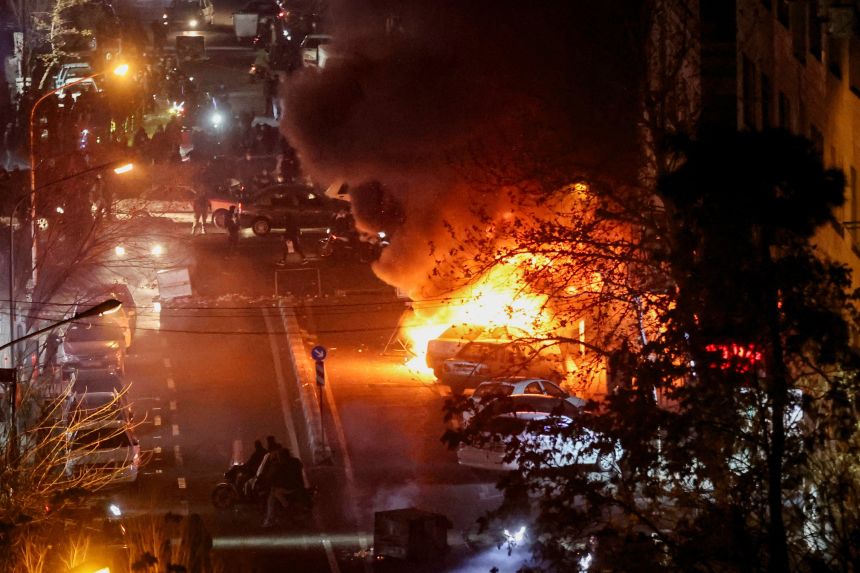
The latest unraveling began when the Singapore-flagged container ship Ever Lovely was struck by an Iranian drone, an attack Trump branded a "foolish violation" of the ceasefire. In response, U.S. aircraft struck Iranian military surveillance infrastructure, communication systems, air-defense sites, drone storage facilities and minelaying capability — the first American military action since the June 17 agreement was signed. Iran's Islamic Revolutionary Guard Corps (IRGC) answered in the early hours of June 28 with missile and drone attacks on U.S.-linked sites, with Kuwait and Bahrain both reporting incoming projectiles. U.S. forces then struck "multiple targets" inside Iran for a second consecutive night, extending an exchange that by Sunday morning showed no sign of abating.
Trump escalated his public rhetoric sharply, writing on Truth Social that "there may come a point when we are no longer able to be reasonable, and will be forced to militarily complete the job that we very successfully started," and warning that Iran "will no longer exist" if Washington is compelled to use further military force. The IRGC, for its part, said the renewed American strikes amounted to a ceasefire violation that "will result in the complete halt of all diplomatic processes," suggesting Tehran sees little reason to return to the negotiating table for now.

The Strait of Hormuz remains the crisis's most economically dangerous flashpoint. Iran has effectively restricted passage through the strait since the war began in February, with the IRGC boarding and attacking merchant vessels and laying sea mines; on June 27 a tanker was struck by an unidentified projectile in the strait, damaging its bridge, though the crew was reported safe. Tehran has separately reasserted a claim to toll shipping passing through the waterway, a demand the U.S. and Gulf states jointly rejected. In a notable counter-move, the U.S. Navy's Joint Maritime Information Center announced on June 27 a widened transit route through the strait near Oman, allowing increased two-way naval traffic in what amounts to a direct challenge to Iran's attempted control of the chokepoint.
The war's economic toll has been severe. Brent crude jumped roughly 55 percent in the month after the war began, from about $72 to over $112 a barrel, and the International Energy Agency has described the conflict as among the greatest global energy-security challenges on record. Fuel shortages inside Iran and price spikes across import-dependent economies have compounded the humanitarian and diplomatic fallout. Analysts tracking the Strait of Hormuz crisis note that even partial disruption of the waterway — short of an outright closure — has been enough to inject lasting volatility into energy markets, since insurers and shipping companies have grown wary of routing tankers through a zone where mines and drone strikes remain a live risk months into the conflict.
The military campaign has also reshaped the regional balance in less visible ways. Damage assessments of Iran's nuclear infrastructure at Natanz, Isfahan and Fordow remain disputed, with U.S. and Israeli officials offering shifting public accounts of how much enrichment capacity survived the February strikes, while independent nuclear-monitoring bodies have had limited access to verify the extent of the destruction. That ambiguity has itself become a point of friction: Washington has cited it as justification for continued military pressure, while Tehran has used it to argue that further strikes are unjustified given the program's already-degraded state.
A parallel front has opened in Lebanon. A U.S.-brokered framework signed in Washington on June 26 between Israel and Lebanon was meant to de-escalate hostilities with Hezbollah, providing for a phased Israeli withdrawal from parts of southern Lebanon and deployment of the Lebanese army, while permitting Israeli forces to remain temporarily in an expanded security zone. Hezbollah secretary-general Naim Qassem rejected the deal outright on June 27, calling it "humiliating, shameful, and a surrender of sovereignty," and declaring it "null and void." Qassem specifically objected to linking an Israeli withdrawal to Hezbollah's disarmament, and argued that an earlier Iran-U.S. memorandum of understanding guaranteeing Lebanese territorial integrity should instead form the basis for ending the conflict. He vowed Hezbollah would "continue as a resistance in the field," and Israeli forces reportedly struck targets in southern Lebanon the following day amid fears the rejection could reignite full-scale fighting.
Reactions
International reaction has split along familiar lines. Gulf states that have themselves been targeted by Iranian strikes — Kuwait and Bahrain chief among them — have backed the U.S. military response while privately pressing Washington to avoid an uncontrolled escalation that could draw their own infrastructure into the crossfire. European governments have urged restraint on all sides and renewed calls for a negotiated settlement, with the UK Parliament's own research service tracking the conflict's legal and humanitarian implications. China has used the war to position itself as a stabilizing alternative to what it casts as American recklessness; notably, Xi Jinping traveled to Pyongyang this week to mark what he and Kim Jong Un described as the "unbreakable" bond between China and North Korea, a visit widely read as Beijing signaling solidarity among governments wary of U.S. power projection. Inside Israel, officials have welcomed the renewed U.S. strikes but are bracing for potential Hezbollah retaliation following Qassem's rejection of the Lebanon deal. Humanitarian and legal scholars, including researchers at Chatham House, have separately argued that aspects of the broader U.S. campaign — including earlier actions against Iranian leadership — lack clear justification under international law, a critique Washington has rejected.
What's Next
The immediate question is whether the June 17 framework can survive its first real test. Trump's explicit threat to "complete the job" suggests Washington is prepared to escalate further if Iranian attacks on shipping continue, while the IRGC's signal that diplomacy is effectively frozen points toward a longer, grinding phase of tit-for-tat strikes rather than a swift return to talks. The widened Hormuz transit corridor announced by the U.S. Navy will be an early test of whether Iran can meaningfully contest American and allied naval movements without triggering a still-larger confrontation. In Lebanon, the durability of the fragile Israel-Hezbollah arrangement now hinges on whether Beirut's government can implement its side of the deal without Hezbollah's cooperation, and whether Israel responds to Qassem's rejection with renewed strikes or further negotiation. Oil markets, already volatile, are likely to remain hostage to each new exchange of fire, and a wider regional war — drawing in Gulf states more directly — remains a live risk if either side miscalculates in the days ahead.
Published By | Features Editor