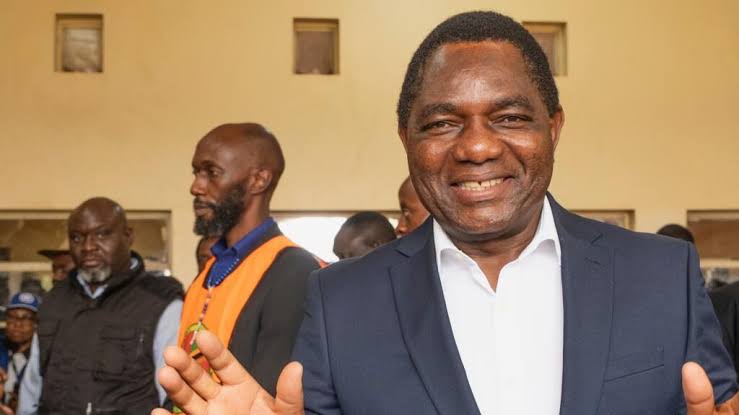
LUSAKA, Zambia
President Hakainde Hichilema is scheduled to be sworn in Tuesday for a second five-year term, but the ceremony will take place under a cloud that has drawn condemnation from human rights groups worldwide. Zambia's entire judiciary shut its doors for a single day this month at the precise moment his chief rival needed it most, and that rival, along with 17 other people, now faces a treason charge that carries the possibility of a death sentence.
The convergence of these events, an inauguration proceeding as scheduled while the man who finished second sits in the shadow of Zambia's most serious criminal charge, has turned what might have been a routine transfer of power into a test of whether Africa's second-largest copper producer can keep the democratic reputation it built over three decades of peaceful transitions.
What Happened
Hichilema, leader of the United Party for National Development, won re-election on Aug. 13 with 2,965,326 votes, or 60.49% of the ballots cast, according to final results declared by the Electoral Commission of Zambia on Aug. 18 after all 226 constituencies had reported. His nearest challenger, Brian Muntayalwa Mundubile of the National Reconciliation Party for Unity and Prosperity, took 1,856,217 votes, or 37.87%, out of 4,902,050 valid votes nationwide, a margin of 514,300 votes.
The count itself was marred by violence. On the night after the election, security forces raided a property in Lusaka's Kabulonga neighborhood linked to Mundubile's camp. Former Cabinet minister Mutotwe Kafwaya was shot and killed in the operation, and 11 people were arrested. Police alleged the group was engaged in insurrection or militia activity, an accusation Mundubile has repeatedly denied.
Fearing for his safety, Mundubile went into hiding on Aug. 17 and took refuge inside a building belonging to an international human rights organization in Lusaka, where he remained for roughly two weeks. He emerged and surrendered to police on Aug. 27 under an arrangement brokered by a representative of United Nations Secretary-General António Guterres, with the Zambian state pledging that Mundubile and his running mate, Makebi Zulu, would be afforded due process under the rule of law.
That pledge is now being tested. Zambian police confirmed on Aug. 27 that Mundubile and Zulu had been issued "warn and caution" statements, a procedural step that typically precedes formal charges, in connection with an alleged offense of treason. By Aug. 30, Lusaka Times and other local outlets reported that prosecutors had formally charged both men, and that the case had widened to encompass 18 defendants in total. Treason is among the gravest offenses on Zambia's statute books and can carry the death penalty upon conviction, although the country has not carried out an execution since 1997 and maintains what amounts to a de facto moratorium.

The Court Closure
The most contentious element of the past two weeks was not the treason case itself but the manner in which Zambia's judiciary became unavailable to hear it, or anything else, at a critical juncture. Under Article 103 of the Zambian Constitution, a losing candidate has seven days from the declaration of the winner to file an election petition. Under Article 104, the act of filing such a petition automatically suspends the president-elect's swearing-in until the matter is resolved.
Mundubile had publicly pledged to challenge the results in court. But on the Monday that marked the final valid day to file, which fell within the seven-day window after the Aug. 18 declaration, Zambia's entire court system closed, with authorities citing unspecified "security reasons." The closure meant Mundubile's legal team had no venue in which to physically lodge a petition before the constitutional deadline lapsed.
Zambia's Constitutional Court said afterward that it had not received any petition challenging the outcome, which cleared the legal path for Hichilema's inauguration to proceed. Chief Justice Mumba Malila disclosed that he had personally received a petition submitted to his private email address by a member of the public, a method he described as "highly irregular," though he said he had forwarded it to the Constitutional Court for consideration. It remains unclear whether that submission will be treated as satisfying the constitutional filing requirement.
Human Rights Watch called the episode "a blow to the administration of law, transparency, and due process in Zambia." Domestic legal and civil society groups have echoed that assessment, arguing that shutting the courts on the single day they were needed most functioned, in effect, as a mechanism to foreclose any judicial review of the election result.
The Stakeholders
Hichilema, a 63-year-old businessman-turned-politician, entered the race as the clear favorite. His first term was defined by an economic turnaround: he steered Zambia through a restructuring of roughly $13 billion in external debt following the country's 2020 default, the first sub-Saharan African nation to default during the COVID-19 pandemic, and courted renewed investment in the copper sector that anchors the national economy. That record gave him a strong claim to a second mandate.
Mundubile, a 55-year-old lawmaker who has represented Mporokoso constituency since 2016, arrived at the ballot as the standard-bearer of a fractured but newly consolidated opposition. He built his candidacy atop the ruins of the Patriotic Front, the party of the late former President Edgar Lungu, who died in June 2025 while receiving medical treatment in South Africa. After Lungu's death split the Tonse Alliance into rival factions, Mundubile won a January 2026 convention to lead the alliance's presidential ticket, ultimately running under the banner of the National Reconciliation Party for Unity and Prosperity after a separate legal dispute displaced him from his original party vehicle. His running mate, Makebi Zulu, brought a rival opposition bloc, the PF Pamodzi Alliance, into the coalition.
The United Nations' involvement, through the office of the secretary-general's representative in Lusaka, added an unusual layer of international mediation to what is nominally a domestic legal and criminal matter, underscoring how seriously outside observers have come to view the risk of a violent escalation.
Reactions and the Democratic Backdrop
Rights groups and election observer missions have said the post-election dispute has damaged Zambia's reputation as one of the more durable multiparty democracies in the region. Every transfer of presidential power in Zambia since the country's return to multiparty politics in 1991 has been achieved through the ballot box, a record that stood in contrast to coups and contested successions elsewhere on the continent and that Zambian officials have long cited with pride.
Opposition parties and civil society organizations had already been raising alarms over what they characterized as shrinking democratic space under Hichilema's government well before the Aug. 13 vote, pointing to selective enforcement of public order laws against opposition rallies and increased scrutiny of independent media. The events of the past two weeks, a fatal raid, a fugitive opposition leader sheltering on U.N. premises, a one-day judicial shutdown timed to a constitutional deadline, and treason charges against 18 people, have hardened those concerns into a broader debate about whether Zambia's institutions can withstand a genuinely close and contested election.
Analysis
The manner of Hichilema's second-term victory carries risks that a comparable margin in a less contentious environment would not. A 22-point winning margin is not, on its face, a marginal result, and Hichilema's economic record gives him a credible mandate independent of the controversy. But the sequence of events since Aug. 13, the fatal raid, the court closure, and the treason prosecution, has allowed his opponents and international rights monitors to frame the outcome as one secured through the machinery of the state rather than solely at the ballot box. That framing matters because Zambia has spent three decades building a reputation, rare in the region, for resolving political competition through elections and courts rather than through repression, and that reputation is now itself a subject of the dispute.
The treason charge against Mundubile is legally significant beyond the individual case. Because treason carries the potential for capital punishment, however unlikely an actual execution may be given Zambia's moratorium, the charge raises the stakes of the prosecution considerably and will likely draw sustained scrutiny from regional bodies such as the Southern African Development Community and from international rights organizations over whether due process, the standard the state explicitly promised as a condition of Mundubile's surrender, is honored as the case proceeds.
What to Watch
Several threads will determine how this crisis resolves in the weeks ahead. First is whether the Constitutional Court treats Chief Justice Malila's referral of the irregular email petition as a live challenge to the election result, a decision that could reopen the legal question of the vote's validity even after Tuesday's inauguration. Second is the pace and substance of the treason prosecution against Mundubile, Zulu and the 16 others charged, including whether prosecutors produce evidence to substantiate the insurrection allegations or whether the case is seen, domestically and abroad, as a vehicle for sidelining a defeated political rival. Third is whether regional and international bodies, having already seen the U.N. broker Mundubile's surrender, escalate their engagement, potentially through SADC's own observer findings or renewed statements from bodies such as the African Union. Finally, the durability of Zambia's democratic institutions, and specifically the independence of a judiciary that closed its doors at a constitutionally decisive moment, will remain a live question well beyond the treason case's resolution, shaping how investors, aid partners, and Zambian citizens alike judge the health of the country's political system heading into the second half of the decade.
Published By | News Editor