A humble green alga, a midnight phone call and a "light switch" for the mind: three scientists share medicine's top honour for optogenetics, the tool that rewired brain research and is now being tested to give sight back to the blind
STOCKHOLM
It started with a microscopic speck of pond algae swimming towards the sun. It ended, this morning, with a phone ringing in the dark in California and a sleepy scientist being told he had just won the Nobel Prize.
The Nobel Assembly at Sweden's Karolinska Institutet today awarded the 2026 Nobel Prize in Physiology or Medicine jointly to Karl Deisseroth, Peter Hegemann and Georg Nagel "for their discoveries concerning light-gated ion channels and optogenetics". In plain English: they worked out how to switch individual brain cells on and off with flashes of light.
It sounds like science fiction. It is now one of the most widely used techniques in neuroscience laboratories on the planet, and the Nobel committee says it has "laid the foundation of a new era in neuroscience".
"Optogenetics provides opportunities for mapping the brain in a way that we could once only dream of," said Per Svenningsson, chair of the Nobel Committee for Physiology or Medicine.
The wake-up call
Deisseroth, a professor at Stanford University and the Howard Hughes Medical Institute, was the first of the three to be reached. He was, according to committee secretary Thomas Perlmann, "definitely asleep, but he woke up".
Hegemann, of Humboldt University in Berlin, and Nagel, of the University of Würzburg in Germany, were reached soon after. Perlmann said all three gave strikingly similar reactions: they thought it was "absolutely wonderful" to share the prize with the other two, whom they each described as "my friends".
The three will split the prize money of 12 million Swedish kronor, roughly $1.2 million, equally. They will receive their medals at the traditional ceremony in Stockholm on 10 December, the anniversary of Alfred Nobel's death.
From pond scum to Nobel gold
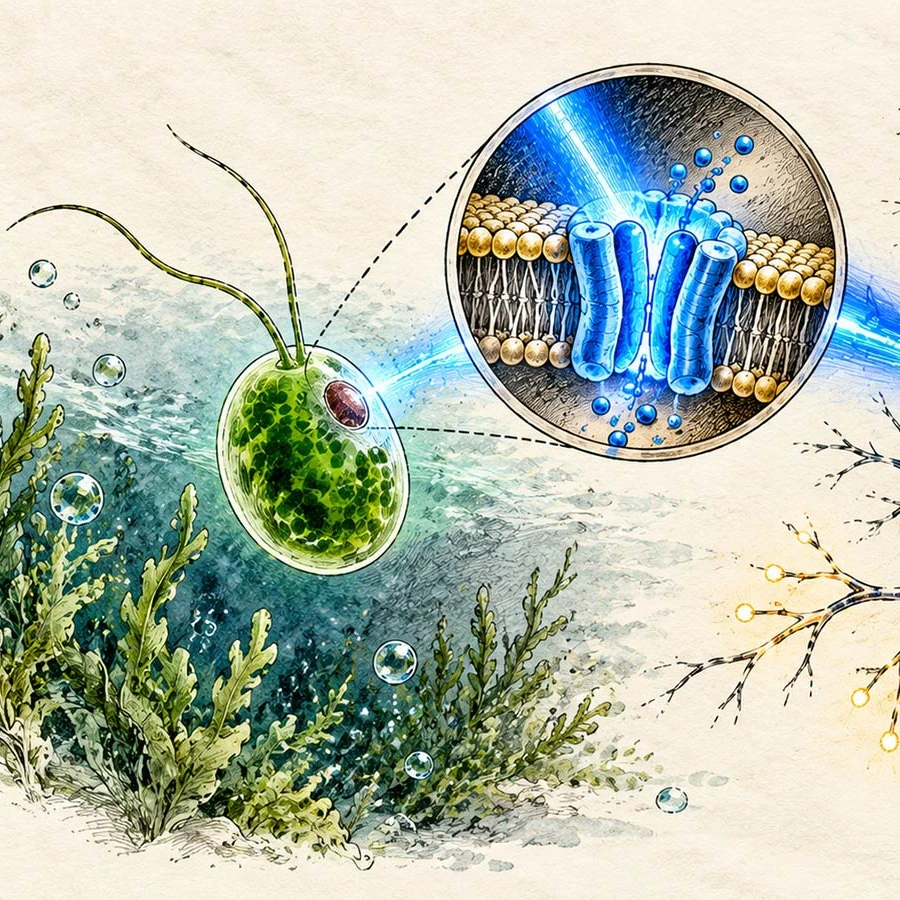
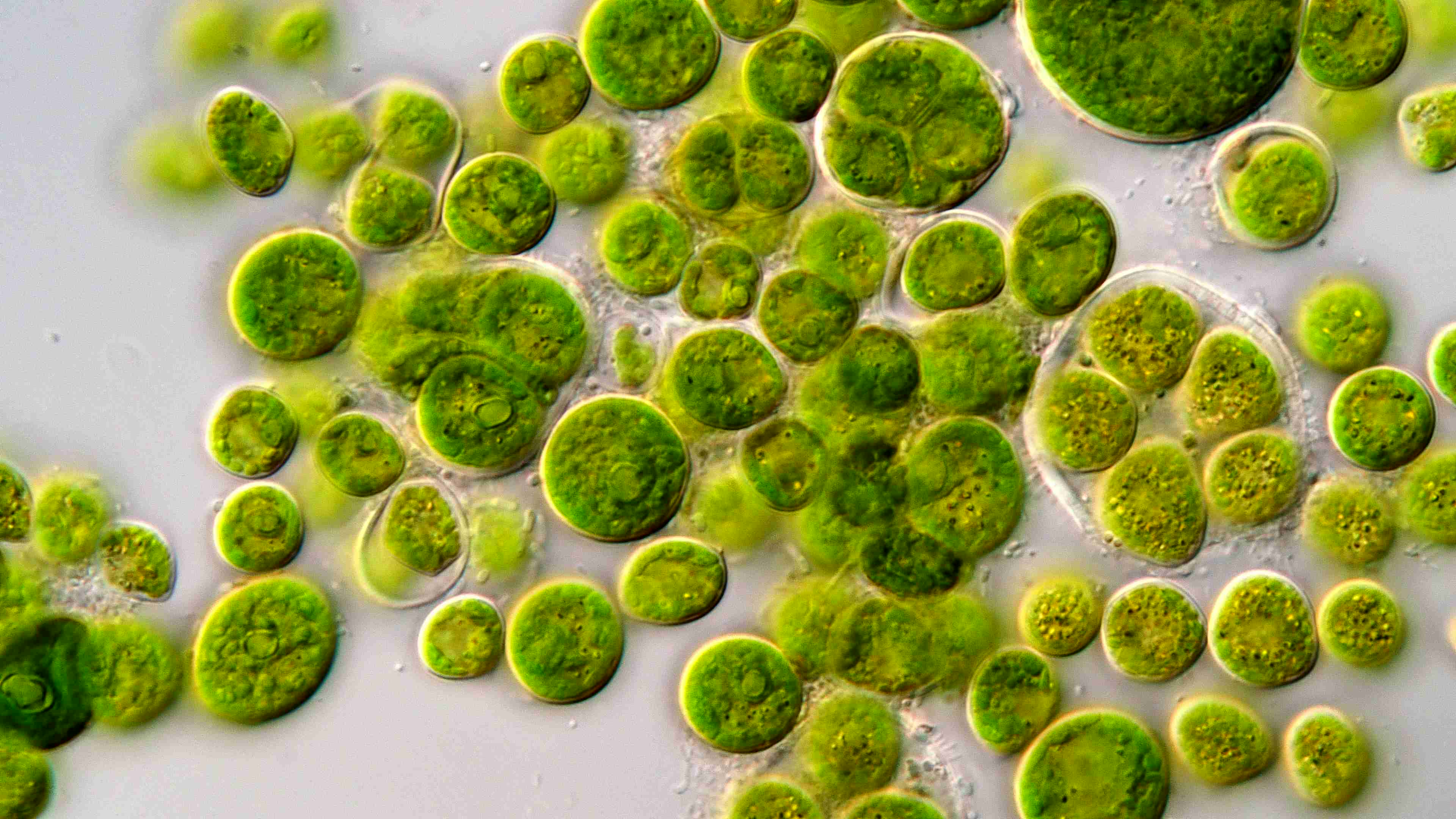
The story begins not in a hospital or a brain lab, but with Chlamydomonas, a single-celled green alga so small you would need a microscope to see it. Like a tiny swimmer with a built-in compass, it steers itself towards light so it can photosynthesise.
Peter Hegemann wanted to know how it did that. Working with Georg Nagel in the early 2000s, the pair tracked down the answer: a remarkable protein sitting in the alga's outer membrane, which they named channelrhodopsin.
Here is the trick that made it extraordinary. Most light-sensing proteins in nature pass their signal along a slow chain of chemical messengers. Channelrhodopsin cuts out the middleman. When blue light hits it, the protein itself opens like a gate, and electrically charged particles called ions rush straight into the cell. That flood of charge creates an electrical impulse — exactly the kind of signal nerve cells use to talk to each other.
Even better, the researchers found the protein still worked when they put it into other kinds of cells. Wherever it went, it turned that cell into something that responded to light.
The light switch goes into the brain
That is where Karl Deisseroth, a psychiatrist as well as a neuroscientist, saw an opportunity nobody else had fully grasped.
For more than a century, scientists studying the brain had a basic problem. The brain contains tens of billions of neurons of hundreds of different types, all tangled together. Poke it with an electrode and you jolt everything nearby at once. Use drugs and you wait minutes or hours for a fuzzy, brain-wide effect. Neither tells you what one particular kind of cell is actually doing in real time.
Deisseroth's idea was to put the gene for channelrhodopsin into nerve cells so that only the chosen cells would carry the light-sensitive gate. In a landmark paper in 2005, his team showed that rat neurons carrying the gene fired an electrical signal on command when they were hit with pulses of blue light — with millisecond precision.
Two years later, he showed the light switch worked in the brains of living mice. Thin optical fibres could deliver light deep into the brain, and only the genetically tagged cells would respond. The method was given a name that combined its two ingredients: optogenetics — optics plus genetics.
Why scientists went wild for it
The impact was enormous. Suddenly researchers could ask questions that had been impossible: what happens to behaviour if we switch on this exact group of cells, right now? What happens if we switch them off?
Using optogenetics, laboratories around the world have since probed the circuits behind memory, fear, reward, sleep, hunger, movement, addiction and social behaviour. Scientists have used it to switch on and off specific memories in mice, to trigger and stop feeding behaviour, and to tease apart the brain wiring involved in anxiety and depression.
Later, researchers found and engineered relatives of the protein that respond to different colours of light, and others that silence nerve cells instead of firing them. Together, the toolkit gave brain scientists both an "on" button and an "off" button.
The Nobel committee said the method makes it possible "to show how nerve cells shape memories, feelings and behaviours in the living brain". It has also become central to research on Parkinson's disease, epilepsy, spinal injury, chronic pain and psychiatric illness.
The blind man who saw again
The most dramatic glimpse of what optogenetics might do for patients — not just lab mice — came in 2021.
A team led by José-Alain Sahel, of the University of Pittsburgh and the Institut de la Vision in Paris, reported in the journal Nature Medicine on a man in his late fifties who had been almost completely blind for around four decades because of retinitis pigmentosa, an inherited disease that destroys the light-detecting cells of the eye.
Doctors injected one of his eyes with a gene for a light-sensitive algal protein, delivering it into surviving nerve cells in the retina that do not normally respond to light. Wearing special goggles that converted the world into pulses of amber light, he was able to perceive, locate and count objects on a table in front of him — including a notebook and a box of staples — and to see the white stripes of a pedestrian crossing.
It was not normal sight, and it was a single patient. But it was the first time optogenetics had been shown to partially restore vision in a human being, and other teams have since been running trials of their own. The Nobel committee pointedly mentioned it today: in clinical medicine, it said, researchers are using the method in attempts to restore sight in people with visual impairment.
Expert perspective: a tool, not (yet) a cure
It is important to be clear about what today's prize honours. The Nobel committee rewarded a discovery that changed how science is done — a research tool — rather than a treatment sitting on pharmacy shelves.
Optogenetics in humans faces formidable hurdles. To work, it needs two things: a gene delivered into the right cells, usually with a modified harmless virus, and a way to get light to those cells. The eye is the obvious first target precisely because light can get in naturally. For the brain, it would mean implanted light sources, raising questions about safety, durability and long-term effects of having an algal protein permanently expressed in human neurons.
That is why most neuroscientists describe optogenetics' biggest gift so far as knowledge. By showing which circuits do what, the technique has guided the design of other treatments, including better targeting of deep brain stimulation, a therapy already used for Parkinson's disease, and research into new approaches for depression and addiction.
The decision also revives an old debate about who gets credit in big science. The Nobel statutes allow a maximum of three laureates per prize, and optogenetics was built by many hands. Ernst Bamberg was a co-author on the key early channelrhodopsin papers; Ed Boyden, now at MIT, was a co-author on the 2005 paper with Deisseroth; and Gero Miesenböck, at the University of Oxford, pioneered light-controlled neurons with a different system several years earlier. Several of them shared earlier awards, including the 2013 Brain Prize. Deisseroth and Hegemann also shared the 2021 Lasker Award for basic medical research for this work.
What this means for you
Will optogenetics be in your doctor's surgery next year? Almost certainly not. But it may already be shaping the medicine you get.
If you or a family member live with Parkinson's, epilepsy, chronic pain, depression or addiction, much of the modern understanding of which brain circuits are going wrong came from experiments using this light switch. Those insights feed directly into the drugs, devices and brain-stimulation treatments being developed today.
For people with inherited blindness such as retinitis pigmentosa, optogenetic gene therapies are being tested in clinical trials. If you are affected, ask your eye specialist whether you could be eligible for a trial, and look up registries such as ClinicalTrials.gov. Be wary of any clinic offering unapproved "optogenetic" or "gene" cures for cash: legitimate trials do not charge patients to take part.
And there is a wider lesson. This prize-winning medical revolution started with scientists who were simply curious about how a speck of pond algae finds the sun. Nobody set out to cure blindness. Funding for basic, curiosity-driven research — the kind that rarely makes headlines — is what produced it.
The bottom line
Twenty-odd years ago, channelrhodopsin was an obscure protein in an obscure alga. Today it sits at the heart of one of the most powerful tools ever handed to brain scientists, and it has earned three friends the most famous prize in medicine.
The deeper mysteries of the human mind — how memories form, why depression takes hold, what goes wrong in dementia — are still far from solved. But thanks to a flash of blue light, researchers can now watch the brain's circuits at work and flip their switches one by one. As the Nobel committee put it, the laureates have laid the foundation of a new era in neuroscience.
For Karl Deisseroth, rudely woken in the middle of the Californian night, that era has just begun with an unforgettable phone call.
Published By | Health News Editor