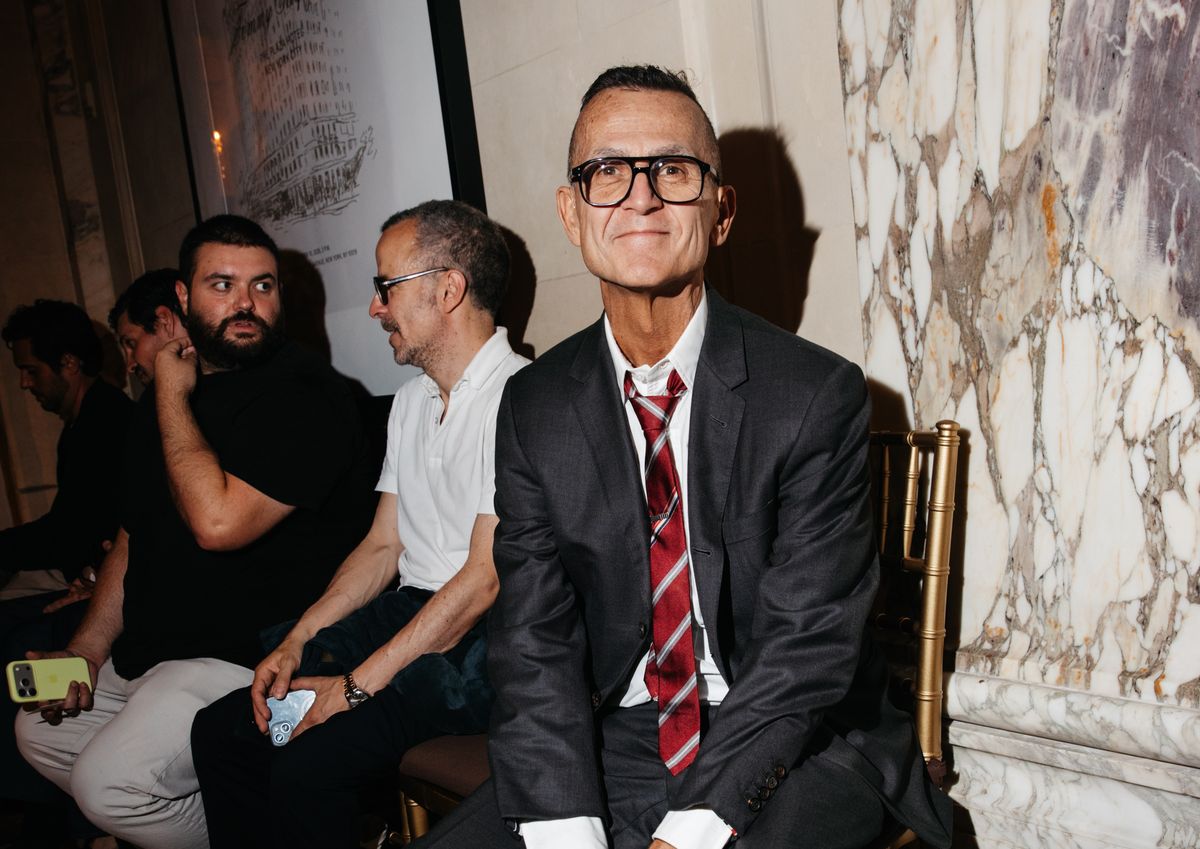
Steven Kolb ran American fashion's most powerful trade body for two decades. Thirty seconds of video from a runway in Lower Manhattan ended it — and the campaign that triggered it has already moved to London.
NEW YORK
Sunday afternoon, 175 Water Street
The COS show on Sunday 13 September was meant to be an unremarkable entry on a crowded New York Fashion Week schedule. Mid-afternoon slot, downtown venue — WSA at 175 Water Street — a commercial collection from H&M Group's elevated label.
Then at least five PETA representatives got inside, and several of them got onto the runway, holding signs reading: 'Sheep beaten and bloodied for wool. Don't buy it.'
What happened next was filmed. Steven Kolb, the chief executive and president of the Council of Fashion Designers of America, was captured on video physically restraining two of the protesters — grabbing them, snatching at their printed signs, and, in the case of one woman, holding her to the floor, locking a leg around her and covering her mouth and nose with his hands as she shouted her slogan.
By Friday 18 September, after two decades at the CFDA, Kolb had resigned.
Five days
The sequence was brisk by the standards of institutional crises. On Monday the CFDA board placed Kolb on leave pending an investigation. That same day he posted a lengthy apology to Instagram Stories.
'My actions were wrong and I am deeply sorry,' he wrote, adding: 'What happened was completely out of character for me, both personally and as a leader. Frankly, I don't recognise that person.'
The leave of absence became permanent on Friday. In his resignation statement, Kolb struck a different register: 'I am enormously proud of what we have built together and believe this is the right moment for both me and the organisation to begin a new chapter.' The board responded in kind — 'We respect Steven's decision to step down and are grateful for his many years of leadership and service to the CFDA and our industry' — and named no successor.
The scale of the departure is worth stating plainly. Kolb spent more than twenty years at the CFDA, fifteen of them as chief executive. He presided over the CFDA Fashion Awards, the official New York Fashion Week calendar, the organisation's designer grant programmes and its policy positions — including, last season, the ban on fur at NYFW. He was, by any measure, the most powerful non-designer in American fashion.
What the protest was actually about
The runway invasion was not improvised theatre. It is the visible end of a campaign that began in May 2026, when PETA Asia released investigative footage recorded at a wool farm in South Africa. The group says the footage documents workers kicking and hitting sheep, dragging them by their legs, and injuring them during rough shearing.
PETA's specific allegation is about certification. It says the facility had been certified by Nativa, an ethical-fibre industry standard, and that the operation is linked to H&M Group's supply chain — though, as FashionNetwork noted in its own reporting, linked to the supply chain is not the same claim as used for products sold in its stores. That distinction matters, and it is the ground on which any industry response will be fought.
PETA's campaign objective is broader than one farm or one retailer. The group is attempting to push wool — one of the most widely used materials in clothing — out of the fashion supply chain altogether. That is a considerably larger ask than the fur bans of recent years, and it is why this fight is likely to last.
Then it went to London
Four days after the COS disruption, PETA did it again — this time at H&M's own show on the opening Thursday evening of London Fashion Week.
Security was conspicuously heavier. It did not work. Protesters reached the runway a second time while others demonstrated outside, carrying signs reading 'H&M: Wool is BLOODY Cruel. Drop It!'
The collection itself, as it happens, was barely a wool story. H&M showed an instantly shoppable line-up of corset tops, ruffled jackets, embroidered pieces, lacing and military-edged button detail, anchored in a cream, black and burgundy palette and styled with jeans and tailored trousers. The embroidered off-white hussar jacket and the appliqued peplum drew the best notices. Wool did not form a large part of it.
That is rather the point of a protest at a fashion show: the target is the corporate group, not the garments on the rail.

PETA's closing move
The organisation issued a statement on Friday night, after Kolb's resignation, that declined to claim the scalp and instead redirected it.
'This unfortunate incident, which has cost Mr Kolb his job, would never have taken place if the CEO of H&M had, as PETA requested so many times, taken action to avoid extreme violence to animals exploited for clothing,' the statement read. 'We will still be meeting with Mr Kolb, and hopefully others in the industry will meet and take meaningful steps to stop this epidemic of cruelty.'
Whatever one makes of the framing, the tactical logic is clear. A trade-body chief executive losing his job over a wool protest guarantees that the next brand approached by PETA will take the meeting.
What this means for your wardrobe
One genuinely useful takeaway, independent of where you land on the ethics: a certification label is a claim about a system, not a guarantee about a specific animal on a specific day. Schemes like Nativa audit suppliers against a standard. Audits are periodic, supply chains are long, and certification bodies can be — and regularly are — accused of missing things.
If animal welfare drives your buying, the practical questions are narrower than 'is this certified?'. They are: who audits, how often, is the audit announced, and is the result published? Very few brands answer all four.
The wider reckoning
Fashion has spent a decade retiring materials — fur first, then exotic skins at several major houses, then angora. Wool is a different order of problem: it is everywhere, it is renewable, it is biodegradable, and its defenders argue it is one of the few genuinely circular fibres the industry has.
What changed this week is not the argument. It is the cost of being on the wrong side of a camera while it is being had.
Published By | Features Editor