Written By | Fashion and Design Desk
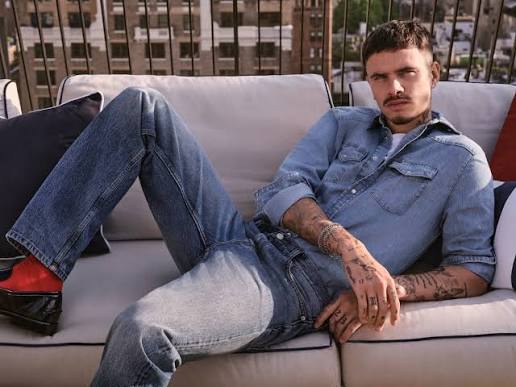
Tommy Hilfiger's Fall 2026 campaign bets on a 25-year-old with the family pedigree and generational reach to sell denim's biggest comeback season in years
NEW YORK
There's a version of a celebrity denim campaign that feels like pure transaction: a famous face, a product, a check. Tommy Hilfiger's new "Always Denim" campaign, fronted by Romeo Beckham and unveiled in the final days of July, is being pitched as something more deliberate — a bet not just on a recognizable name, but on the specific cultural moment denim is currently having, and on a 25-year-old whose own biography happens to intersect neatly with the brand's founding mythology.
Shot at The Mark Hotel in downtown New York, the campaign places Beckham — model, sometime footballer, third child of David and Victoria Beckham — at the center of rooftop sunsets and casual gatherings alongside Dutch model Yasmin Wijnaldum and a cast of emerging creatives, all built around the loose narrative of "Classic American Cool." It's a phrase that could describe half of Tommy Hilfiger's back catalogue, but this season, the brand is using it to reintroduce denim not as a seasonal trend piece but as an everyday foundation — the thing you build an outfit, and apparently a personal brand, around.
The Pitch: Denim as Autobiography
What separates "Always Denim" from a standard celebrity tie-in is how explicitly founder Tommy Hilfiger has tied the campaign to his own origin story. "Denim has always represented the pinnacle of self-expression to me," Hilfiger said of the launch. "When I was a teenager growing up in Elmira, I'd drive to New York City to buy jeans, customise them and sell them out of the trunk of my car. Through every decade, it's evolved with music, youth culture and changing attitudes, yet never lost that timeless appeal. This campaign celebrates that legacy through a new generation, showing how the classics continue to be reimagined in personal ways."
It's a notably personal framing for a brand campaign, and it does real work: it positions denim not as this season's trend but as the connective tissue of the label's entire 40-year identity, with Beckham cast as the latest inheritor of a lineage that started with a teenager reselling jeans out of a car trunk in upstate New York.
The collection itself leans into that legacy-over-novelty approach. Rather than chasing a single "it" silhouette, the campaign is built around four named, semi-permanent fits: the 90s-inspired "Theo" baggy jean and straight-leg "Dover" for men, and the high-waisted "Sarah" and low-rise "Daisy" for women. Naming denim cuts like recurring characters — rather than launching and retiring them each season — is a small but telling signal that Tommy Hilfiger is building denim as an ongoing franchise, not a one-off marketing moment.
Why Romeo Beckham, Why Now
Beckham's casting isn't incidental. He arrives with inherited fashion credibility — his mother built a namesake label, his father has fronted campaigns for everyone from Armani to H&M — but has spent recent years establishing a modeling career distinct from the family name, including previous work for brands like Prada. He's also, notably, part of a generation of famous offspring who've had to prove they can carry a campaign on charisma and not just surname recognition, and Tommy Hilfiger's bet is that he can do both.
In comments tied to the campaign, Beckham has described denim as a genuinely flexible part of his own wardrobe — a category that lets each wearer develop an individual style rather than following a single prescribed look. That message dovetails with the campaign's broader thesis: that the right pair of jeans should function less like a trend purchase and more like a piece of personal infrastructure, worn from "morning to midnight," in the campaign's own language, with no fixed "correct" way to style it.
Denim's Bigger Moment
The Beckham campaign doesn't exist in isolation. It's landing squarely inside what multiple fashion outlets are now describing as denim's defining comeback trend of 2026 — part of a broader runway shift toward nostalgic, wearable basics after several seasons dominated by maximalism and directional statement pieces. Industry trend coverage this year has repeatedly flagged denim, in various silhouettes, as one of the few categories bridging both luxury runways and mainstream retail simultaneously, which makes Tommy Hilfiger's timing look less like coincidence and more like a brand moving to claim territory before its position becomes crowded.
That positioning matters commercially, too. Denim remains one of the highest-margin, highest-repeat-purchase categories in fashion retail — a customer who buys into a specific fit tends to return for the same fit again, which is precisely the loyalty the "Theo," "Dover," "Sarah," and "Daisy" naming convention seems designed to cultivate. In an industry currently nervous about discretionary spending and tariff-driven cost pressure, a campaign built around durable, repeat-purchase basics — fronted by a globally recognizable face — is a relatively low-risk, high-visibility way to reassert relevance.
What This Means for Shoppers
For readers who've watched denim cycle through skinny, wide-leg, low-rise, and back again over the past decade, the "Always Denim" campaign is a useful signal of where the pendulum currently sits: toward the 90s-inflected baggy and straight-leg silhouettes represented by the "Theo" and "Dover" fits, and toward high-rise options like "Sarah" for women, rather than the ultra-low-rise extremes that briefly resurfaced earlier in the decade. If you've been holding off on a denim refresh, the current moment favors relaxed, slightly retro shapes over anything aggressively fitted.
It's also a reminder that celebrity casting in fashion campaigns increasingly functions as a values statement as much as a marketing device. Tommy Hilfiger didn't need Romeo Beckham to sell jeans — the brand has sold jeans successfully for four decades without him. What his casting signals is an attempt to connect denim's current cultural cachet among younger, digitally native consumers to a brand whose core customer has historically skewed older, using a 25-year-old with genuine reach across both audiences as the bridge.
The Bigger Picture
"Always Denim" is a small campaign in the scheme of a fashion year that has included creative-director shakeups at Versace, Fendi, and Dior, and headline-grabbing runway theatrics at fashion weeks worldwide. But its quieter ambition — to make a single garment category feel like a lifestyle rather than a purchase — reflects where a meaningful chunk of the industry's actual revenue lives: not in the show-stopping look that generates a thousand red-carpet headlines, but in the pair of jeans a customer buys, wears out, and comes back to replace. Whether Romeo Beckham becomes the face associated with that shift long-term, or simply this fall's most visible one, the bet Tommy Hilfiger is making is that denim, done right, never really goes out of style — it just needs the right person standing in it.



