Mali
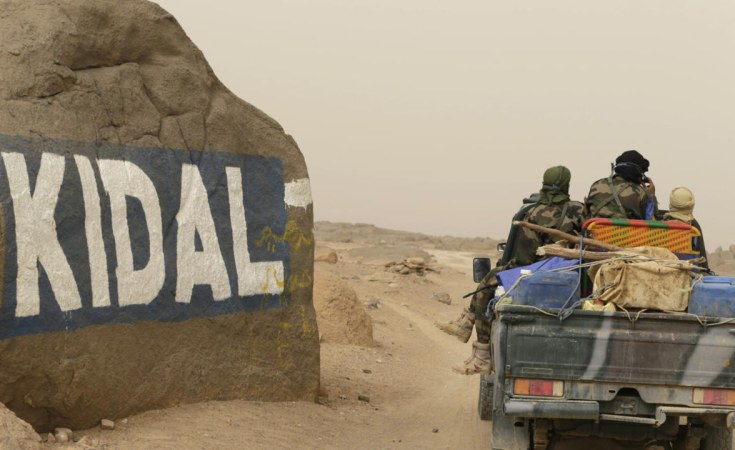
Mali's military government said this week that its troops had re-entered Kidal, the northern Tuareg stronghold that separatist rebels seized in April, after the rebels announced a withdrawal. The return of the town is a rare piece of good news for the junta of Gen. Assimi Goita, which has spent six months reeling from the most serious assault on its rule since 2012. Whether it marks a turning point or only a pause in a grinding stalemate is the question now facing Bamako, its Russian partners and the insurgents.
What happened in Kidal
On October 6 the Azawad Liberation Front (FLA), a Tuareg separatist movement, announced what it called a "strategic and controlled withdrawal" from Kidal, which it said was intended to "preserve human lives," Al Jazeera reported. The group blamed the "disproportionate use of aerial assets by Russian mercenaries from Africa Corps." Mali's transitional government said its troops had "consolidated their positions" in the town "supported by their Russian partners," and described "intense air-ground neutralization operations." Al Jazeera reported that the entry took place without reported fighting.
The government said its forces had begun "reinforcing their presence," which it said would enable "the gradual return of public administration and basic social services," according to ThePrint's account. The FLA described its pullout as a "temporary operational measure" that does not mean abandoning the struggle, according to African Perceptions, a commentary site that also reported that the departure took place days before it was announced.
African Perceptions further claimed that the FLA's ally, the al-Qaeda-linked Jama'at Nusrat al-Islam wal-Muslimin (JNIM), had decided weeks earlier not to defend the city, and that Khalifa Haftar, the eastern Libyan commander, had led undisclosed mediation efforts. Both claims rest on unnamed sources in a single outlet and are not confirmed by the other reporting reviewed for this story.
How Kidal was lost
Al Jazeera describes Kidal as a Tuareg stronghold, and control of it has changed hands repeatedly. Malian troops and Wagner fighters retook the city in November 2023. They lost it again in April.
The loss came on the weekend of April 25 and 26, when the FLA and JNIM launched coordinated attacks. Reporting from the time described a wave of assaults on Bamako, the garrison town of Kati, Kidal, Gao and Sevare, according to Michigan Public and Khaleej Times. The most prominent casualty was Defense Minister Sadio Camara, who was killed in an attack on his home in Kati; his second wife and two grandchildren also died, the reports said. Khaleej Times reported that the 47-year-old Camara "fought his attackers, some of whom he succeeded in neutralising" before dying of his wounds. (Khaleej Times dates the attack to April 27, while the Michigan Public report and the funeral on April 30 cited by Africanews point to the weekend of April 25 and 26.) Michigan Public's report called it one of the largest coordinated attacks seen in recent years, and the rebels claimed "total" control of Kidal.
Goita, who had been the face of Mali's military rule since the 2020 and 2021 coups, was not seen in public in the immediate aftermath. The Khaleej Times report said he "has not been seen or spoken publicly since the start of hostilities," and Africa Confidential reported that he took refuge at an old air base in Bamako and resurfaced three days after the minister was killed. He gave his first address on April 29, telling Malians the situation was "under control," Africanews reported. Michigan Public reported that U.S. citizens in Bamako were told to shelter in place and that airport flights were cancelled. Africanews counted at least 23 deaths in the attacks, including civilians and children.
The political consequences came quickly. On May 4 a decree made Goita himself defense minister, Africanews reported, with Gen. Oumar Diarra, a former military chief of staff, appointed as minister delegate. The move concentrated yet more authority in the hands of a leader whose hold looked uncertain. Militants also announced a partial blockade of Bamako, and a transport company manager told Africanews his firm had "suspended all departures for Bamako until further notice."

Russia's role and its limits
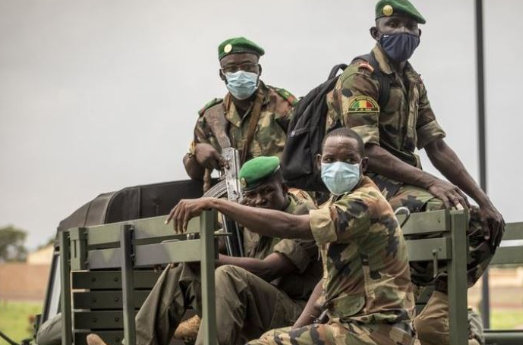
The junta has shifted toward Russian military support and away from France, and relies on the Africa Corps, which Al Jazeera says was established in June 2025 as the successor to the Wagner group and operates under the direct control of Russia's Defense Ministry. The rebels' complaint about Russian airpower is therefore also a statement about who is winning the fight on the ground: the FLA's own communiqué credits Africa Corps aircraft for forcing its hand.
The partnership has not been without strain. Africa Confidential, in an analysis whose full text is behind a paywall, described the Goita regime as "teetering," said "Russian allies" were withdrawing support, and concluded that a stalemate had set in. That characterization cannot be independently verified here, and the preview available does not specify the extent of any Russian drawdown. African Perceptions pointed to a drone strike at Goundam on a joint Malian and Africa Corps base as evidence of the insurgents' reach.
What the recapture does and does not change
Beverly Ochieng, an associate at the consultancy Control Risks, assessed the recapture as "symbolic" rather than "decisive" in the counterinsurgency campaign, though she said it bolsters the government's authority and morale after recent setbacks, according to ThePrint. That judgment seems sound. Retaking a town that was evacuated without a fight is different from defeating the force that held it. If the FLA and JNIM preserved their fighters and equipment, as the rebels claim, they remain free to choose where and when to strike next.
For the junta, the optics matter. Since April, Goita's government has faced questions about its ability to protect the capital, its relationship with Moscow and its own cohesion. A reoccupied Kidal lets officials in Bamako argue that the offensive has been reversed. It also hands them a platform for a return of state services in the north, a promise that earlier governments made repeatedly and that insurgent violence has repeatedly undone.
The risk for the junta is overreach. Holding Kidal requires supply lines across vast desert terrain, air cover that depends on Russian assets, and enough troops to garrison a population whose loyalties are contested. The same combination held the city from November 2023 until April, and then lost it. A second loss would be far more damaging than the first.
The wider Sahel picture
Mali's trajectory matters beyond its borders. According to the Global Terrorism Index, cited by Michigan Public, the Sahel accounted for over half of global terrorism deaths in 2025. Mali's neighbors, including Algeria, whose position Africa Confidential also addresses, are watching for any spillover. The United Nations and European Union condemned the April attacks, and the United Arab Emirates issued a travel ban, according to Khaleej Times, reflecting international anxiety over the junta's survival.
The political question is whether Mali's rulers will use whatever breathing room Kidal gives them to broaden their base or to harden it. The post-April record points one way so far: the defense portfolio now sits in Goita's own hands, which suggests a regime consolidating rather than opening up.
What to watch
Several developments will show whether this week's events are a turning point. Watch first for whether the FLA and JNIM stage fresh attacks in the north or return their focus to southern Mali and the Macina region, the areas African Perceptions flagged. Second, watch for any confirmation of the reported mediation track involving Haftar, which would signal that a political channel exists alongside the military contest. Third, monitor whether public administration, schools and health services actually return to Kidal, which would be the first real test of the government's claims. Fourth, watch the junta's relationship with Moscow, including any change in Africa Corps posture. And finally, watch Bamako: the blockade threat of April has not been reported in the sources reviewed to have been lifted, and the capital's supply situation remains a pressure point.
For now, the facts on the ground are narrower than the headlines suggest. Mali's army is back in a town it lost, with Russian help and without a battle. The insurgency that took it is still intact, and the political crisis in Bamako that began in April has not been resolved.
Published By | News Editor