Written By | International News Agencies
What makes Lesotho's 2026 worth studying is not the arithmetic of the slowdown but its anatomy. The contraction did not originate in a drought, a currency crisis or a fiscal blowout.
Economic and Social Transformation
A growth line that fell off a cliff
Few African economies have had their trajectory rewritten as abruptly as Lesotho's. According to the African Development Bank's June 2026 country outlook, real GDP growth slowed to 1.4 percent in 2025 from 5.2 percent in 2024, and is projected to fall further to just 0.5 percent in 2026 before a partial recovery to 1.8 percent in 2027. The International Monetary Fund's own projection for 2026 sits at 1.1 percent, while the World Bank expects growth to average roughly 1.5 percent across 2026 to 2028. The three institutions disagree at the margins, but not about the direction: a mountain kingdom of about 2.3 million people has moved, in the space of two years, from one of the stronger performers in the Southern African Customs Union to something close to stagnation.
What makes Lesotho's 2026 worth studying is not the arithmetic of the slowdown but its anatomy. The contraction did not originate in a drought, a currency crisis or a fiscal blowout. It originated in trade policy decisions taken in Washington, transmitted almost instantly to factory floors in Maseru and Maputsoe. And it is being partially offset by construction activity on a dam whose water is destined for Johannesburg. Both of Lesotho's principal economic lifelines, in other words, are owned and directed by someone else.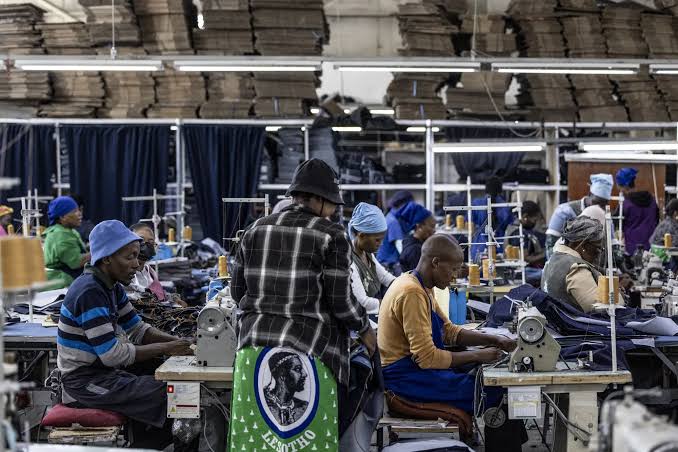
The garment shock, in numbers
Lesotho's apparel sector employs roughly 34,000 workers, about three-quarters of them women, and accounts for around 35 percent of national exports, the great majority destined for the United States. It was built deliberately on the African Growth and Opportunity Act (AGOA), which for two decades gave duty-free access to the US market and turned the country into one of sub-Saharan Africa's largest apparel exporters.
That structure inverted in 2025. The United States announced a punitive tariff on Lesotho's exports in April 2025, later reduced to 15 percent and effective from 7 August. AGOA itself then lapsed in September 2025. Orders were cancelled, shifts cut and facilities closed; unions documented at least 12,000 garment workers laid off or placed on unpaid leave, and Lesotho's trade minister warned that as many as 40,000 jobs could be lost across the wider value chain. The IMF, in its own assessment, put roughly 30,000 jobs at risk. Because each garment worker in Lesotho supports an estimated four dependents, the arithmetic of exposure reaches well beyond the payroll: informal vendors, transport operators and service providers clustered around the industrial zones absorbed the second wave.
The reprieve, when it came, was short. AGOA was reauthorised on 3 February 2026, retroactive to its September 2025 expiry, but runs only until 31 December 2026. Analysts at ODI, writing in April 2026, described the effect precisely: production has partly resumed and job losses have stabilised, but with market access guaranteed for less than a year, orders remain cautious, investors hesitant and long-term upgrading on hold. A ten-month window restores cash flow without restoring confidence. Firms plan for survival rather than transformation, which in a labour-cost-competitive sector means holding wages down rather than moving up the value chain.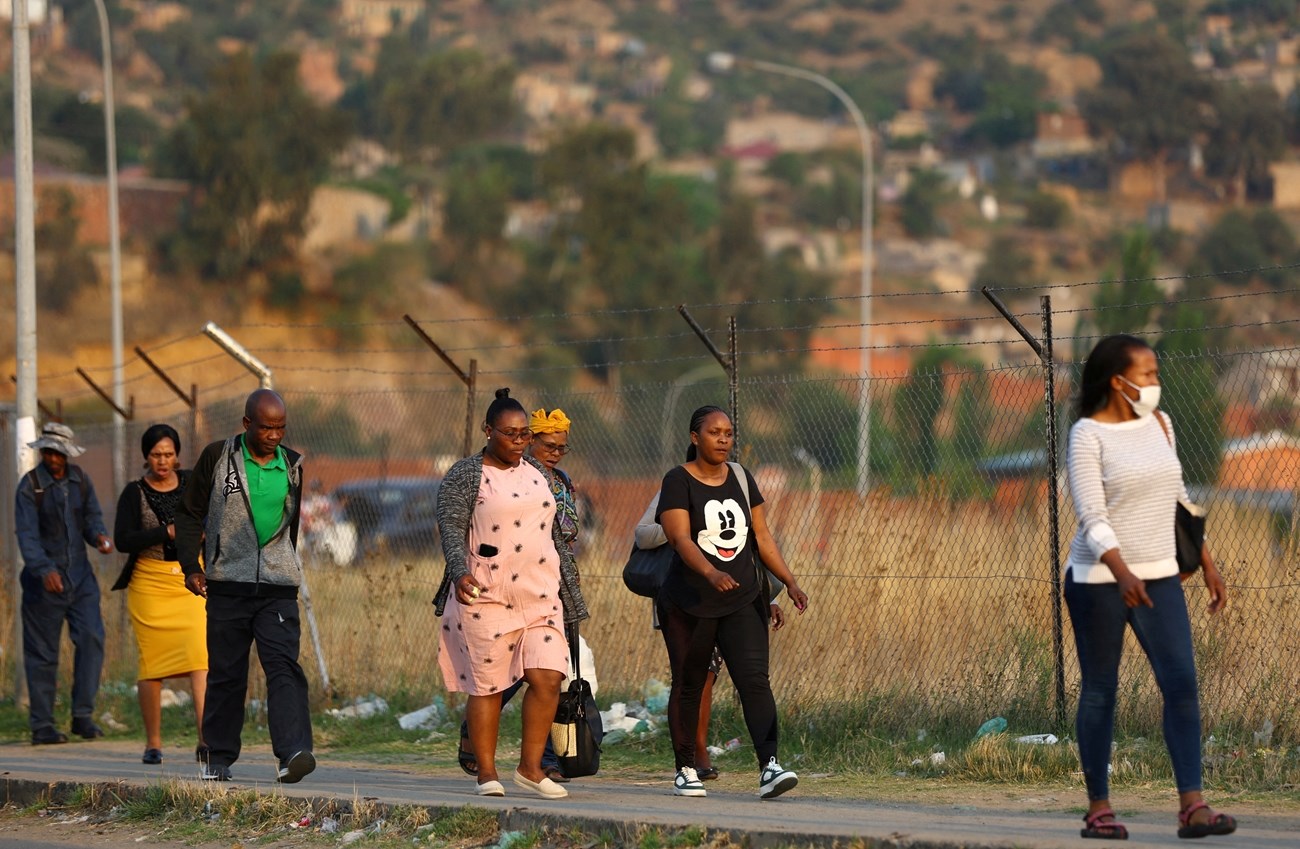
A state of disaster declared over jobs
The policy response was unusual. On 7 July 2025 the government gazetted a national state of disaster over unemployment, running two years to 30 June 2027. The trigger was the 2024 Labour Force Survey, which put unemployment at 30.1 percent, up from 22.5 percent in 2019. The AfDB records youth unemployment at 38.9 percent; other readings put the 15-to-35 rate at 39 percent, with young women at 41 percent.
The instrument has since acquired concrete content. Under the 2026/27 budget, government infrastructure projects carry a mandatory 40 percent youth labour participation requirement, the National Volunteer Corps is being expanded, and a National Youth Development Bill has been prioritised. For contractors bidding on the state's capital programme, youth employment quotas and structured apprenticeship frameworks are becoming contractual conditions rather than aspirations.
The social ledger explains the urgency. Real GDP per capita grew by only 0.3 percent in 2025, meaning living standards effectively stalled, with the sharpest pressure in the export-dependent urban belt. Lesotho's 2025 Human Development Index value improved only modestly, to 0.550. Compounding matters, the cancellation of the Millennium Challenge Corporation's Compact II removed a significant external financing stream at precisely the moment the trade shock landed.
The dam as counterweight
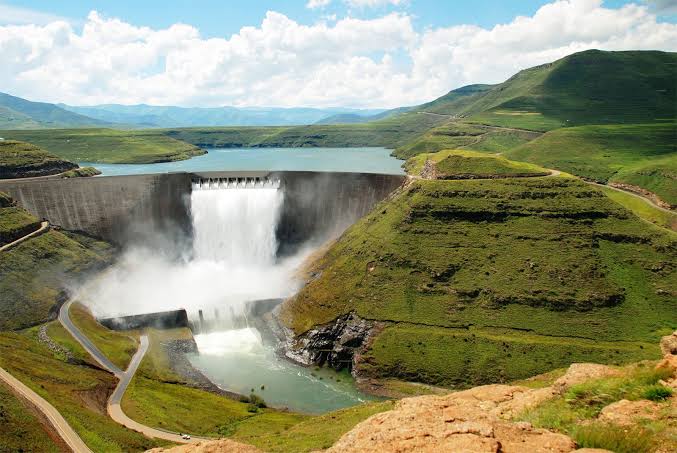
Against this, one sector is booming, and it is literally being carved out of the Maloti mountains. Phase II of the Lesotho Highlands Water Project is now the dominant driver of investment activity. By July 2026 the Polihali Dam had reached 50 percent completion, with 9.6 million cubic metres of rock placed at an average of 26,000 cubic metres per working day, taking the rockfill component to 67 percent. The scheme remains on schedule for reservoir impoundment during the 2027/28 rainy season.
The transfer tunnel is advancing from both ends. A tunnel boring machine launched from the Katse side in January 2025 has excavated more than 600 metres; a second machine started from Polihali in January 2026 and has advanced hundreds of metres, with drill-and-blast methods used in the more complex geology. The two are boring toward a meeting point beneath ranges rising above 3,000 metres. On completion, transfer capacity rises from 780 million to 1,270 million cubic metres a year, securing water supply for Gauteng, South Africa's industrial heartland.
For Lesotho the payoff is royalties, and the World Bank explicitly identifies higher water royalties, alongside the construction activity itself and still-elevated SACU receipts, as the main supports to an otherwise subdued outlook. It is a reliable income stream. It is also, structurally, the same arrangement as the garment sector and the gold mines before it: revenue determined by demand conditions in a neighbouring economy, over which Maseru has no control.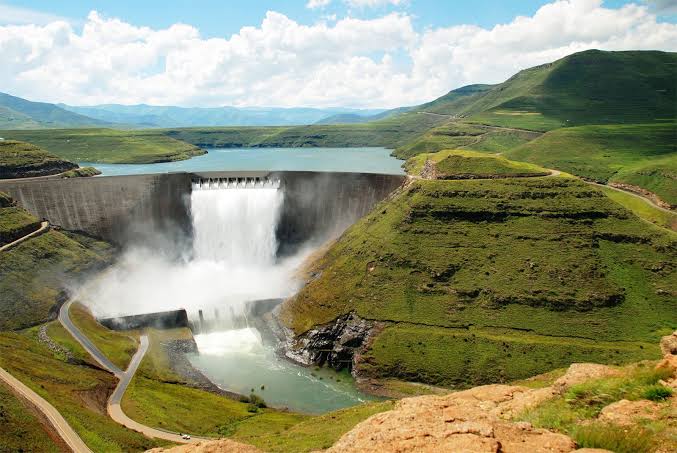
Diamonds: better prices, smaller sector
The third external earner has had a better year than expected. Gem Diamonds, which holds 70 percent of the Letšeng mine, reported first-quarter 2026 revenue of US$32.1 million from 16,727 carats at an average US$1,501 per carat. Across the first half of 2026 revenue rose 32 percent to US$59.7 million, with the average rough price up 38 percent to US$1,395 per carat, and the company swung to a US$0.6 million profit for the six months to 30 June, against an US$11.7 million loss a year earlier. Letšeng yielded three stones above 100 carats in the period, including a 346.99-carat diamond named the Lesotho Jubilee.
Those numbers reflect the top end of a shrinking market rather than a sector-wide recovery. The AfDB records that Lesotho's diamond production declined in 2025 amid weak global prices and rising competition from lab-grown stones. Recognising the squeeze, the 2026/27 budget announced a rules-based fiscal stabilisation framework for mining, intended to preserve employment and extend mine life during periods of market stress. In practice that implies royalty relief mechanisms, revised fiscal terms and conditional state support tied to employment obligations, a notable shift for a jurisdiction whose mining fiscal regime has historically been static.
Fiscal rules in place of fiscal luck
Finance Minister Retšelisitsoe Matlanyane presented the 2026/27 budget on 18 February 2026 under the theme "Accelerating Economic Transformation; Building Resilience", framing it as a shift from stabilisation to structural reform. The headline structural change is the adoption of a rules-based fiscal framework: a debt ceiling of 60 percent of GDP, a debt anchor of 50 percent, an external debt limit of 40 percent, and a structural deficit target of 3 percent of GDP.
The starting position is comparatively strong. Public debt fell to 50.0 percent of GDP in FY2025/26 from 54.3 percent the year before. The fiscal surplus narrowed to 2.6 percent of GDP in 2025 from 9.5 percent in 2024 as revenue normalised, and the AfDB projects surpluses of 2.1 percent in 2026 and 3.1 percent in 2027, while the budget's own framework works to a deficit of around 3 percent in 2026/27 on a different perimeter. Inflation eased to 4.3 percent in 2025 from 6.1 percent, with the policy rate cut 100 basis points to 6.50 percent by year-end in line with the rand peg; the AfDB expects inflation to tick back up to 5.7 percent in 2026.
The vulnerability is concentrated in one line item. SACU receipts amounted to 20.4 percent of GDP and are projected to stabilise near 20 percent, which the minister herself flagged as a major macro-fiscal risk given its dependence on South African trade performance. The budget therefore lifts capital expenditure to 19.7 percent of GDP, with M2.4 billion for water, M2.1 billion for roads and buildings, M1.7 billion for energy and M386.4 million for ICT, and pairs it with a Special Economic Zones Bill, a National Single Window for trade, digital business licensing and border modernisation. Government has also flagged fiscal risks from state-owned enterprises and legacy public-private partnership contracts with potential exposure of up to 3.8 percent of GDP, and has an audit of those agreements underway.
Externally, the current account swung from a 5.0 percent surplus in 2024 to a 3.9 percent deficit in 2025, and is projected to widen to 8.7 percent of GDP in 2026 on import costs and project-related imports, before narrowing to 4.5 percent in 2027 as construction spending eases.
The pattern beneath the shock
Recent research from the University of Johannesburg's Frederich Kirsten and Mduduzi Biyase, published in African Arguments on 1 September 2026, places 2026 in a much longer sequence. In 1987, remittances from Basotho men working South Africa's gold mines reached 236 percent of Lesotho's GDP. Today the figure is around a fifth. South African gold-mining employment fell from roughly 536,000 workers in the late 1980s to about 94,000 in 2023. Using structural-break methods, the authors date Lesotho's net migration reversal to 1986 and the start of the remittance decline to 1988; measurable shifts in aid did not appear until 1998, and South Africa's own gold output did not register a formal structural decline until 2004.
Their central finding, which they present as ongoing and not yet peer-reviewed, is that Lesotho's remittance inflows never responded to Lesotho's own climate shocks. Money that moves with conditions outside your borders is not insurance; it is exposure wearing the appearance of a safety net. Swap Johannesburg's gold for Washington's tariffs, they argue, and the structure of the 2025-26 crisis is identical to the one that hit miners' families four decades earlier.
That framing sharpens what the 2026/27 budget is actually attempting. Fiscal rules, SEZ legislation, tax administration reform and a mining stabilisation framework are all, in different ways, attempts to build income streams and buffers that respond to Lesotho's own conditions rather than to someone else's decisions. Whether they succeed will not be visible in the 2026 growth number, which is largely already determined. It will be visible in whether the next external shock, when it arrives, finds a state with the fiscal space to absorb it and a private sector with somewhere else to sell.



