TECH
With just 1.2 million people, the Kingdom of Eswatini rarely features in continental conversations about African tech, which tend to gravitate toward Nigeria, Kenya, or South Africa. Yet over the past two years, the country's central bank, telecom regulator, and government have been quietly executing one of the more methodical digital-finance build-outs on the continent — not by chasing unicorns, but by wiring interoperability, broadband access, and a national fintech strategy together from the ground up before scale arrives rather than after.
A Payment Switch Built for Everyone, Not Just Banks
The centerpiece is the Eswatini Payment Switch (EPS), an instant-payments rail designed and funded by the Central Bank of Eswatini (CBE) with an unusual governance choice: banks and non-bank mobile money operators were brought into the same project from day one. In a November 2025 interview with TechCabal, Sabelo Gama, the CBE's Deputy Director of Operations for Payments, explained that the switch now connects eight participants — the country's four commercial banks, three mobile money operators, and a newly licensed Building Society. According to Gama, the final participant was scheduled to go live in November 2025, meaning every payment provider in the country would be reachable through a single national switch.
The regulatory logic is explicitly consumer-first: agents are barred from signing exclusive agreements with a single operator, providers must follow defined dispute-resolution timelines, and the National Payment Systems Act of 2023 gives the CBE clear authority over licensing and compliance across all participants. Gama described the country's financial inclusion rate as having risen to approximately 87 percent, up from around 50 percent a decade ago, with the CBE attributing almost all of that gain to mobile money adoption.

From P2P Transfers to a Full Digital Economy
Despite the inclusion numbers, usage remains shallow: most mobile money activity is still peer-to-peer transfers followed by an immediate cash-out, rather than sustained digital savings, merchant payments, or credit. Only one provider currently offers a limited mobile credit product, and government payments flow through just one operator today — a gap regulators want closed by pushing all government-to-person and person-to-government payments onto the shared switch. The CBE's next phase is to move beyond "getting every provider connected" toward enabling merchant acceptance, domestic e-commerce, and interoperable payment gateways.
Digital identity is the piece regulators describe as still unsettled. Eswatini's national digital ID is managed by the Ministry of Home Affairs, and while it functions for basic verification, the country has not yet agreed on a unified electronic Know-Your-Customer (eKYC) framework — a decision that directly affects how quickly new fintech entrants can onboard customers digitally. The 2022 Data Protection Act provides the legal backbone, but officials describe eKYC governance as an active, unresolved discussion.
A National Fintech Strategy With a Ten-Year Runway
Layered on top of the payments overhaul is Eswatini's first-ever National Fintech Strategy, covering 2025 to 2030, published in partnership with the Alliance for Financial Inclusion. The strategy sets out five pillars — digital infrastructure, human capital, agile regulation, financial safeguards, and regional integration — structured in three sequenced tiers: a 2025–2027 "foundational" phase focused on standing up a coordination office and expanding the regulatory sandbox; a 2027–2029 "catalytic" phase aimed at full interoperability and scaled digital government payments; and a 2029–2030 "sustaining" phase centered on cybersecurity and growing homegrown fintech firms. The CBE has also stood up a dedicated fintech unit to oversee licensing and innovation policy.
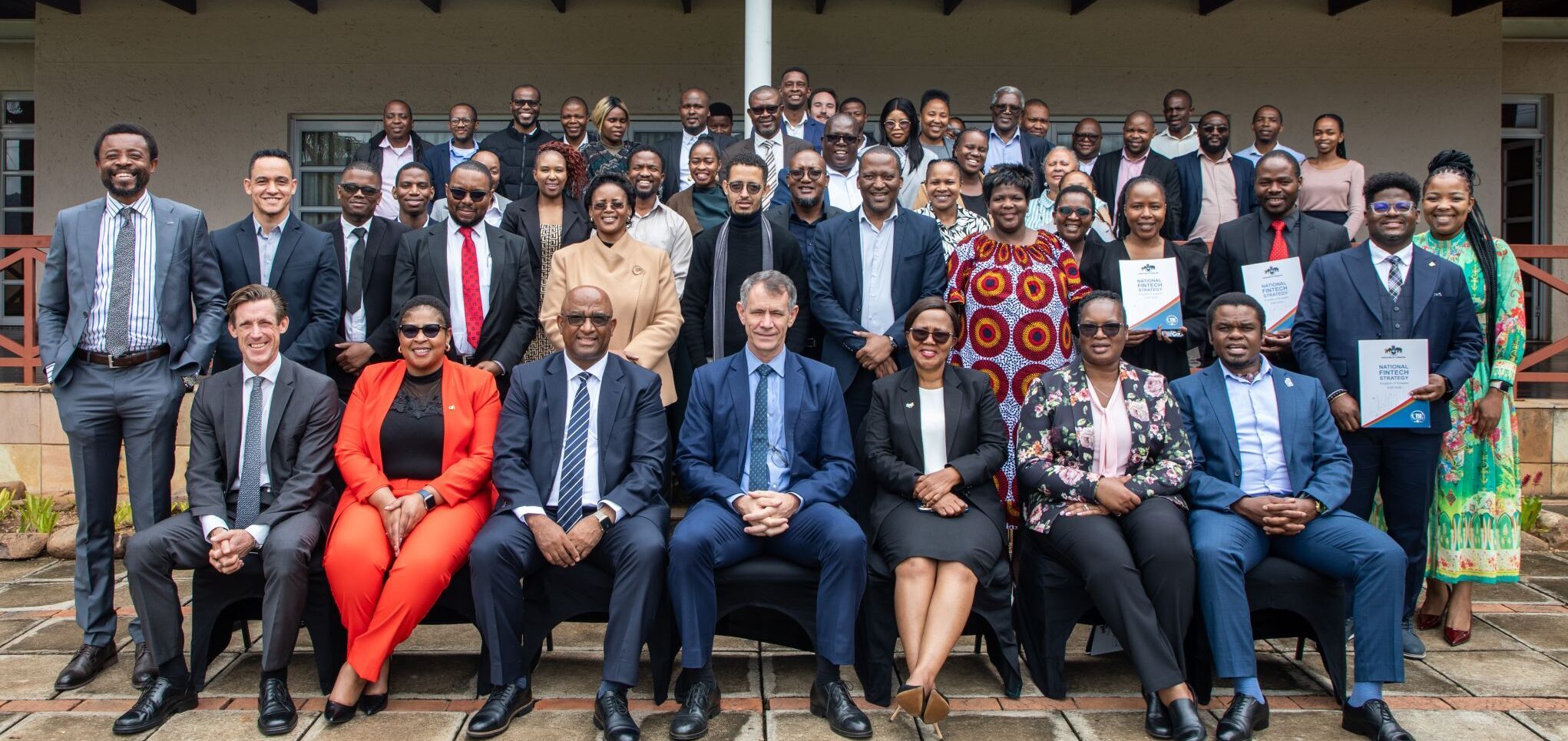
Eswatini's National Fintech Strategy aims to build a trusted and competitive digital finance ecosystem - Alliance for Financial Inclusion
Financing the Physical Layer
None of this works without connectivity, which is where the World Bank-backed Eswatini Digital Transformation Project comes in. Valued at roughly E1.2 billion, or about $65 million, the largest single component — approximately E648 million ($36 million) — is dedicated to affordable broadband. That breaks down into about E468 million ($26 million) for stabilizing the state telecoms operator, E144 million ($8 million) for expanding the national broadband market, and E36 million ($2 million) for ICT reform. A second major component, worth roughly E450 million ($25 million), funds a "Government in Your Hand" initiative to deliver public services digitally. Direct beneficiaries identified by the World Bank include 859 schools, 134 health centres, and 38 local governance centres slated for broadband connectivity — infrastructure the government frames as a prerequisite for the fintech strategy's later phases to succeed.
Why the Small-Market Approach Matters
Eswatini's experiment is instructive precisely because of its scale, not despite it. Larger African fintech markets built mobile money and interoperability policy reactively, often years after a dominant private operator had already captured the bulk of the market, leaving regulators to negotiate interoperability costs after the fact. Eswatini's central bank, funding and governing the national switch itself while pulling every provider into the same project simultaneously, is attempting to avoid that path dependency altogether. Whether a market of 1.2 million people can generate enough transaction volume to make merchant payments, credit, and open banking commercially viable remains the open question — the CBE's "toughest bottleneck" over the next several years.
Sources: TechCabal, The Fintech Times, Alliance for Financial Inclusion, World Bank, Tech Review Africa, Eswatini Positive News, Central Bank of Eswatini
Published By | Tech Wiz