Written By | International News Agencies
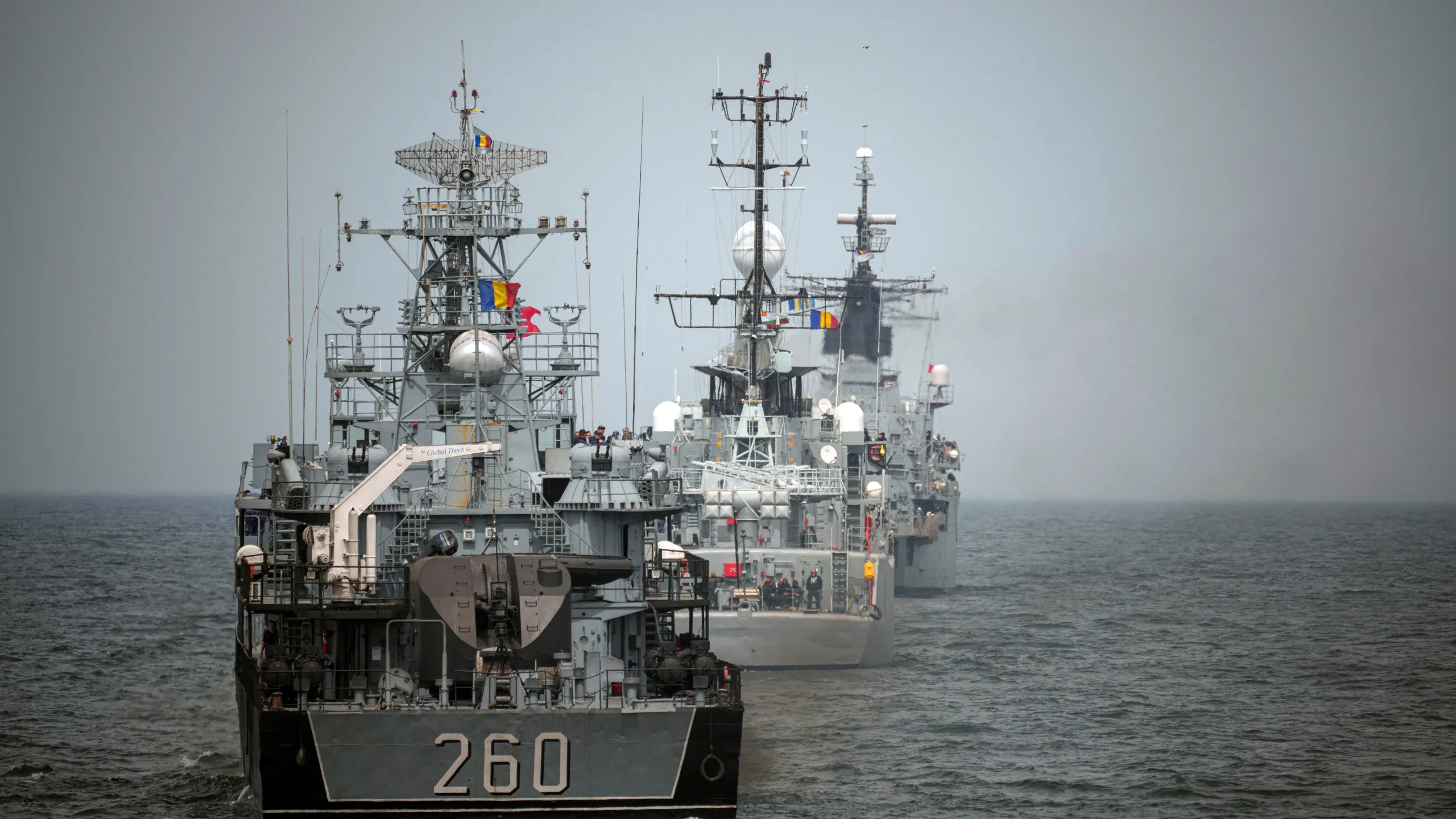
The Black Sea has been a theatre of the Russia-Ukraine war since 2022, when Moscow's invasion closed Ukrainian ports and later led to the collapse of the original grain corridor deal.
World Politics
Overview
For most of the war in Ukraine, the western Black Sea has been a place where the fighting was close but not quite inside the alliance. That distinction is now under severe strain. Over the past two weeks, drones have struck a string of merchant ships off the coasts of Romania and Bulgaria, two NATO members, setting tankers ablaze, sinking at least two vessels, and leaving sailors dead or missing. Reuters has counted at least five cargo ships hit in ten days, with 23 sailors dead or missing, while other tallies put the number of vessels attacked at seven or eight since early October.
The attacks have pushed Bucharest and Sofia to do something they had long avoided: say out loud, with varying degrees of certainty, that Russia is responsible. They have also produced a flurry of diplomatic and military activity, including a Romanian proposal for a standing joint NATO command for the Black Sea, a Bulgarian request for combat aircraft and anti-drone systems, a French surveillance aircraft deployed to Romania, and reports that NATO is adding patrol aircraft, radar, drones and intelligence personnel to the region. Yet the central question remains unresolved: what, exactly, does NATO owe its members when ships are attacked in the waters just beyond their coasts, and who is willing to say so formally?
Background: A War That Keeps Spilling West
The Black Sea has been a theatre of the Russia-Ukraine war since 2022, when Moscow's invasion closed Ukrainian ports and later led to the collapse of the original grain corridor deal. Ukraine reopened its own shipping route along the western edge of the sea, hugging the Romanian and Bulgarian coasts, and Russia has repeatedly struck Ukrainian ports on the Danube and at Odesa. The risk of stray or deliberate spillover onto NATO territory has been a feature of the conflict ever since.
What has changed in 2026 is the frequency and proximity of incidents. According to a news digest published today, Romania has recorded 35 unauthorised drone incursions this year, compared with nine in 2025. Romania expelled a Russian diplomat on 27 July after Russian drone fragments were found on its territory, though that case involved airspace rather than shipping. In August, according to analysts at the Center for European Policy Analysis (CEPA), a Romanian F-16 destroyed an explosive-laden sea drone near the Neptune Deep gas platform, and a merchant ship sank in the same waters a week later.
Neptune Deep matters well beyond the immediate crisis. The field is expected to begin production in 2027 and holds an estimated 100 billion cubic metres of recoverable gas, a resource central to Europe's effort to reduce its dependence on Russian energy. Romania's chief of defence, General Gheorghiță Vlad, has said the offshore infrastructure is not covered by NATO's collective defence guarantee because it sits in Romania's exclusive economic zone rather than its territorial waters, a legal gap that has become increasingly uncomfortable.
Key Developments: Two Weeks of Strikes
The sequence of attacks, as reported by several outlets, began on 5 October, when a Turkish cargo ship sank in Romania's exclusive economic zone. A Togo-flagged vessel with a reported 12 sailors aboard also sank in Bulgaria's exclusive economic zone earlier in the month, and a Bulgarian ferry evacuated 18 crew from a damaged Palau-flagged ship. On 13 October, the Malta-flagged, Ukrainian-operated Chelsea 3 was struck off Bulgaria and all 15 crew were evacuated, while the Guinea-Bissau-flagged HS Dignity was also hit and sank, with 11 crew reported missing. Sofia summoned the Russian ambassador that day.
The pace then shifted to Romania. Late on 14 October, the Comoros-flagged tanker Yara J was hit inside Romanian territorial waters off Sulina; its crew put out the fire and no one was reported missing, and the ship was towed to Constanța. In the early hours of 15 October, the San Marino-flagged chemical tanker Wine Trader was struck and caught fire. Five of its 12 crew were rescued and seven were still missing as of 16 October. Reports differ on exactly where the Wine Trader was hit: one account places it about a mile outside Romanian waters, while a photo caption in the same report suggests around 14 nautical miles off the coast. Romanian Foreign Minister Oana Țoiu said four ships had been attacked within 24 hours and that eight people had died, though she did not specify which vessels those deaths belonged to.
Casualty figures vary significantly by source and by the date of reporting. Reuters' count of 23 dead or missing is the highest; CEPA analysts, writing on 19 October, put the confirmed toll at at least two killed and 21 missing. Both are consistent with a picture in which a small number of deaths are confirmed and a larger number of sailors remain unaccounted for. The discrepancy is a reminder that the full human cost may not be known for some time.
The military dimension escalated at the weekend. On 17 October, Romania said it shot down two jet-powered Russian Geran-4 drones heading west, according to CEPA. On 18 October, France sent a maritime reconnaissance aircraft to Romania. And a news digest published today reports that Russia said it struck five cargo ships on Tuesday; that claim comes through a secondary summary and I could not verify it against a primary Russian statement, so it should be treated with caution.
Attribution: How Sure Is NATO?
One of the most striking features of the crisis is how carefully officials are talking about who is responsible. A NATO military source told Reuters that the drones that hit the two tankers near Romania were of Russian origin, but that source is anonymous and the alliance has not formally attributed the attacks to Moscow. Romania's foreign minister was blunter, declaring on 15 October that Russia "bears full responsibility" and calling the strikes a crime. President Nicușor Dan called the attacks an obvious Russian effort to destabilise Romania and Bulgaria, but said it was too early to say definitively that Russia launched the drones.
Bulgaria's Prime Minister, Rumen Radev, offered a formulation that captured the dilemma. He told parliament the attacks served Russia's interests and that "logic leads there," but acknowledged that "we cannot prove it." Russia's ambassador in Sofia said she had no information from the Russian Defence Ministry. Several outlets reporting on the attacks noted no substantive Russian response to Romania's accusations.
CEPA analysts Mark Montgomery and Antonia-Laura Pup, writing in an opinion piece rather than as neutral reporters, argue that some of the targeted ships were trading with Ukraine but several were not, which they say suggests a broader purpose than simply interdicting Ukrainian commerce. That reading, if correct, would mean the strikes are meant to raise costs and fear for anyone using the western Black Sea, including NATO members' own commercial traffic.
Reactions: Capitals Move in Different Directions
Romania has pushed the most ambitious institutional answer. On 14 October, Acting Defence Minister Radu Miruță called for a joint military command of NATO's Black Sea states, with leadership rotating among members. He said Romania could host it from 2028 and would accept a start on Türkiye's coast in the interim, and he proposed a joint Romania-Bulgaria letter backing the idea. Țoiu said NATO Secretary General Mark Rutte had agreed to convene allies within days, and NATO ambassadors are expected to meet this week, though no date had been announced as of the latest reports.
Bulgaria has asked for hardware. On 16 October, Defence Minister Dimitar Stoyanov said Sofia had asked Rutte and the Supreme Allied Commander to strengthen Bulgaria's capabilities and deploy additional forces on its territory, including combat aircraft and anti-drone systems. Bulgaria is awaiting a decision, expects to join a NATO anti-drone initiative by the end of October, and has floated a moratorium on attacks against civilian vessels in the Black Sea, an idea Radev said EU leaders would discuss. Stoyanov also plans to meet his Romanian and Turkish counterparts, a reminder that Türkiye, which controls access through the Bosphorus, is an indispensable player.
Rutte has been measured, saying the alliance will keep working closely with Black Sea allies and adjust its deterrence and defence posture as needed. The latest news digests indicate that NATO is now sending extra patrol aircraft, radar, drones and intelligence personnel. Analysts note the legal ambiguity: Radu Tudor, a Romanian analyst, observed that it is debated whether an incident in an exclusive economic zone would trigger Article 5, and that it appears not to have so far.
The Washington Question
The crisis lands in the middle of a debate about America's footprint in Europe. According to CEPA, the Pentagon in October 2025 declined to replace a rotational brigade in Romania, a reduction of about 800 troops, mostly from Mihail Kogălniceanu air base. Republican committee chairs Roger Wicker and Mike Rogers objected at the time. The 2026 defence authorisation act contains a provision barring US force reductions in Europe below 76,000 personnel without congressional certification. Pentagon policy chief Elbridge Colby has prioritised deterring China and shifting more of the defence burden to Europe.
The authors argue that Romania has earned a place near the top of Washington's priorities. Mihail Kogălniceanu has supported US aircraft refuelling for strikes on Iran this year, with Romania granting access the same day it was requested, unlike several other European countries. Romania has invested more than €2.5 billion in the base and $6.5 billion in the F-35 programme. They urge preserving the remaining US forces there and adding rotational maritime patrol aircraft, counter-drone systems and air defences covering offshore platforms. That is an advocacy position, but it reflects a widely held concern in the region: that a US administration preoccupied with Ukraine diplomacy, the Iran confrontation and domestic midterm politics may not provide the political anchor allies want.
Economic Stakes
The economic effects are building. Insurance premiums for vessels in the wider region are rising, and although trade through Romania's port of Constanța has not been significantly disrupted so far, grain consultant Cezar Gheorghe warned that disruption is "a matter of time." Constanța has become a vital outlet for Ukrainian grain and a gateway for Central European commerce. If shipowners begin to avoid the route, the effects would reach food markets and energy supply chains well beyond the region.
What's Next
Several decisions are imminent. NATO ambassadors are expected to discuss Bulgaria's request and Romania's command proposal. The alliance will have to decide whether to formally attribute the attacks to Russia, a step that carries political weight and could set expectations for a response. EU leaders may take up the proposed moratorium on attacks against civilian ships, though a moratorium is only meaningful if Moscow agrees to it, and Russia has shown no sign of that.
The deeper question is whether the alliance will extend its protective logic to the exclusive economic zones where much of the energy and shipping activity actually takes place. Closing that legal and operational gap would require political will from the United States and capabilities that Black Sea members, including Türkiye, may have to share. Without it, adversaries may conclude that attacks just beyond the territorial line carry little risk. Until then, sailors in the western Black Sea, and the allies who depend on their cargoes, are left in a zone of deliberate ambiguity.



