Written By |
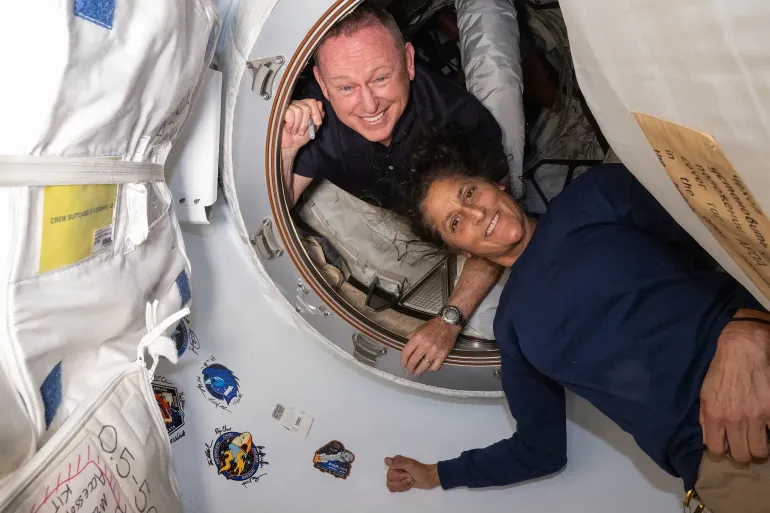
Nasa Astronauts finally came home after longer than planned mission
Two NASA astronauts have returned to Earth after spending nine months stranded in space due to a failed Boeing spacecraft. Sunita Williams and Barry Wilmore departed the International Space Station (ISS) early Tuesday morning, splashing down off the coast of Florida after a 17-hour journey. Their original return spacecraft, Boeing’s Starliner, was deemed unsafe, forcing them to stay in space far longer than planned.
Who were the astronauts stuck in space?
The two stranded astronauts were Sunita “Suni” Williams, 59, and Barry “Butch” Wilmore, 62, both veteran NASA-trained space travelers. Williams, a retired United States Navy officer, joined NASA in 1998. She has spent 322 days in space and completed nine spacewalks. She previously held the record for most spacewalks by a female astronaut until Peggy Whitson surpassed her in 2017. Wilmore first flew to space in 2009 aboard the Space Shuttle Atlantis. Before the Boeing Starliner mission, he had logged 178 days in space. As a flight engineer and commander on previous ISS missions, he conducted research on plant growth, the effects of microgravity on the human body, and environmental changes on Earth. For the Boeing Starliner mission, Wilmore served as commander, and Williams was pilot.
When and how did they return to earth?
Williams and Wilmore’s return process began late Monday night. Hatch closure preparations started at 10:45 PM ET (02:45 GMT). The SpaceX Crew Dragon capsule undocked from the ISS at 1:05 AM ET (05:05 GMT) on Tuesday and splashed down in the Atlantic Ocean just before 6 PM ET (22:00 GMT). NASA livestreamed their departure and return journey.
The Crew Dragon capsule had been docked at the ISS since September 2024. It originally transported NASA astronaut Nick Hague and Russian astronaut Aleksandr Gorbunov to the ISS, leaving two empty seats for Williams and Wilmore. However, the duo couldn’t return until a new crew arrived to replace them.
On Sunday at 12:04 AM ET (04:04 GMT), Crew-10 docked at the ISS, bringing NASA astronauts Anne McClain and Nichole Ayers, Japanese astronaut Takuya Onishi, and Russian astronaut Kirill Peskov. Their arrival finally allowed Williams and Wilmore to head home.
Why were they stranded?
Williams and Wilmore were originally supposed to return to Earth within eight days of their arrival. However, technical failures on the Boeing CST-100 Starliner made it too risky for human travel. The astronauts had traveled to the ISS on Starliner as part of its first crewed test flight, under NASA’s Commercial Crew Program, which aims to develop private spacecraft for ISS missions while NASA focuses on deep space exploration.
During the 25-hour flight to the ISS, Starliner experienced helium leaks and a malfunctioning thruster, which helps steer and control reentry. When the spacecraft arrived on June 6, 2024, four more of its 28 thrusters failed, delaying docking. Although engineers restored four of the five failed thrusters, NASA deemed Starliner unsafe for the return journey and sent it back empty. This left Williams and Wilmore stranded on the ISS.
By August 2024, NASA decided to bring them back using SpaceX’s Crew Dragon-9, which launched on September 29, 2024 and remained docked at the ISS. However, bringing them home earlier would have left only one U.S. astronaut aboard the ISS, which would have limited research and emergency response. With Crew-10’s arrival, NASA finally gave the green light for their return.
How long were they stuck in space?
Williams and Wilmore were in space for over nine months, having launched on June 5, 2024.
The standard ISS mission duration is about six months, meaning their stay was significantly longer than planned.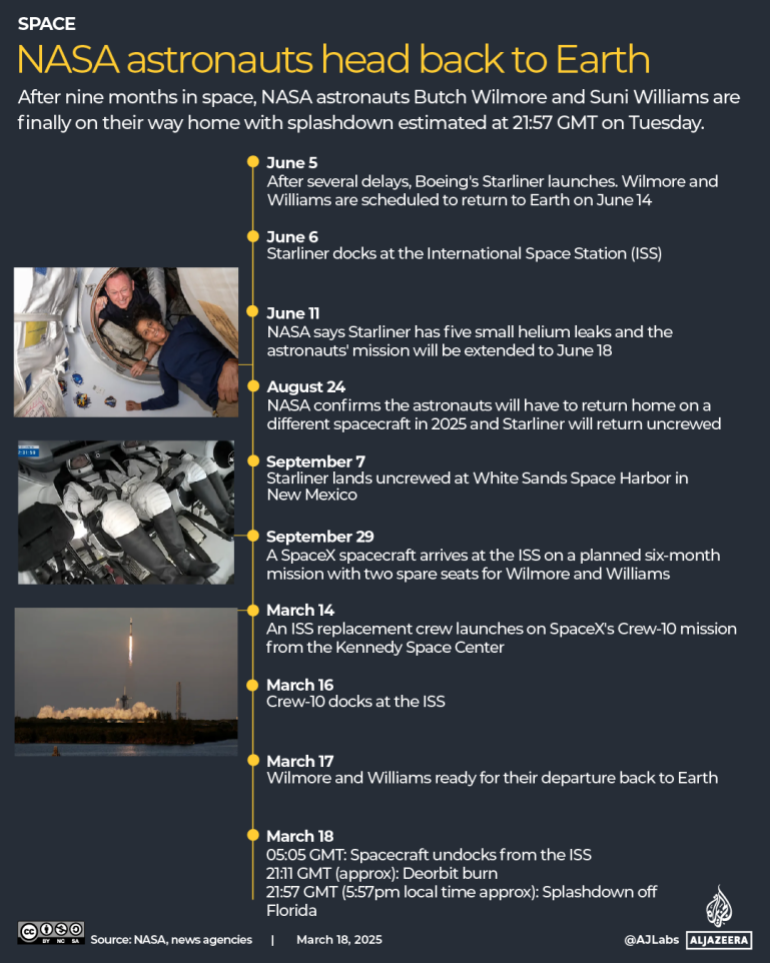
How did they cope with the extended mission?
Despite the unexpected extension, Williams and Wilmore remained in good health and even conducted a spacewalk in January. Life aboard the ISS follows a structured routine of exercise, work, and leisure. The astronauts performed regular workouts on the treadmill and resistance machines to maintain bone and muscle strength. The ISS is resupplied periodically with food, water, and oxygen by space agencies and private companies. During Christmas, Williams and Wilmore even enjoyed a festive meal, including smoked oysters, crab, foie gras, cranberry sauce, Atlantic lobster, and smoked salmon, according to The Times in London. The two maintained contact with their families via email and phone calls.
In a November interview with Lester Holt on NBC Nightly News, Williams reassured viewers, saying:
“We’re feeling good, working out, eating right… We have a lot of fun up here too. People who are worried about us—really, don’t worry about us… We’re a happy crew up here.”
Have astronauts been stranded in space before?
Yes. Williams and Wilmore are not the first astronauts to experience extended space missions due to unforeseen circumstances. The longest single spaceflight by a U.S. astronaut was Frank Rubio’s 371-day mission on the ISS (2022–2023), extended due to issues with the Soyuz spacecraft that brought him to orbit. He eventually returned on a different Soyuz capsule. In 1991, Soviet astronaut Sergei Krikalev was stranded on the Mir space station for 311 days due to the dissolution of the Soviet Union. Political turmoil and funding shortages delayed his return. When he finally landed in March 1992, he returned not to the Soviet Union, but to a newly independent Russia.
Final thoughts
Despite an unplanned nine-month mission, Williams and Wilmore handled the situation with resilience and professionalism. Their return marks the successful completion of an extraordinary chapter in human spaceflight—one that underscores both the risks and the advancements in modern space exploration.
Source: Aljazeera



