World Politics
The British government confirmed on 8 September that it will ban the import of goods produced in Israeli settlements in the occupied West Bank, the sharpest step London has taken against Israel in decades and the first substantive foreign-policy break of Prime Minister Andy Burnham's premiership. Foreign Secretary Ed Miliband was due to set out the details in the House of Commons on Tuesday afternoon, a week after promising to "reset" Britain's relationship with Israel. The commercial effect will be small — settlement exports to the United Kingdom are a rounding error, mostly fresh produce and wine — but the diplomatic effect is unlikely to be. Israeli ministers were threatening retaliation before the statement was delivered, the United States ambassador in Jerusalem called the policy discriminatory, and European governments already reviewing their own trade arrangements with Israel now have a precedent to point to.
Background
Israel captured the West Bank in the 1967 war and has since built settlements housing several hundred thousand Israeli citizens across territory that would form the bulk of any Palestinian state. Successive British governments, like most of the international community and the International Court of Justice, have held those settlements to be unlawful under international humanitarian law. What has changed is not the legal analysis but the willingness to attach consequences to it.
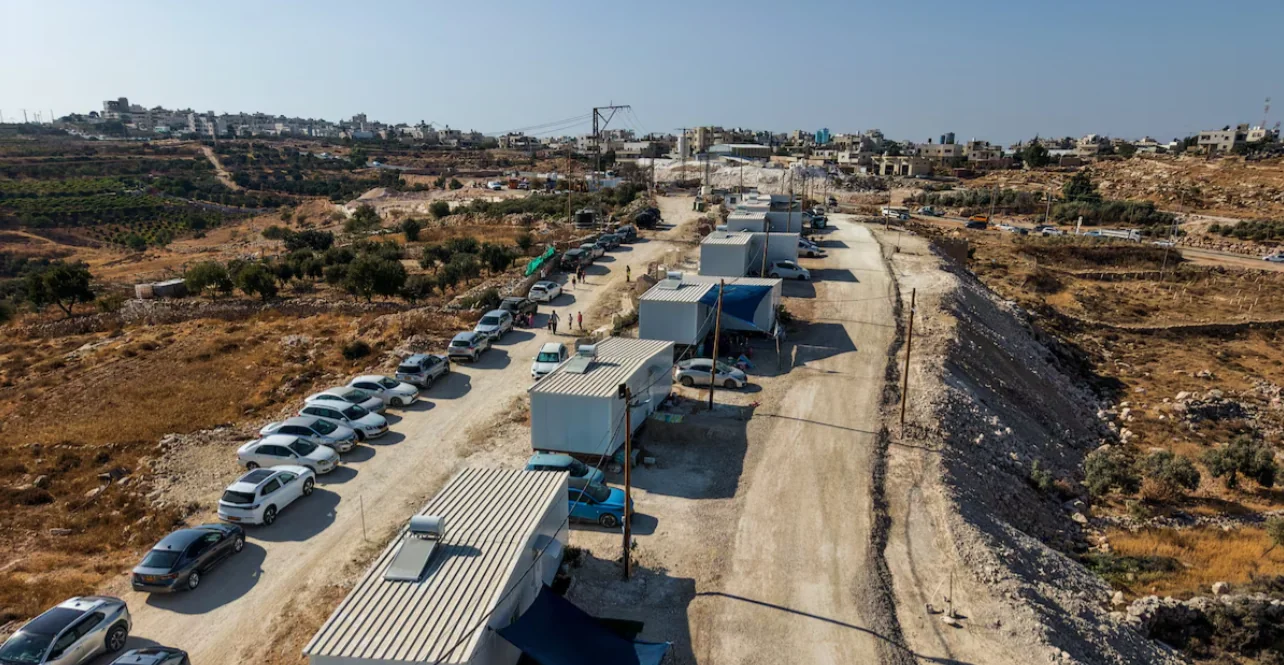
Benjamin Netanyahu's coalition, the most nationalist and religious in Israel's history, has presided over a sustained acceleration of settlement construction and has been explicit in rejecting Palestinian statehood, treating the West Bank as the biblical and historical homeland of the Jewish people. The specific trigger for British action is the E1 project, a long-frozen plan to build roughly 3,400 housing units in the corridor between Jerusalem and the settlement of Ma'ale Adumim. Because of its geography, E1 would sever East Jerusalem from the rest of the West Bank and interrupt the north-south link between Ramallah and Bethlehem, which is why critics describe it as the single construction decision most capable of foreclosing a contiguous Palestinian state. More than twenty countries, including the United Kingdom, Australia and Japan, have condemned the plan as a violation of international law.
Britain's trajectory has been incremental. It suspended free trade negotiations with Israel and sanctioned individual settlers, two illegal outposts and organisations linked to violence against Palestinian communities. Last year it recognised Palestinian statehood, an attempt to inject life into a two-state framework that its own ministers concede is close to dead. Burnham, who replaced Keir Starmer in Downing Street in July 2026, campaigned within his party on a harder line, and appointed Miliband — a figure of the Labour left on this question — to the Foreign Office.

Key Developments
The government's announcement, trailed to the Associated Press and confirmed by Downing Street on Tuesday morning, expands existing sanctions to cover trade in goods, and possibly some services, with all West Bank settlements. It is expected to be accompanied by targeted designations of individuals and organisations — including, according to reporting in the Israeli press, settlers linked to violence against Palestinians and groups that have obstructed the entry of humanitarian aid into Gaza.
Ministers moved quickly to define the limits of the measure. Work and Pensions Secretary Pat McFadden told Times Radio that it "isn't intended to be a boycott of all Israeli goods," and that the measures were "specifically targeted at the expansion of these settlements, which are illegal under international law, in the West Bank." He framed the rationale in terms of preserving a negotiating horizon: "At the heart of the statement is the idea that the U.K., along with many other countries, do not want to see the possibility of a two-state solution in Israel and Palestine being erased by changes to the facts on the ground."
Two caveats are worth registering. The first concerns timing: Israeli diplomatic sources quoted by Israel Hayom argued that most of what London announces will initially amount to declarations of intent, since import bans and designations require regulations and legal instruments that take months to draft, and are therefore unlikely to bite before a new Israeli government is formed. That characterisation comes from officials with an interest in minimising the measure, and the Foreign Office has not confirmed it; the substance of Miliband's Commons statement will settle the question. The second concerns scope: British diplomats have privately reassured Washington that the sanctions are largely symbolic and will not affect the wider UK-Israel trade and security relationship — a message that sits awkwardly beside the government's public framing of a "comprehensive reset."
Burnham's office said the prime minister spoke to President Donald Trump by telephone on Monday, setting out "the U.K.'s commitment to working toward peace and security in the region" and to a two-state solution. No account was given of Trump's response, and the call was widely read as advance notification rather than consultation. It came days after Trump publicly questioned whether the United States would support Britain in a hypothetical Falklands conflict, an unrelated irritant that has nonetheless made London's calculations about American reaction more fraught.

Reactions
The Israeli response was immediate and unusually blunt. Foreign Minister Gideon Sa'ar warned that "if Britain acts against Israel, Israel will act against Britain," and accused London of attempting to interfere in Israel's elections, scheduled for October, by escalating sanctions during the campaign. Itamar Ben-Gvir, the hard-line national security minister, called on Netanyahu to respond by recognising Argentina's claim to the Falkland Islands — a deliberately provocative suggestion that lands in the middle of a separate dispute in which President Javier Milei has just moved to sanction firms working the Sea Lion oil field.
Mike Huckabee, the United States ambassador to Israel, said the British measure amounted to "discrimination against the Jewish people" and warned that the United Kingdom could face "repercussions or retaliations" from Washington. Whether that reflects settled administration policy or the ambassador's own position is unclear; the White House has not commented.
Within Britain, the politics run the other way. A tougher line on settlements is popular with Labour members and backbenchers, many of whom spent the Starmer years demanding exactly this, and it lands three weeks before the party's annual conference on 27 September. Israeli officials read the timing as decisive, arguing in briefings that the policy is driven by Burnham's need to satisfy his party's left rather than by any assessment of what would change Israeli behaviour. Sceptics in London make a version of the same point from the opposite direction: that a measure calibrated to be economically negligible buys domestic credit without imposing real costs.
A more serious objection, raised by some Labour figures, is that external pressure during an Israeli election campaign may help the man it is aimed at. Netanyahu faces a difficult contest in October, and foreign sanctions have historically been usable as evidence of hostile interference. Palestinian officials and rights groups, by contrast, have argued for years that the distinction between Israel proper and the settlements is precisely the distinction international law requires states to enforce, and that failing to draw it in trade policy has subsidised the expansion Britain now says it opposes.
What's Next
The first test is legislative and administrative. An effective ban requires customs rules capable of identifying settlement-origin goods — a problem the European Union has grappled with since its 2015 labelling guidelines — and a designation process robust enough to survive judicial review. Watch for whether Miliband announces a commencement date or merely an intention, and whether services, financial links and pension-fund exposure are included alongside physical goods.
The second is whether Britain is alone. The National and other regional analysts have argued that London's move could reshape European policy by demonstrating that settlement-specific measures are legally and politically survivable. The European Union's foreign policy chief, Kaja Kallas, has said the bloc is reviewing the trade provisions of its association agreement with Israel, with a large majority of member states wanting to send a signal; Canada and Australia have moved in parallel with the UK on recognition and on settler sanctions. Israeli diplomats explicitly fear this cascade, and a diplomatic source predicted a cycle of "retaliatory blows" in which Jerusalem seeks to exclude Britain from international arrangements on Gaza and other files.
The third is the Israeli election. If Netanyahu returns in October, the confrontation is likely to deepen and the practical measures may arrive into a hostile environment; if he does not, London will have to decide whether the sanctions were about settlements or about a government. Either way, the announcement marks the point at which Britain stopped treating settlement policy as a matter for statements and started treating it as a matter for customs schedules — a smaller change than its critics claim and a larger one than its own diplomats are telling Washington.
Published By | News Editor