NEW YORK
There is a particular kind of documentary that rap has never really been given. Not the rise-and-fall arc, not the tour footage, not the talking-head parade of collaborators saying he changed everything. Something slower and stranger: a writer, sitting down, explaining the writing.
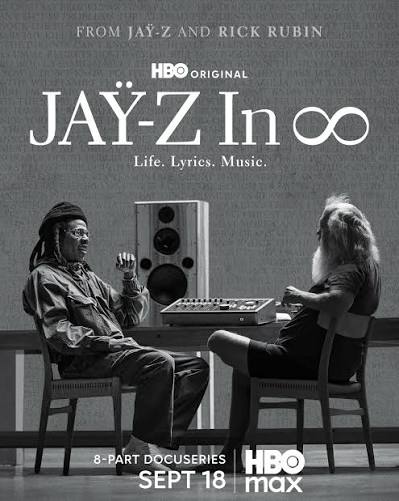
That is what "JAŸ-Z IN 8" appears to be. The eight-part series premieres Friday, September 18, on HBO and HBO Max, with the first two episodes airing back-to-back from 8 p.m. ET and two new instalments arriving every Friday thereafter through October 9. It is directed by Rick Rubin — his documentary directorial debut — and executive produced by Rubin, Shawn Carter himself, and the Academy Award-winning actor Daniel Kaluuya.
Not a Career, a Method
The structural choice is the news. Most artist documentaries move chronologically: childhood, breakthrough, excess, reckoning, legacy. "JAŸ-Z IN 8" instead organises itself around eight pivotal projects, with Carter breaking down specific tracks and, crucially, explaining how they were built.
The premiere reportedly covers "Intro," "Meet the Parents," "Can't Knock the Hustle" and "What More Can I Say." Later episodes reach into "Brooklyn's Finest," "Can I Live," "Politics as Usual," "Dead Presidents II," "Public Service Announcement (Interlude)," "99 Problems," "The Story of O.J.," "4:44" and "No Church in the Wild." Read as a list, it is a strange and revealing selection — a mix of the canonical and the deep-cut, spanning three decades from the 1996 debut to the confessional late period.
What links them is not chart position. It is craft. "Meet the Parents" is a narrative exercise with a twist ending. "The Story of O.J." is an argument. "4:44" is an apology. "99 Problems" is a legal deposition disguised as a hook. Asking one writer to account for all of them in sequence is closer to a literature seminar than a music doc.
The Rubin Factor
Rubin is an unusual choice to direct, and also an obvious one. He has spent five decades as a producer whose primary skill is subtraction — stripping records back until only the necessary thing remains — and more recently as a professional interviewer whose podcast conversations have built a reputation for patience over provocation. He does not chase the headline. He waits.
That temperament suits a subject who has spent thirty years managing his own mythology with extraordinary discipline. Carter is not a reluctant interviewee so much as a strategic one; he gives away exactly as much as serves the story he is telling. Rubin's method — long silences, unhurried follow-ups, no visible agenda — is one of the few approaches that has historically produced anything unguarded from him.
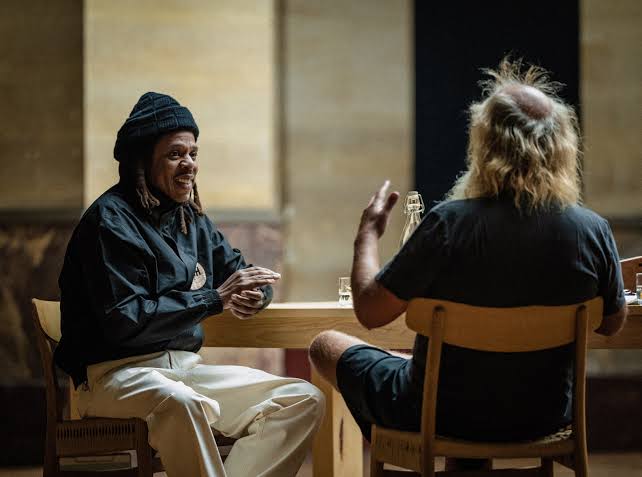
The trailer, released in late August, leans into that stillness. There is footage, but the spine of the thing is two men in a room, one talking and one listening. For a genre whose documentaries usually run on montage and archive, it is a conspicuously quiet pitch.
Why This, Why Now
Carter turns the corner into a fourth decade as a recording artist this year, and his cultural position has shifted from rapper to institution — Roc Nation, the sports agency, the streaming ventures, the philanthropy, the art collecting, the entertainment portfolio that increasingly dwarfs the discography that funded it.
That shift creates a documentary problem. The business story has been told repeatedly and is, frankly, easier to tell. The writing story has not. There is no comprehensive account, on film, of how the lyrics on "Reasonable Doubt" were actually constructed, or why a man who famously stopped writing anything down was able to hold sixteen bars of internal rhyme in his head and deliver them in one take.
By framing the series around eight projects rather than one life, the producers have given themselves permission to skip the parts everyone already knows. The bet is that an audience who has heard the Marcy Houses story a hundred times will sit still for a close reading of a verse instead.

Kaluuya, and the Question of Ownership
Daniel Kaluuya's presence as an executive producer is worth noting. The actor has spent recent years building a producing slate — his 59% company has moved deliberately into projects where Black artists retain creative control of their own narratives — and his involvement signals that this is not a licensing exercise dressed up as a documentary.
That matters in a genre with a poor record on the subject. Music documentaries about living legends are frequently made with the subject's cooperation but not their authorship, which produces films that are simultaneously deferential and shallow. Here, the subject is an executive producer, the director is a peer rather than a journalist, and the format — long conversation, minimal narration — leaves almost nowhere for a house style to hide.
The obvious critique writes itself: a documentary co-produced by its subject is not an investigation. That is fair, and viewers should calibrate accordingly. "JAŸ-Z IN 8" is not going to relitigate anything. What it can plausibly deliver is something rarer than scandal — a working writer explaining, at length and in his own words, how the sentences got made.
What This Means for You
If you have any interest in how songs are actually written — not the romantic version, the mechanical version — this is the release to clear a Friday night for. Two episodes a week is a manageable commitment, and the weekly drop schedule rather than a full-season dump suggests HBO wants conversation to build between instalments.
If you are a casual listener, the track list is a decent primer in itself; queueing the eight source projects before each episode turns the series into a guided reintroduction to a catalogue most people know in fragments. And if you are a writer of any kind — lyrics, prose, screenplays — the premise alone is worth the time. Eight hours of a master describing his own decisions is not a common offer.
The Bottom Line
Rubin has made a career of getting people to strip things back until the essential part shows. Pointing that instinct at the most guarded lyricist of his generation is either a fascinating idea or a very expensive stalemate. On September 18, we find out which.
Published By | Entertainment Editor