Written By |
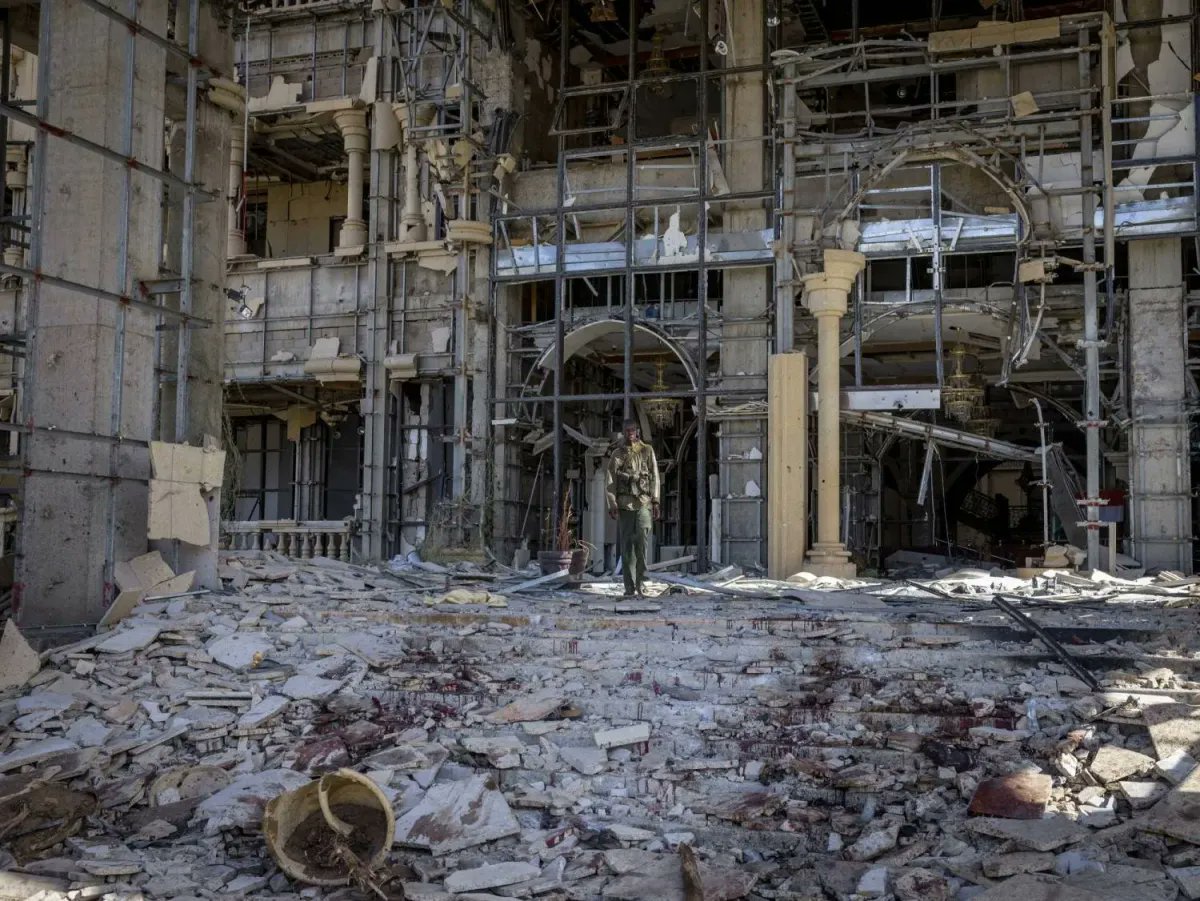
A Sudanese soldier on the bloodstained steps of the presidential palace in Khartoum, two days after the military recaptured it (The New York Times)
Khartoum, Sudan – The battle-scarred presidential palace in the heart of Sudan’s shattered capital has become a symbol of the ongoing war, marked by destruction and fresh bloodshed.
On Sunday afternoon, under the glow of a chandelier, soldiers gathered inside the palace, rifles and rocket launchers slung over their shoulders, listening to orders. They soon marched out, down a red carpet that once welcomed foreign dignitaries, into the deserted city center. Their mission: to flush out the remaining pockets of paramilitary resistance after nearly two years of brutal conflict.
The Sudanese military seized the presidential palace on Friday after an intense battle that left hundreds dead. This marked a significant turning point in the war, as government forces reclaimed most of central Khartoum from the Rapid Support Forces (RSF).
Key Areas Fall to the Military
By Sunday, the military had taken control of: The Central Bank, the National Intelligence Headquarters, the Corinthia Hotel, a towering landmark along the Nile River
Journalists from The New York Times became the first Western media team to cross the Nile into central Khartoum and visit the palace since the war erupted in April 2023. Their observations painted a grim picture—while the battle has decisively shifted in favor of the military, the conflict is far from over.
“We will never leave our country to mercenaries,” declared Mohamed Ibrahim, a special forces officer, referring to the RSF paramilitary fighters.
As their vehicle sped down a deserted street that was recently under RSF control, the devastation in Khartoum was evident.
The palace reduced to ruins
The Chinese-built presidential palace, once shared by Sudan’s warring generals, now lies in ruins.
Nearby, in the older British-built palace, soldiers rested under the charred arches of bombed-out buildings.
On the palace steps, piles of bloodstained rubble served as a grim reminder of Friday’s brutal battle. A fresh bloodstain marked the spot where an RSF drone-fired missile killed four state TV employees and two military officers that morning.
A desperate last stand by RSF fighters
As the military closed in, RSF leader Lt. Gen. Mohammed Hamdan released a video message, urging his fighters to stand their ground. When the final assault began, at least 500 RSF fighters were still inside, according to military officers. However, their attempts to flee turned into a massacre.
A verified video, recorded half a mile from the palace, showed dozens of bodies lying along the street, alongside burnt-out and bullet-riddled vehicles. “This is the season for hunting mice,” the officer who filmed the video remarked.
RSF fighters on Tuti Island, located where the Blue Nile and White Nile Rivers meet, tried to escape by boat. It remains unclear how many succeeded. A Sudanese military spokesperson reported that hundreds of RSF fighters were killed, though he did not provide exact figures. Military sources privately admitted that dozens of government troops also perished due to RSF drone attacks and combat losses.
What’s next for the war?
According to Alan Boswell, Director of the Horn of Africa Project at the International Crisis Group, Sudan’s military will likely capture the entire city soon, forcing the RSF to retreat to Darfur, their stronghold in western Sudan. “It’s quite a fall from where they were during the first year and a half of the war when they controlled most of Khartoum,” Boswell noted.
However, few believe the war is near its end. Both the Sudanese military and the RSF are heavily supported by foreign powers, who have flooded the country with weapons over the past two years. Sudan’s Deputy Leader Malik Agar recently estimated that the country now has 36 million small arms—an alarming figure for a pre-war population of 48 million.
A nation in ruins
As Sudan’s military consolidates its hold on Khartoum, the war’s devastation continues to unfold.
With a shattered capital, thousands dead, and millions displaced, peace still seems a distant dream for Sudan.
Source: Asharq Al Awsat



