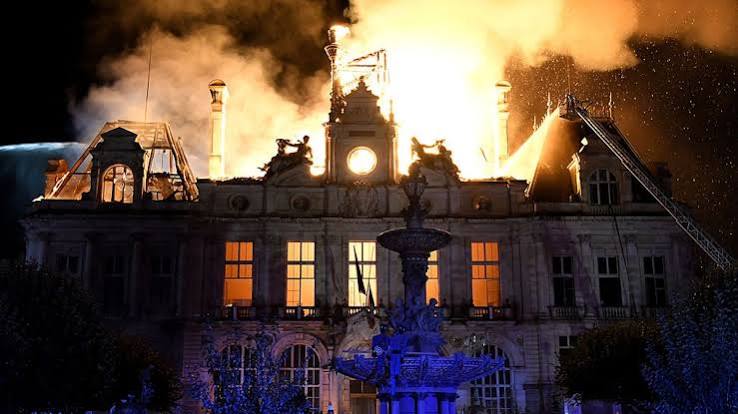
The 1883 Renaissance-style Hôtel de Ville, a protected monument built to crown a city's civic life, was largely destroyed during nationwide unrest. Its mayor is already calling for a 'Notre-Dame plan'.
LIMOGES, France
A night of fire
On Saturday, October 17, one of the grandest civic buildings in central France was set alight. According to Euronews, masked protesters broke into the Limoges town hall at around 6 pm, and as flames spread through the roof overnight the building's tower collapsed. The regional prefecture called the structure "a heritage site and iconic landmark for everyone" and said it was "largely destroyed."
The fire came amid nationwide demonstrations over the cost of living that merged with ongoing student protests. France's Interior Ministry put turnout at about 550,000 people, including roughly 110,000 in Paris. Some marches turned violent. In Limoges, about 2,000 people gathered in the Casseaux area in the afternoon, more than 500 of them seeking confrontation, and four police officers were seriously injured. Nineteen people were detained there, and investigations continue.
The town hall was not the only target. Reuters reported that a tourist office in Lyon was ransacked and set on fire, and The Guardian, as cited by Dezeen, reported around 2,400 arrests nationwide. This article focuses on the building, but it is impossible to separate the architecture from the events that destroyed it.
The building: a Renaissance dream in ashlar stone
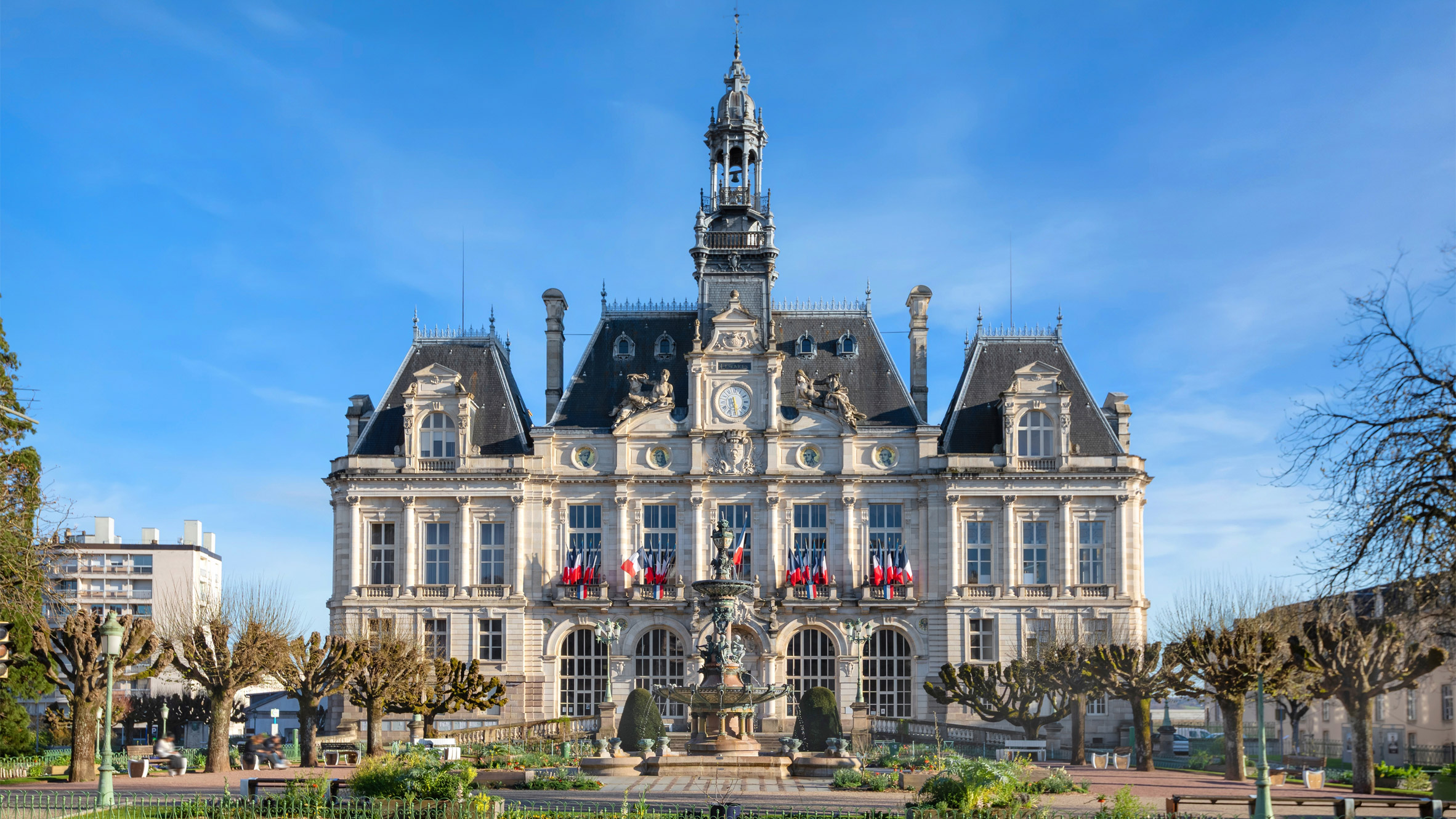
The Hôtel de Ville was designed by Charles-Alfred Leclerc and built in ashlar stone in a neo-Renaissance idiom. Its symmetrical main frontage runs to eleven bays. The central five have tall carriage arches at ground level and, above, tall casement windows set between balustrades. A parapet carries four medallions by Giandomenico Facchina depicting four historical figures: Léonard Limosin, Henri François d'Aguesseau, Pierre Victurnien Vergniaud and Jean-Baptiste Jourdan.
The three-bay end sections have their own mansard roofs, and statues by Tony Noël beside the clock represent goldsmithing and enamelling. Above it all rose a central clock tower with an ornate belfry, 43 metres tall. In 1893 a stone fountain by Charles Genuys was added in front of the building.
The commission had unusual roots. Per the building's history, the city's earlier hall was demolished after Alfred Fournier died in July 1875 and left his estate to Limoges. The foundation stone of the new one was laid in July 1879, and it opened on July 14, 1883. The French state listed it as a monument historique in 1975, and in 2022 its address was renamed Place Jacques Chirac.

Why civic architecture matters
Town halls are an odd kind of monument. They are not cathedrals or palaces; they are working buildings where marriages are registered, councils meet and citizens come to argue with the state. Their grandeur is deliberate. Leclerc's design, with its arcades, balustrades and tower, was meant to tell residents that local democracy deserved a dignified home.
That is part of what makes the loss so charged. The building was a statement of civic pride in 1883, built after a local benefactor's bequest. It had, as its history records, endured turbulence before: in April 1871, revolutionaries inspired by the Paris Commune stormed the town hall and prefecture, and in May 1940 it hosted the Belgian government in exile. It survived all of it until this month.
Heritage specialists often note that the material in buildings like this, from carved medallions to timber roof structures and slate, is difficult to replace. Whether anything of the original decorative programme survives will depend on structural assessments that officials had not yet confirmed at the time of reporting, according to the BBC as cited by Dezeen.
There is also the matter of scale. A town hall of this size, with a 43-metre tower, a fountain and sculpted pediments, was a major public investment for a provincial city in the 1880s. Losing it is not only an architectural loss but the loss of a shared reference point, the place where residents would meet for civic ceremonies and where the city's own history was literally carved into the facade. How Limoges chooses to rebuild, as a faithful replica or something new, will say a good deal about how it sees its past.
What officials have said
The prefect of Haute-Vienne, Maurice Barate, condemned what he described as an arson attack. Limoges mayor Guillaume Guérin said that protest is a right but that destroying property is never justified, calling the violence unacceptable: "Protesting is a right, and anger deserves to be heard," he said, according to Euronews. President Emmanuel Macron wrote on social media that there is "no place for violence" and that those who vandalised or looted town halls "will be prosecuted and punished."
The Telegraph, as cited by Dezeen, reports that the mayor has demanded a "Notre-Dame plan" to restore the building. The reference is to the 2019 fire at Paris's cathedral, which brought down its spire and parts of the roof; after five years of reconstruction it reopened in 2024 with a replica of the 1859 spire. It is a heavy comparison, and it signals that Limoges expects national attention and funding.
What this means for you
For travellers, the fire is a reminder that even listed buildings are vulnerable, and that sites in affected French cities may see closures or disruption. Anyone planning a visit to Limoges should check local advice, since the area around the town hall was the focus of clashes and looting along Rue Jean Jaurès.
For designers and architects, the episode raises practical questions: how to document historic fabric digitally so that it can be reconstructed, how to protect civic buildings during unrest, and how to rebuild when cultural memory is as important as stone. The Notre-Dame precedent shows that restoration is possible, but also that it takes years and public consensus about what to restore.
For everyone else, it is a sobering example of how quickly a 143-year-old building can be lost, and why the debate over how France remembers and rebuilds it is likely to continue well after the embers have cooled.
Published By | Features Editor