Written By | International News Agencies
Mladic took command of the Army of Republika Srpska in 1992 and led the campaign that seized roughly two-thirds of Bosnian territory in the first months of the war.
World Politics
Thousands of mourners filled the streets around the Church of St. Luke in Belgrade on 7 September to bury Ratko Mladic, the wartime commander of the Bosnian Serb army convicted of genocide at Srebrenica. Within hours, Bosnia and Herzegovina announced it was reducing diplomatic relations with Serbia to the lowest level its own constitution permits, the European Commission president called the images from the ceremony "shocking," and a Serbian government that had spent the day defending the funeral asked its president to dissolve parliament and call a snap election. A death that had been expected for years has, in the space of ten days, reopened the central unresolved question of the western Balkans: whether the states that emerged from the wars of the 1990s can share a region while telling incompatible stories about what happened in them.
Background
Mladic took command of the Army of Republika Srpska in 1992 and led the campaign that seized roughly two-thirds of Bosnian territory in the first months of the war. His forces besieged Sarajevo for more than three years, shelling and sniping at a civilian population of some 300,000, and in July 1995 overran the United Nations-declared "safe area" of Srebrenica. In the days that followed, Bosnian Serb forces separated men and boys from women and children at the Dutch UN base in Potocari and executed more than 8,000 of them, an act international courts have repeatedly classified as genocide — the first such finding in Europe since the Second World War.
He evaded capture for sixteen years, sheltered for much of that time in Serbia, before being arrested there in 2011 and transferred to The Hague. In 2017 the International Criminal Tribunal for the former Yugoslavia convicted him of genocide, crimes against humanity, and violations of the laws or customs of war, and sentenced him to life imprisonment; the conviction was upheld on appeal in 2021. He died on 27 August 2026, aged 84, still in custody.
What followed was not a private family matter. His relatives sought burial in Serbia, and the Serbian state obliged in a manner that went well beyond repatriation. Justice Minister Nenad Vujic announced that Mladic would receive military and state honours — a formulation that drew immediate protest from Sarajevo, Brussels and Washington, and which President Aleksandar Vucic subsequently sought to soften without disowning.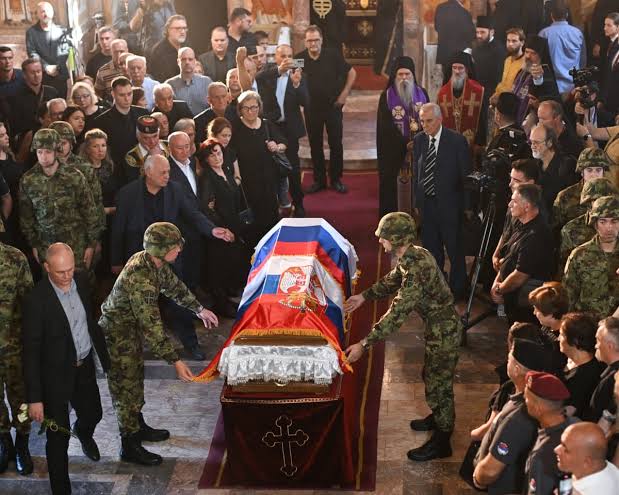
Key Developments
On 4 September a Serbian government aircraft carried Mladic's body from the Netherlands to Belgrade, where soldiers lifted a coffin draped in the Serbian flag from the plane. The same day, EU Enlargement Commissioner Marta Kos postponed a planned visit to Serbia, saying the glorification surrounding Mladic's death was incompatible with the values on which the EU path is built. A commemoration followed over the weekend at an official Serbian army venue.
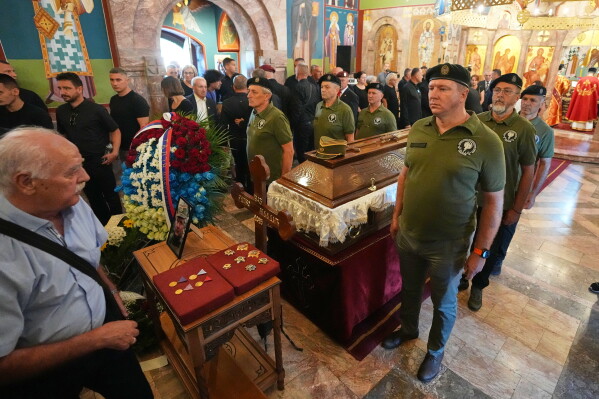
The funeral itself took place on 7 September. The body lay in state at the Church of St. Luke, where the funeral service was led by Patriarch Porfirije, head of the Serbian Orthodox Church, who said the Hague convict's name "will remain deeply embedded in the memory and prayers of the majority of the Serbian and Orthodox people." Veterans of the former Bosnian Serb army stood watch beside the coffin in rotation; four buses of demobilised former soldiers travelled from Banja Luka, transport organised by the Republika Srpska Veterans Organization. The Archive of Public Meetings, a Serbian monitoring group that has estimated crowd sizes since 1991, put attendance at around 16,000. Mourners chanted Mladic's name and applauded the arrival of the coffin; some wore T-shirts bearing his image.
Accounts of the ceremonial dimension differ, and the discrepancy matters politically. The European Western Balkans portal and Radio Free Europe/Radio Liberty reported that Mladic was buried at Topcider Cemetery with full military honours — an honour guard of the Serbian Army, an honorary volley, and a coffin covered by the flags of Serbia and of Republika Srpska. Other outlets, including RTE and Euronews, reported that the burial proceeded without serving officials, artillery salutes or a ceremonial military presence, describing the weekend commemoration as having stopped short of state honours. The competing versions appear to reflect both a partial climbdown by Belgrade after international pressure and disagreement over what counts as an official honour when soldiers and ministers are present in person.
The guest list was less ambiguous. Serbia sent its culture, justice, public investment and defence ministers — Nikola Selakovic, Nenad Vujic, Darko Glisic and Bratislav Gasic — along with Minister without portfolio Nenad Popovic. From Republika Srpska came President Sinisa Karan, Prime Minister Savo Minic, National Assembly Speaker Nenad Stevandic, Banja Luka Mayor Drasko Stanivukovic and Milorad Dodik. Russia's ambassador to Belgrade, Aleksandr Botsan-Kharchenko, led a delegation. Two attendees were more explosive still: Zeljka Cvijanovic, the Serb member of Bosnia's own tripartite presidency, and Aleksandar Vranjes, Bosnia's ambassador to Serbia. Vucic did not attend, saying he was hosting Uzbek President Shavkat Mirziyoyev.
Late on 7 September, Bosnian Foreign Minister Elmedin Konakovic announced that Sarajevo was recalling every member of its embassy staff in Belgrade whose withdrawal does not require presidential approval. Only the ambassador and the consul may remain, because their appointment and recall fall to the state presidency, where the Serb member holds an effective veto. Consular work is to be transferred to Bosnia's embassies in Zagreb and Podgorica and to its consulate general in Novi Pazar. "If I could, I would break off diplomatic relations with Serbia right now," Konakovic said. "What I can do is to reduce the relations to the lowest possible level." He added that he would seek sanctions "at all addresses" against officials who attended the funeral, naming Cvijanovic among them.
Reactions
For survivors, the ceremony was an inversion of justice. Fazila Efendic, president of the Mothers of Srebrenica association, who lost her son, her husband and 22 other relatives in the massacre, told RFE/RL that Mladic had been buried "as if he were a statesman." "This is terrible for me. But there it is. This is a mirror of Serbia, let the whole world see," she said. The association had warned beforehand that the funeral threatened to become the largest fascist gathering in Europe in seventy years. That anxiety was sharpened by scenes in the preceding days, including a tifo displayed by Red Star Belgrade supporters showing Mladic's portrait beside the words "Direction Potocari" — a reference to the village where the killings began.
Denis Becirovic, the chairman of Bosnia's presidency, had said on 27 August that the Hague judgment placed Mladic among the most brutal killers of the twentieth century, and on 4 September condemned the granting of state and military honours as an "unacceptable act of institutional glorification" and an insult to the victims of the Srebrenica genocide.
The European Union's diplomatic service said on 7 September that "any glorification of war criminals, genocide denial, and revisionism contradict the most fundamental European values and have no place in the EU or in EU candidate countries." On 8 September, Commission President Ursula von der Leyen went further in a post on X: "The images from Ratko Mladic's funeral yesterday in Belgrade were shocking... The elements of official support and the presence of some senior Serbian officials at the funeral are deeply regrettable. They demonstrate a failure to confront a dark chapter in Europe's recent history and contradict the values underpinning Serbia's path towards the European Union."
In Washington, Senators Jeanne Shaheen and Chuck Grassley and Representative Keith Self issued a joint statement before the funeral: "The coming days will be a test of whether Serbia and RS are ready to break with the past and move toward European Union membership and Euro-Atlantic integration." Representatives Greg Murphy and Marc Veasey travelled to Srebrenica the same week to honour the victims.
Vucic was unrepentant. He dismissed an EU statement as "very short but stupid, as usual," asking sarcastically whether Serbia should ban the funeral and build "cemeteries for dogs," and later characterised the turnout as an emotional outpouring. Serbian Foreign Minister Marko Djuric answered Konakovic by accusing him of hypocrisy, saying he should "first state the names of Serb victims, condemn crimes against them and explain why convicted military commanders are still celebrated in Sarajevo," and pointing to commemorations of Rasim Delic, the Bosnian army commander convicted at The Hague in 2008.
What's Next
The immediate practical consequences of Sarajevo's downgrade are modest. Bosnia cannot expel Serbia's ambassador or sever relations outright, because those decisions require a presidency in which Cvijanovic — who attended the funeral — sits. The measure is therefore a statement about the limits of Bosnian statehood as much as about Serbia, and it will feed directly into Bosnia's general elections in October, which the OSCE's election observation body has already warned are likely to be dominated by ethnic division and polarisation.
Serbia is heading to the polls too, and faster. At an extraordinary session on 7 September — the day of the funeral — the government of Prime Minister Djuro Macut formally asked Vucic to dissolve the National Assembly and call an early parliamentary election, arguing that a vote would "bring back the political struggle from the streets into the institutions," a reference to the protest movement that has convulsed Serbia since the Novi Sad railway station canopy collapse. Under Serbian procedure Vucic has 72 hours either to issue the dissolution decree or to explain publicly why he will not. Pro-government media have pointed to 25 October as the likely election date, which would require the vote to be called no later than 10 September. A campaign fought partly on national memory is now unavoidable.
The longer-term casualty may be Serbia's candidacy for EU membership, formally open since 2012 but effectively stalled. Brussels has few instruments short of freezing accession funds or negotiating clusters, and past experience suggests reluctance to use them while Serbia remains geopolitically contested between the EU, Russia and China. The presence of the Russian ambassador at the graveside was itself a message. What the week has established is narrower but harder to walk back: that Belgrade will pay a diplomatic price in Sarajevo and a rhetorical one in Brussels rather than treat a genocide conviction as settled history — and that Bosnia, three decades after Srebrenica, still lacks the constitutional means to respond as a single state.



