KHARTOUM
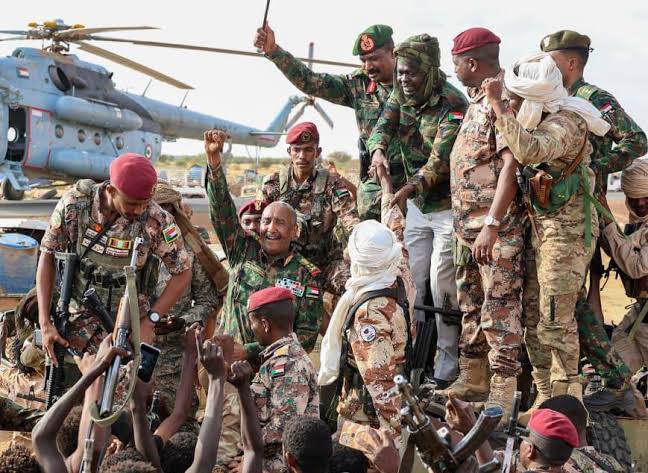
Sudan's army chief and de facto head of state, Gen. Abdel Fattah al-Burhan, has opened a national political dialogue explicitly designed to shut the leadership of the rival Rapid Support Forces out of any future government, even as his forces fight to hold newly recaptured trade corridors in North Kordofan and lose ground to the paramilitary group along the Ethiopian border. The dual-track approach — a political process that forecloses reconciliation with the RSF's command while the military pushes forward on multiple fronts — signals that Sudan's more than three-year civil war is entering a phase in which Burhan is betting military momentum can be converted into a durable, army-controlled political settlement rather than a negotiated peace with his adversaries.
The stakes could hardly be higher. Sudan's war, which erupted in April 2023 between the Sudanese Armed Forces (SAF) and the RSF over the paramilitary force's planned integration into the regular military, has killed more than 200,000 people by aid workers' estimates, displaced or forced nearly 15 million people from their homes, and produced what the United Nations has called the world's largest hunger and displacement crisis. A U.N. investigation has found that mass killings and gang rapes carried out by the RSF amount to genocide.

A Dialogue That Excludes the Enemy
Speaking on the 72nd anniversary of the Sudanese Armed Forces this month, Burhan, who also chairs Sudan's ruling Sovereign Council, announced a political transition plan built around what he described as an independent national dialogue mechanism. "We will not accept a peace that returns the leaders of the Rapid Support Forces to power," Burhan said, describing the RSF's commanders as "criminals and murderers." He said any path to peace must begin with a cessation of hostilities, the laying down of weapons and the restoration of state security and services — conditions the RSF has shown no sign of accepting.
According to Burhan's presentation of the initiative, the dialogue is being brought forward by an independent group of Sudanese citizens rather than being run directly by the state; the government's role, he said, would be limited to providing logistical, political and security support, without dictating the agenda or predetermining outcomes. To draw in a wide range of participants — political groups, technocrats, Sufi leaders, traditional authorities, academics, professionals and civil society representatives are among those already engaged in preparatory consultations — Burhan offered legal guarantees: participants would receive "temporary procedural immunity" from existing criminal proceedings to enable their involvement, though he was careful to clarify that this does not amount to a blanket amnesty or the dismissal of eventual accountability. Immunity for opinions and proposals expressed during the dialogue itself, by contrast, would be permanent, shielding participants from later criminal, civil or administrative retaliation for what they say at the table.
Burhan cast the dialogue's ultimate objective as reaching a national consensus sufficient to complete Sudan's governing institutions, singling out the formation of a legislative council as a constitutional necessity. An African Union delegation met Aug. 16 in Khartoum with Burhan and Prime Minister Kamil Idris to discuss the bloc's own push for inclusive dialogue and reconciliation as a route toward eventual elections — a sign that the AU is engaging with Burhan's process even as critics argue it is designed less to share power than to consolidate the military's hold on the state under the appearance of a democratic opening.
The RSF's Rival Government
Burhan's insistence on excluding RSF leadership from any settlement reflects, in part, the fact that the paramilitary group has already tried to build a state of its own. In late August of last year, the RSF and allied factions swore in a parallel government based in Nyala, in South Darfur, with RSF commander Mohamed Hamdan Dagalo — widely known as Hemedti — presiding over the formation of a 15-member Presidential Council that he now heads. Abdelaziz al-Hilu, leader of the Sudan People's Liberation Movement-North (SPLM-N), was installed as Hemedti's deputy, while Mohamed Hassan al-Taishi, a former member of Sudan's earlier transitional government from South Darfur, became prime minister. The move was widely read as an attempt to partition the country in fact if not in name, and to pressure foreign governments into recognizing a rival authority to Burhan's if they will not recognize Khartoum's. Sudan's Foreign Minister, Omar Mohamed Ahmed Siddig, dismissed the prospect flatly: "I don't think there is any rational government that can provide any sort of recognition to this so-called parallel government in Nyala." No foreign government has formally recognized the Nyala administration, but its existence has hardened the practical reality that Sudan is now governed, in different regions, by two rival armed authorities — a fact Burhan's dialogue, by design, does nothing to bridge.

Momentum Shifts in Kordofan, Reverses in Blue Nile
While Burhan pursues his political track, Sudan's army has notched its most significant battlefield successes in months in North Kordofan, even as it has lost ground hundreds of kilometers away on the Ethiopian frontier. On July 26, the SAF announced it had recaptured the Al Sadarat highway along with the towns of Bara, Umm Sayala and Jabra al-Sheikh, restoring government control over roughly 350 kilometers of a critical logistics corridor linking Khartoum to El Obeid, the North Kordofan state capital. The recaptured territory matters strategically as well as symbolically: Bara sits roughly 60 kilometers northeast of El Obeid and has repeatedly changed hands during the war, while Jabra al-Sheikh and Umm Sayala sit astride routes the RSF had used to threaten El Obeid and to maintain a logistics link between Darfur and central Sudan. The gains prompted Khartoum's State Security Committee to lift emergency restrictions on commercial traffic and reopen the export road linking Khartoum, El Obeid and Bara — a tangible economic dividend from the military's advance.
El Obeid itself remains a flashpoint. The city hosts more than 1.2 million displaced people who have fled fighting across Darfur and Kordofan, according to reporting from the region, and has endured what the United Nations has described as one of the world's worst humanitarian sieges. On Aug. 15, the RSF, reinforced from neighboring West Kordofan, launched a major assault on army defenses south of the city in the areas of Um Arda, Jebel al-Hashaba and Al-Ban Jadid; the SAF said it repelled the attack, a day after beating back a separate assault on the nearby Al-Ayara area. A drone strike attributed to the RSF struck El Obeid earlier that week, killing civilians, according to the Sudan Doctors Network and the rights-monitoring group Emergency Lawyers, which also documented more than 27 drone incidents around the city in June alone — the highest monthly total since the war began.
Sudan's northeastern front has moved in the opposite direction. On Aug. 13, the RSF and its allies in the Sudan People's Liberation Movement-North seized the town of Kurmuk in Blue Nile state, on an important cross-border route linking Ethiopia to the Nile Valley, as army units withdrew and repositioned outside the town. The RSF said the offensive inflicted heavy losses on army troops and seized weapons and ammunition; local administrators in Kurmuk said the town had endured three days of drone and artillery bombardment before falling. The reversal is notable because the army had recaptured Kurmuk only last month after the RSF first seized it in March — underscoring how fluid front lines remain even as Burhan claims the political initiative. By Aug. 15, the army was reported to be massing outside Kurmuk again, having recaptured the surrounding areas of Magja, Sharkam, Al-Baraka, Khor Hassan and Al-Kaili in a methodical counteroffensive, setting up a fresh battle for the town.
Adaptation, Not Collapse
RSF commander Hemedti has responded to the setbacks in Kordofan not by seeking terms but by doubling down. In a July 31 speech, he called on supporters to mobilize fighters for a renewed offensive toward Khartoum and announced a fresh mobilization for operations in Kordofan, leaning increasingly on tribal recruitment — including outreach to the Fur, a majority-Sunni farming community in Darfur — rather than relying solely on the foreign fighters and mercenaries that have featured heavily in RSF ranks earlier in the war. Analysts at the Foundation for Defense of Democracies' Long War Journal have described the shift as evidence of "strategic adjustment" rather than collapse: despite losing the Al Sadarat corridor, the RSF retains substantial territory, external backing — the group continues to receive support from the United Arab Emirates, including Chinese-manufactured drone systems, while the SAF has fielded Iranian- and Turkish-made drones alongside commercial Chinese platforms — and the capacity to strike deep behind army lines, as its coordinated drone attacks on five army-controlled cities in mid-August demonstrated.
What to Watch
Burhan's dialogue faces an immediate credibility test: whether it can attract genuine participation from political actors who were sidelined under both RSF and army rule, or whether its RSF exclusion and army-set terms render it, in critics' view, a vehicle for consolidating military rule rather than a genuine transition. The AU's continued engagement, following its Aug. 16 Khartoum visit, will be a signal of whether international actors treat the process as a credible path toward elections or as insufficient given its structural exclusions. On the battlefield, the coming weeks will show whether the army can convert its Kordofan gains into a durable defense of El Obeid and press its counteroffensive to retake Kurmuk, or whether the RSF's tribal mobilization and drone campaign can reverse the momentum yet again, as it has repeatedly done in a war now defined by a grinding cycle of territorial seizure, loss and recapture. Underlying all of it is the unresolved question of Sudan's territorial and political unity: with a rival RSF-led government still functioning in Nyala and unrecognized by any state, the country's de facto partition — and the humanitarian catastrophe accompanying it — shows no sign of ending regardless of which political process gains traction in Khartoum.
Published By | News Editor