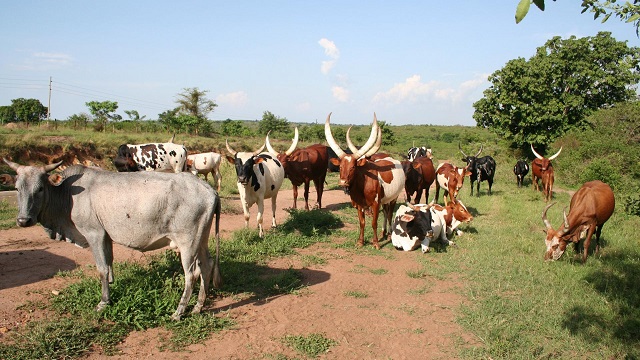
By 4:00 a.m. on August 12, the cattle corridors around Sanga Town Council in Kiruhura District were still dark when officers from the Rwizi Regional Police, reinforced by colleagues from Mbarara Central Police Station, closed in on a rented house in Lubiri Cell, Nyamityobora. Inside, they found what police describe as the tail end of a well-drilled operation: butchered beef, backpacks used to haul meat away from kraals under cover of darkness, and five men who investigators say had turned livestock theft into a small, disciplined business.
The five — a 45-year-old businessman, a bricklayer, and three other men aged between 32 and 70 — are accused of running a syndicate that had been raiding kraals across Sanga, Akayanja, Kanyaryeru and Kitatsi sub-counties. According to SP Samson Kasasira, the Rwizi Regional Police spokesperson, the gang's method was almost industrial in its efficiency: members travelled to Sanga by public transport, walked to targeted kraals, slaughtered animals on the spot between 1:00 a.m. and 4:00 a.m., packed the meat into backpacks, and ferried it to a rented safehouse before delivering it to a butchery in Mbarara City allegedly operated by one of the accused. "The motive of the crime is for financial purposes," Kasasira said.

The Kiruhura bust is only the latest in a string of similar operations this month. On August 11, police in Kyotera District recovered ten cows suspected to have been stolen from villages in Bukunda Sub-county — Kyakonda, Kijumbula and Kawule — arresting a 38-year-old businessman, Issa Walugembe, in what officers say points to a wider trafficking network moving cattle between Kyotera and neighbouring Lwengo District. Days earlier, on August 6, police in Nakasongola recovered another ten stolen cows and arrested two suspects in Nakalikirya Village. Each case follows a similar pattern: intelligence-led night raids, businessmen and butchers among the accused, and stolen animals either slaughtered locally or moved quickly across district lines to frustrate tracing.
Taken individually, these are routine crime blotter items. Taken together, they describe something closer to an epidemic. Uganda's cattle-keeping corridor stretching through Kiruhura, Kazo, Mbarara, Isingiro, Sembabule, Kyotera and Nakasongola — home to roughly 60 percent of the national herd — is under sustained pressure from organised theft rings that have adapted faster than the security response meant to contain them.
The alarm has now reached the highest levels of government. Milly Babalanda, the Minister for the Presidency, has told Resident District Commissioners and security agencies that livestock theft has reached "alarming proportions" and is directly undermining the Parish Development Model (PDM), the government's flagship rural wealth-creation programme. Her concern is specific and pointed: some of the cattle being stolen were bought using PDM funds disbursed to help poor households build livestock assets, meaning the theft is not just a private loss for individual farmers but a leakage of public anti-poverty investment. Babalanda has ordered authorities in Mitooma and Kasese districts — identified as a key transit corridor, with thieves reportedly moving animals from Bushenyi through Mitooma into the large cattle market at Kasese — to tighten enforcement of livestock movement regulations. No animal, she directed, should be transported or traded without a valid movement permit and verified proof of ownership, and livestock markets, checkpoints and transport corridors must face heightened inspection. Investigators say some stolen animals are also smuggled westward across the border into the Democratic Republic of Congo, where demand from Congolese traders has been rising.

That demand side of the equation is central to understanding why theft has surged now. Uganda is in the grip of a beef shortage that has pushed prices from around Shs15,000 per kilogramme to between Shs18,000 and Shs20,000 in a matter of weeks, according to market reports. The squeeze has several causes stacking on top of one another: a foot-and-mouth disease outbreak that shut down livestock markets in Kazo and neighbouring districts for nearly two months earlier this year; a punishing dry spell that has thinned herds and slowed restocking; rising live-cattle exports, including brisk buying by Congolese traders who cross into Uganda to purchase animals directly, tightening local supply; and higher transport costs that are passed through to consumers. Security officials say this scarcity has created exactly the kind of price incentive that organised crime exploits: with legitimate cattle increasingly expensive and hard to source, stolen animals — slaughtered quickly and sold as anonymous meat through informal butchery networks — have become a lucrative shortcut for supplying urban demand in towns like Mbarara.
The human cost falls hardest on smallholder and PDM-beneficiary farmers, for whom a handful of cattle often represents years of savings or a government-backed shot at climbing out of poverty. Community members in affected areas have for months complained that police response has lagged behind the scale of the problem, prompting the reinstatement of highway roadblocks in parts of western Uganda and renewed calls for a centralised database of habitual livestock offenders — an idea security officials have floated but not yet fully operationalised. Older residents in Ankole still invoke the memory of the late Maj. Kamugunda, a security officer remembered for an uncompromising, some say heavy-handed, crackdown on cattle rustlers in the 1990s, as a benchmark for the kind of deterrence many now feel is missing.
The economics of the syndicates also complicate enforcement. Unlike the armed cattle raiding historically associated with pastoralist conflict in Karamoja, the networks being dismantled in Kiruhura, Kyotera and Nakasongola are quieter and more commercial: businessmen, bricklayers and butchers operating through rented houses and licensed-looking meat outlets, using public transport rather than trucks to avoid checkpoints, and slaughtering on site so that stolen livestock disappears into the meat supply chain within hours, long before an owner discovers the loss. That makes recovery difficult even when arrests happen — police in Kyotera, for instance, noted that some stolen animals had already been slaughtered locally while others were dispersed to a different district entirely.
For now, the government's response is running on two tracks: reactive policing, in the form of the intelligence-led raids that have produced arrests in at least three districts this month alone, and regulatory tightening, through Babalanda's directive on movement permits and market inspections in the Mitooma-Kasese corridor. Whether either is sufficient to outpace a criminal economy that is, in effect, arbitraging the gap between a stressed national herd and unrelenting urban demand for beef remains an open question. What is not in doubt is the stakes: for a government that has staked significant political and financial capital on the PDM as a vehicle for rural wealth creation, cattle theft is no longer simply a rural nuisance — it is a direct drain on that programme's credibility, one kraal at a time.
Published By | Features Editor